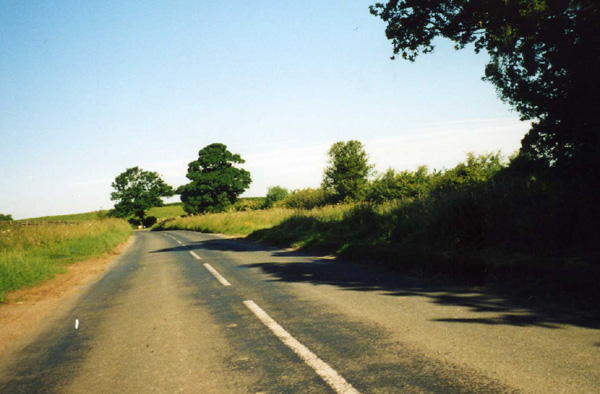
Halifax JB844 near Sheriff Hutton.
At 15.49hrs on 19th July 1944 this 1658 Heavy Conversion Unit Halifax took off from Riccall airfield for the crew of six to carry out a fighter affiliation exercise and also to carry out air to sea firing over the North Sea. Outbound, just after 16.00hrs whilst flying in cloud, both starboard engines failed and were feathered at around 9,000 feet. The aircraft gradually lost height and eventually a forced landing was made to the west of Sheriff Hutton between Mill Hill Farm and Mount Pleasant Farm with the aircraft flying in a roughly south to north direction. It touched down on the south side of the Farlington road, lost at least one propeller in that field and continued up the field, across the Farlington to Sheriff Hutton road and into a field on the north side of the road where upon it caught fire. One crew member was injured in the crash and broke his leg, he was pulled clear by other members of his crew before the fire worsened. At 16.20hrs the East Moor airfield Fire Section were informed that this aircraft had crashed and was burning rapidly, the crash tender attended but was back on station by 18.30hrs. Many of this crew completed their training and were posted to 578 Squadron.
In December 2004 I received an email from local historian, Mr Tony Wright, inviting me to attend a search for where this aircraft had crashed through Mr E.Weightman who was a schoolboy at the time of the crash. Mr Weightman's father farmed Mill Hill Farm at the time and he recalled his memories of the crash to the group. Without this I doubt I would have ever have learned the full story. I quote.. "The plane hit the ground about half way up the field to the south of the road and clipped a tree with one wing, which seems to have straightened it up and it slid straight up, over the road, finishing about twenty feet into the field on the north side. One propeller ended up in the hedge on the west side of the field, where it was found some time later and incorporated into a farm fence (it has subsequently been buried). Two engines detached and remained on the road, one a little to the west and the other to the east. All but one of the crew scrambled out. The local policeman was helping with the harvest at Mill Hill and ran up to the plane, with a group of council workmen who were repairing the road after a tank convoy had damaged it and the others working on the farms. The crew seemed to have a pact to rescue each other in case of an accident and, against the advice of the policeman, they re-entered the aircraft and freed their comrade, although it was by now on fire and ammunition was exploding. They carried him to the entrance of Mill Hill Farm, took a gate off and used that as a stretcher to carry him to the farm. By then bullets were flying." The farmer at Mount Pleasant Farm, Mr Lockwood, rescued a propeller and an axe from the site, he later took them to the Yorkshire Air Museum at Elvington where it is hoped they still remain although the museum show little interest in displaying such items.
Pilot - P/O Angus Frew Forrest RAFVR (172771).
Flight Engineer - Sgt Henry Arthur Reeve RAFVR (1637386). Injured. Taken to York Military Hospital.
Based on who was posted to 578 Squadron with P/O Forrest on 20th August 1944 his crew at 1658 H.C.U. probably comprised of the following..
Navigator - Sgt John Alan Skevington RAFVR (1605146).
Bomb Aimer - F/O Donald Hewitt Hudson RCAF (J/35092).
Wireless Operator / Air Gunner - Sgt Alfred Charles Duncan RAFVR (1294934).
Air Gunner - Sgt Jeremiah Patrick Carey RAFVR (1798902).
Air Gunner - Sgt Edward Benedict Browne RAFVR (1798620).
I visited the site in January 2004 with a local history group from Sheriff Hutton, having gained permission to access the field where it crashed we were able to do a search of the field where it touched down and slid across. A number of small fragments of the aircraft were found. My thanks to local historian Mr Tony Wright for the copy of the witness statement taken from the village history archives and for inviting me on the day the village group located the crash site.
Halifax JB844 was built to contract ACFT/1808/C4/c by English Electric Co. Ltd. at Samlesbury and was taken on charge as new by 78 Squadron at Linton on Ouse on 20th March 1943. Two days later it was transferred to 102 Squadron at Pocklington. As a result of sustaining flak damage on 5th May 1943 and then on 28th May 1943 Cat.A/FB damage was the assessment each time and it was repaired on site each time. On 26th June 1943 it sustained Cat.Ac/FB damage when it was damaged by flak or by falling incendiary bombs on ops to Gelsenkirchen. The crew managed to return the aircraft to base and it was repaired on site by a team from Handley Page Ltd. On 14th July 1943 it was returned to 102 Squadron charge but was re-coded "DY-S". On 10th August 1943 it sustained minor Cat.A/FB damage when it collided with a parked aircraft at Pocklington after landing from Ops to Mannheim. The aircraft was repaired on site. On 24th April 1944 it was transferred to 1663 Heavy Conversion Unit at Rufforth. on 16th May 1944 it was transferred to 1658 Heavy Conversion Unit at Riccall. On 19th July 1944 it was force landed near Sheriff Hutton and while the crew all survived the aircraft was badly damaged. Cat.E2/FA Burnt damage was the assessment and it was struck off charge on 26th July 1944. It had amassed some 558 hours total flying time from new.
Angus Forest had only thirteen hours flying time on the Halifax at the time of the crash at Sheriff Hutton. Just three days after this incident at Sheriff Hutton he was flying Halifax JN917 on 22nd July 1944 when a forced landing was made at Millom, the aircraft was damaged but all on board escaped injury. He would complete his training and later served with 578 Squadron and 51 Squadron. He had received a commission on 25th January 1944 to the rank of P/O on probation (emergency) and rose to F/O (war subs) on 25th July 1944 and F/Lt on 25th January 1946. For his service with 578 Squadron he received the DFC, the notification appeared in the London Gazette on 17th July 1945.
John Skevington received a commission on 26th December 1944 (189451) to P/O on probation (emergency) and rose to F/O (war subs) on 26th June 1945. He was later posted to 51 Squadron following service with 578 Squadron.
Donald Hudson was born in Morton, Saskatchewan, Canada in February 1915 and was working in farming when he enlisted for RCAF service in Ottawa in June 1942. For service with 51 Squadron he was awarded the DFC, Gazetted on 25th September 1945. He died in Bath, Ontario in June 2003.
F/Sgt Arthur Bernard Anger RAF (650167) was Forrest's replacement flight engineer and recording his service briefly desrves a mention here. Arthur Anger would receive a commission to the rank of P/O on probation (emergency) on 22nd January 1945 from the rank of Warrant Officer. He was promoted to the rank of F/O (war subs) on 22nd August 1945. For service with 51 Squadron he was awarded the DFC, Gazetted on 25th September 1945. He remained in the RAF after the War and was appointed to a commission and granted a substantive rank of F/O on 1st November 1947, with seniority of 22nd January 1946. He was promoted to F/Lt on 22nd July 1948 for only one year. On 1st September 1949 he was appointed to a temporary commission of F/Lt in the RAF. He may have died in Westminster, London in 1952.