Halifax HR834 near Wombleton airfield.
At 10.29hrs on 27th May 1944 the crew of this 1666 Heavy Conversion Unit aircraft were attempting to take off from Wombleton airfield to carry out a training flight. On the take off run the starboard outer engine failed and it swung to starboard immediately after leaving the ground. The Halifax sliced the tops off four trees in the wood at the south end of the runway and then crashed into the field behind this wood, just off the airfield boundary. While the crew scrambled clear five sustained injuries and a fire took hold of the damaged aircraft.
A large column of thick black smoke was seen by people living in Harome rising at the far end of the village. The flames had been quickly put out by the airfield's fire crew but it was clearly very badly damaged but the next morning it was reported that virtually everything had been cleared away. The investigation called for the failed engine to be stripped and a broken valve spring was at fault and that the engine was a new one with just fourteen hours running time to it. It was also stated that tests be made on four bladed propellers on Halifaxes to be not used for circuit and landing exercises because of the additional drag that they caused in the event of an engine failure.
The crew flying this aircraft on this occasion were a mixed crew; six of them arrived as a crew on 12th May 1944 (Poirier, Kallal, Harnish, Franklin, Arksey and Atherton) but this "crew" were posted to 425 Squadron on 15th June 1944 but without Atherton who one assumes was recovering from his injuries and was left behind to complete his training at a later date. Sgt Kinnear arrived with another crew on 8th May 1944.
Halifax HR834 was built to contract ACFT/1688/42 by Handley Page Ltd at Radlett and was delivered to 51 Squadron at Snaith in May 1943. It transferred to 102 Squadron at Pocklington later in 1943, but was then transferred to 1659 HCU at Riccall in early 1944 and finally to 1666 H.C.U. at Wombleton. Following the damage on 12th May 1944 the assessment deemed the aircraft as beyond repair, Cat.E2/FA was recorded and it was written off.
Pilot - WO2 Paul-Nazaire Poirier RCAF (R/112271), of Miscouche, Prince Edward Island. Injured.
Flight Engineer - Sgt G F Kinnear RCAF (R/61598). Injured.
Navigator - F/O Joseph Thomas Kallal RCAF (J/28482), of Tofield, Alberta, Canada.
Bomb Aimer - Sgt J I Harnish RCAF (R/176546).
? - Sgt Park. (Possibly Flight Engineer - Sgt L F Park RAF (1591923)).
? - Sgt Hayward. (Possibly Flight Engineer - Sgt W Hayward (..215).
Wireless Operator / Air Gunner - P/O Kenneth Franklin RAFVR (157925).
Air Gunner - Sgt J Atherton RCAF (R/204599). Injured.
Air Gunner - Sgt G J Arksey RCAF (R/210433). Injured.
Hugh Halliday's RCAF awards research details Paul-Nazaire Poirier's service, he was born in 1921 in Miscouche, Prince Edward Island and was a farmer prior to enlisting into the RCAF in Charlottetown on 20th October 1941. He later completed his training and was posted to 425 Squadron, probably many of those named above who were likely to have been his crew. He was later commission (J/88835) and awarded the Distinguished Flying Cross, his award being effective 6th January 1945 as per London Gazette dated 19th January 1945. His award was not presented until 10th March 1946 but there was no proper citation, he was recommended for the DFC on 10th October 1944 when he had flown thirty five operational flights and this recommendation reads as follows.. "This officer is an excellent operational pilot and captain of aircraft, whose gallantry in the face of enemy action has been outstanding. On all the sorties in which he has participated, the primary target has been bombed successfully. Pilot Officer Poirier has completed missions to major German objectives such as Hamburg, Kiel, Sterkrade, Dortmund and the Ruhr area; undeterred by opposition, he has pressed home his attacks regardless of the hazards encountered. On all occasions, this officer has displayed determination and cool judgment. His keenness and fine fighting spirit have set a praiseworthy example, and he is recommended for the "Non-Immediate" award of the Distinguished Flying Cross". He died in 1999 in Summerside, Prince Edward Island. He was seventy eight years old. The photograph of him shown above was found on http://islandstories.ca/island_stories_viewer/craipe:1.356/Miscouche".
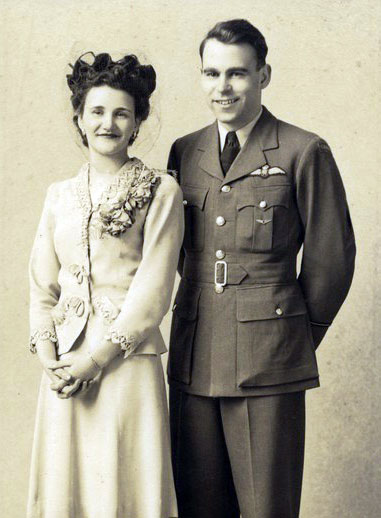
Joseph Kallal was born in Edmonton in October 1913 and was living in Tofield, Alberta and working as a farm labourer when he enlistedin Edmonton in March 1942. He received a commisison in 1943. He too was posted to 425 Squadron and was awarded the DFC, Gazetted on 16th January 1945. The recommendation dated 13th October 1944 when he had flown thirty four operational flights (156 hours flying time) reads.."An outstanding navigator of a Halifax bomber and of exceptional ability, Flying Officer Kallal has recently completed a tour of operations over enemy territory. His crew have bombed successfully such heavily defended targets as Hamburg, Kiel, Castrop-Rauxel, Wanne Eickel, Bottrop, Sterkrade and Dortmund. Flying Officer Kallal has acted in fact, if not officially, as captain of his aircraft throughout his operational tour, and his capable leadership has inspired his crew with confidence. His skill, courage and constant determination to attack with absolute precision have set a fine example to the squadron and his efficiency as a navigator on more than one occasion has been responsible for saving the lives of the crew. This officer has shown dogged determination and keenness at all times. His outstanding gallantry is worthy of high praise." He died in Tofield, Alberta, Canada in July 2005.
Kenneth Franklin received his commission to P/O on probation (emergency) on 9th November 1943, rising to F/O (war subs) on 9th May 1944 and F/Lt (war subs) on 9th November 1945. He remained in the Reserve post-war and on 17th June 1948 he was appointed to a commission in the RAFVR (Training Branch) to the rank of F/O. On 18th June 1958 he extended his period of service by a further four years and it is assumed that he left the forces at the end of this period as nothing further has been traced.
Sgt Kinnear completed his training and was posted to 427 Squadron on 15th June 1944. On 30th October 1944 he was flying in Halifax MZ903 on Ops to Cologne when the aircraft suffered an engine failure, the pilot made a forced landing at Manston, Kent with no injuries to his crew.