Halifax EB205 near Sowerby, Thirsk.
On 15th April 1944 the crew in this 1664 Heavy Conversion Unit aircraft and others from the same training unit were taking part in evening cross-country training exercises. This aircraft took ofd from Dishforth at 20.05hrs and were tasked with flying an east-west route twice for the training exercise but on returning to the Dishforth area on return from the first leg they were to contact base by radio. Because of the weather it would allow flying control to recall their aircraft early should the conditions worsen. Having returned to the skies around Dishforth by around 23.00hrs the weather had become poor, there was thick cloud above 400 feet and it was raining very heavily at the time. The crew received the order not to fly the second leg of the training exercise but to land at Dishforth, they joined the landing circuit and soon after it came their turn to land. Their first attempt at landing was aborted well before ground level because the pilot realised that the runway in use was to have meant landing down-wind so they overshot and questioned the runway they were to use. They received notification that they were to land down-wind and to try again. The aircraft then began to circle around Dishforth at 800 feet to go in for another landing but while flying around the pilot lost sight of the airfield because of the rain, they found themselves over Topcliffe airfield. Dishforth signalled to them that they were over the wrong airfield but at this time both the port engines failed. Topcliffe airfield also signalled to the aircraft. Because of the two failed engines and because one of the propellers had not been feathered the aircraft lost height quickly. At 23.05hrs it crashed into a row of houses next to the main East Coast railway line next to the Sowerby to Topcliffe road bridge where upon the wreckage caught fire. Four airmen who survived the initial crash were dragged clear by local farmers Mr Alfred Rooke and Messers Tom and Cecil Starr. Airmen Pearce and Tynski were taken to the Friarage Hospital at Northallerton. Smith died in an ambulance while being taken to Northallerton hospital. Who the fourth was I do not know. Two occupants of the cottage were also killed in the crash and a man cycling on the road
on the way home from the pub also lost his life in the accident, he was simply in the wrong place at the wrong time. NFS Thirsk attended the crash and Topcliffe airfield sent their ambulance
and crash tender. The bomber's engines blocked the LNER railway line for some time. Halifax EB203 crashed soon after this incident and was on the same training exercise.
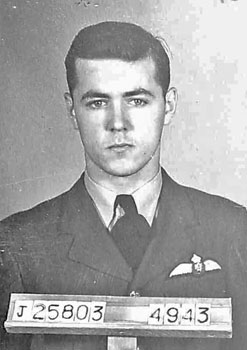
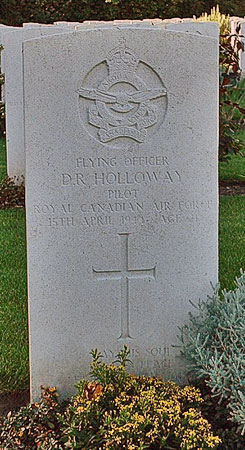
Pilot - F/O Donaldson Rendal Holloway RCAF (J/25803), aged 21, of Ottawa, Ontario, Canada. Died of injuries. Buried Harrogate Stonefall Cemetery, Yorkshire (B/A/12).
Flight Engineer - Sgt Henry George Coles Powell RAFVR (1894686), aged 20, of Balham, London. Buried Wandsworth (Streatham) Cemetery, London.
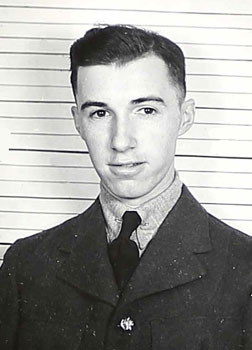
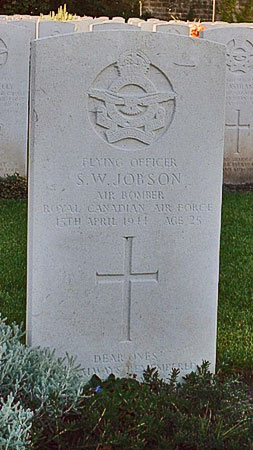
Bomb Aimer - F/O Stewart Walter Jobson RCAF (J/27433), aged 25, of Renfrew, Ontario, Canada. Buried Harrogate Stonefall Cemetery, Yorkshire (B/A/13).
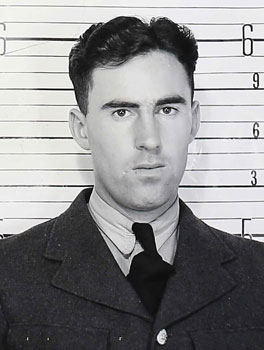
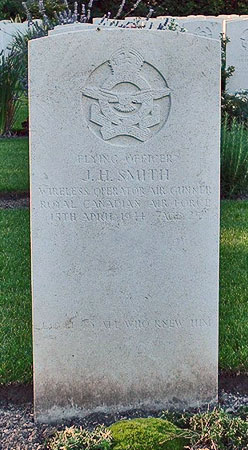
Wireless Operator / Air Gunner - F/O James Henry Smith RCAF (J/18558), aged 25, of Nairn Centre, Ontario, Canada. Died of injuries on way to hospital. Buried Harrogate Stonefall Cemetery, Yorkshire (B/A/11).
Air Gunner - Sgt Kenneth French RCAF (R/197655), aged 21, of Creston, British Columbia, Canada. Buried Harrogate Stonefall Cemetery, Yorkshire (B/A/10).
Navigator - F/O Samuel Henry James Pearce RCAF (J/27505), of Calgary, Alberta, Canada. Injured.
Mid Upper Gunner - Sgt John William Tynski RCAF (R/183425), aged 26. Of Sydney, Nova Scotia. Injured.
Civilian - Mr Albert George Grimwood Stone, aged 48, of Topcliffe Road Bridge, Thirsk. Killed. Burial location unknown.
Civilian - Mrs Clara Stone, aged 62, of Topcliffe Road Bridge, Thirsk. Killed. Burial location unknown.
Civilian - Mr James McNulty, aged 36, of Curradraish, Foxford, Co.Mayo, Irish Republic. Buried Bonnifinglas Cemetery, Attymass, Co.Mayo. Ireland.
Donaldson "Bud" Holloway was born on 25th July 1922 ar Ottawa, Ontario, Canada and was the son of Berkeley Rendal and Helen Elizabeth (nee Reilly) Holloway. In 1940 he started work as a bookkeeper in Ottawa then in January 1941 he joined the Royal Canadian Mounted Police, serving in Regina and Saskatoon, Saskatchewan. He enlisted for RCAF service in Regina on 13th April 1942. After training in Canada he was awarded this pilots' flying badge and also a commission on 30th April 1943. On arrival in the UK soon after he trained at 18(P)AFU and 22 OTU before posting to 1664 HCU on 18th March 1944.
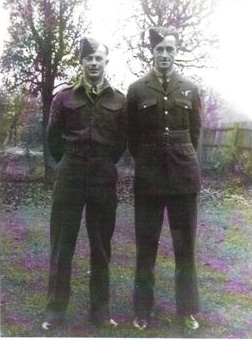
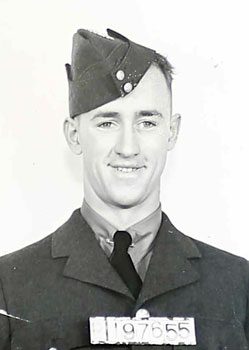
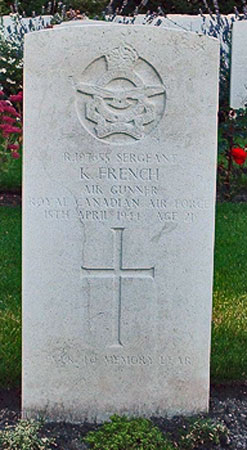
Sgt French's gravestone and photograph of him and also shown is a further photograph of him with his brother Charles, this photograph was taken the day the two were arranging his brother's wedding to which Ken was to have been Charles' best man. Apparently the first the family knew that there was a problem was when he failed to turn up for the wedding (Photos Mr C. French, via Mr L. Green). Kenneth French was born on 28th January 1923 at Creston, British Columbia, Canada and was the son of Arthur Everton and Barbara (nee Wagun) French. Both his parents were born in the USA. He was still at school when he enlisted for RCAF service on 23rd October 1942 in Vancouver and after training he was awarded his air gunners' flying badge on 17th September 1943. On arrival in the UK the following month he trained at 22 OTU before posting to 1664 HCU on 18th March 1944.
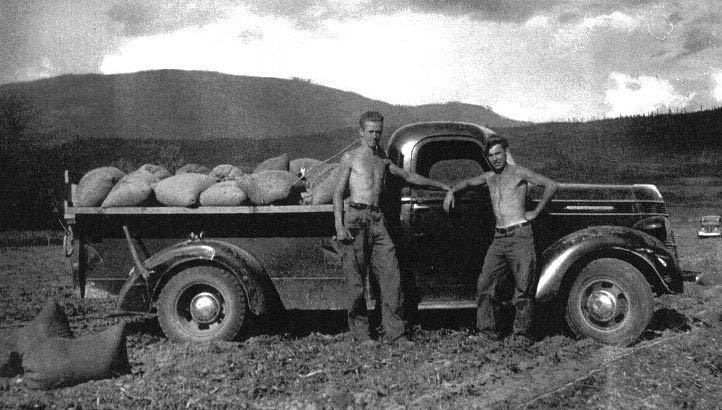
Sgt Ken French with his friend Bill Constable (who would later became an RCAF pilot) harvesting peas at home in Canada. (Photos Mr C. French, via Mr L. Green).
Stewart Jobson was the son of William Clement and Margaret Jean Rae (nee Stewart) Jobson and was born on 25th May 1918 in Renfrew, Ontario, Canada. Both his parents were British but emigrated to Canada before Stewart and his four sisters were born. As a young man he began working in a menswear shop in Renfrew after leaving school there in 1937. He enlisted for RCAF service in Toronto on 23rd March 1943. After basic RCAF training he was awarded an interim Air Observer's badge on 25th June 1943 and also received a commission on the same date. When he arrived in the UK he would then train at 3 (O)AFU and 22 OTU before posting to 1664 HCU on 18th March 1944.
James Smith was born on 4th July 1918 at Iroquois Falls, Ontario, Canada and was the son of Hilliard Smith and Viola Johnston. After leaving school his main employment since 1934 was with the International Nickel Company, of Sudbury, Ontario where he worked as a miner and then in the furnaces. He enlisted for RCAF service at North Bay on 7th July 1941.Following training in Canada he was awarded his air gunners' flying badge on 11th May 1942. By the end of 1942 he was in the UK training at 6 OTU. He was posted to 487 Squadron on 16th December 1942 where he served until October 1943, apart from a brief attachment for training at 1482 Flight. He received a commission on 22nd August 1943. On 5th October 1943 he was posted to 22 OTU and appears to have remained there for too long a period of time to simply have been training. He was then posted to 1664 HCU on 18th March 1944.
"Harry" Pearce was born on 23rd October 1916 at Empress, Alberta, Canada and was the son of Frank Harold and Margaret Wilson (nee MacKenzie) Pearce. He left school in 1934 and worked as various jobs. In 1941 he took a job in the C.P.R. munitions factory as a machine operator. He married Mary Elizabeth London in Drumheller, Alberta in July 1941 and then couple would have a baby girl born in 1942. He enlisted for RCAF service on 20th April 1942 and trained as a navigator. He was awarded his flying badge and also a commission on 25th June 1943. On arrival in the UK he trained at 6 (O)AFU and 22 OTU before posting to 1664 HCU on 18th March 1944 with the rest of this crew. Following his injuries sustained in April 1944 it was not until mid-August 1944 that he was deemed fit where upon he returned to 1664 HCU. With the heavy conversion unit training completed he was then posted to 434 Squadron on 25th October 1944. He was killed on 17th / 18th December 1944 when the 434 Squadron Halifax NR118 he was flying with crashed on the France / Begium border. This incident has been researched in great detail by Mr Leslie Green who was partly behind a memorial being erected at that crash site in France.
Sgt John Tynski. (Photo himself, via Mr Leslie Green). John Tynski was born in Sydney, Nova Scotia to a Polish parents Peter and Ludwika Tynski. Prior to enlisting into the RCAF
he worked at a steel manufacturing plant. He made a recovery from his injuries sustained at Sowerby and later returned to Canada, but before he returned to Sydney he attended the Ontario College of Art in Toronto. He returned to Sydney and established his own business; John Tynski Signs and Designs. He later taught art and sign writing until his retirement in 1980. He died in Cape Breton in October 2009, aged ninety three.
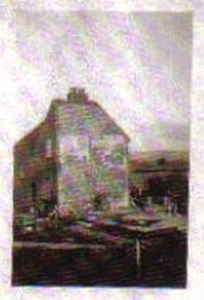
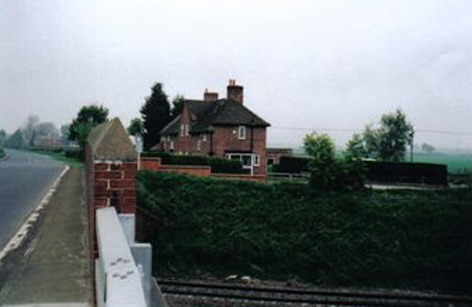
The scene of the crash taken at the time and in 2004. Ken Reast, Eric Barton and Albert Pritchard sort permission from the house owners in 2007 and located small fragments in the gardens. They also sought permission from the owner of the field opposite and located fragments there that suggest it first crashed in the field but then ran across the road into the houses. I am also informed that small pieces of the aircraft still remain on the neighbouring railway embankment. The height of field level opposite the houses was increased with spare soil after more modern road improvements. The photograph shown below shows the damaged houses after the site had been cleared prior to being rebuilt.
I thank Mr Leslie Green for his input in documenting this incident and the crew.
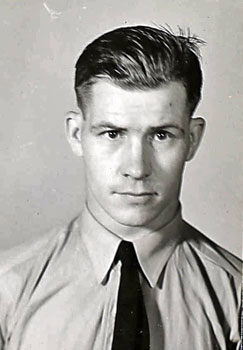
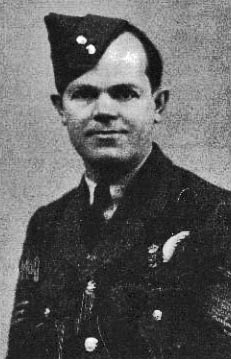
Albert Stone married Clara Taylor at Sessay, North Yorkshire on 30th May 1925. She was a widow by this date and eleven years old than he.