During the night of 12th / 13th April 1944 the crew of this 1663 Heavy Conversion Unit, based at Rufforth airfield, were undertaking a basic night flying exercise consisting of a series of practice take offs, flying circuits of the airfield and landing. The first three short flights were made with an instructor present and while the first two short flights were not perfect by the time the third was made with the instructor he was satisfied with the way the flight was made. After landing following the third flight the instructor left the aircraft having asked the trainee crew to fly further circuits and landings on their own. This was a common type of basic training flight for trainee Halifax crews to make and a common way of carrying it out. At 00.46hrs the aircraft took off for the fourth time. After taking off the aircraft did not climb above 100 feet off the ground and remained in a direct line with the runway for a few miles. It then clipped the top of a first tree, 150 yards later flew through a second tree which removed the starboard outer portion of the wing and then rolled over before crashing around 300 yards from the impact with the first tree south of the village of Healaugh. The crash removed the rear fuselage of the aircraft from behind the main spar, this appears to have saved the rear gunner's life. The rest of the aircraft disintergrated and the rest of the crew were sadly killed. All except the pilot had previously served with 158 Squadron.
The Court of Inquiry is published in the pilot's service file, it includes a lot of technical information on the way the instructor told the trainee pilot to fly this individual Halifax and that the trainee was probably following the advice given regarding reaching a certain flying speed before raising the flaps and then gaining height. As I understand the report to read, by the time the aircraft clipped the first tree it was simply not high enough. Bill Chorley (in his superb Bomber Command losses HCU book) and Brian Mennell (in his equally good "Wings Over York" book) both state that the cause of the crash was down to the premature retracting of the flaps causing the aircraft to sink towards the ground. This is not how I understand the Court of Inquiry to read though both historians have clearly come to the same conclusion so could well be correct.
Pilot - F/O Ross Stuart Ewart RCAF (J/35149), aged 22, of Toronto, Ontario, Canada. Buried Harrogate Stonefall Cemetery, Yorkshire (B/A/1).
Flight Engineer - Sgt John Illingworth RAFVR (1091212), aged 22, of Haslingden. Buried Stonefold Churchyard, Lancashire.
Bomb Aimer - F/O Reginald Chester Pelham Medhurst RCAF (J/23727), aged 27, of Toronto, Ontario, Canada. Buried Harrogate Stonefall Cemetery, Yorkshire (B/A/2).
Wireless Operator / Air Gunner - Sgt Stanley Oates RAFVR (1439442), aged 20, of Lower Grange, Bradford. Buried Allerton Methodist Chapelyard, Yorkshire.
Air Gunner - Sgt Frederick Charles Pinfold RAFVR (1303878), aged 23, of Stratford on Avon. Buried Clifford Chambers Churchyard, Warwickshire
Rear Gunner - F/Sgt Harold Frank Owen RAFVR (1385469). Injured.
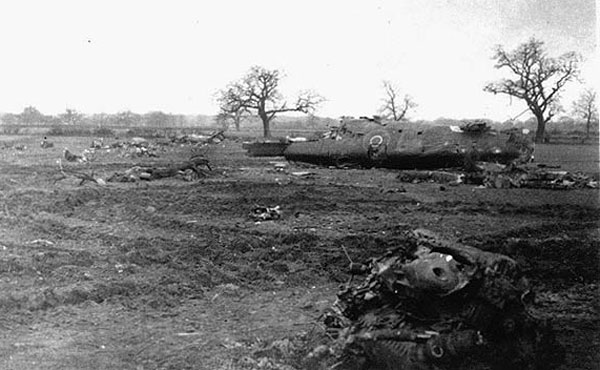
The crash site of Halifax EB204 (Unknown photograph source).
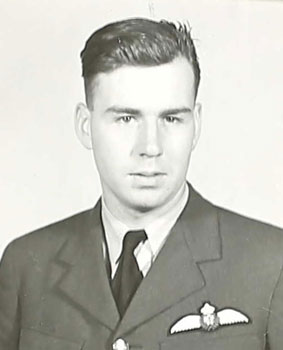
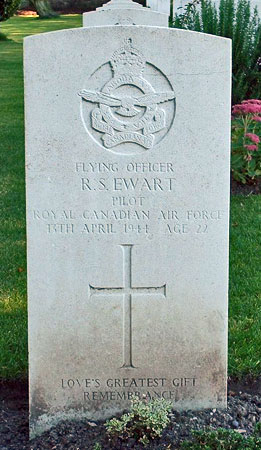
Ross Ewart was born on 10th September 1921 at Toronto, Ontario, Canada and was the son of Ivan Elmer and Jessie May (nee Barnes) Ewart. After leaving school in 1938 he studied a printing at college before starting work as a printer for a company in Toronto. He enlisted for RCAF service on 10th March 1941 in Toronto and after training in Canada was awarded his pilots' wings on 19th June 1942. After gaining his wings he appears to have remained in Canada and served with No.1 C.N.S. until September 1943 possibly as a staff pilot. He received a commission on 8th September 1943. In October 1943 he was posted to the UK, sailing via New York. He trained at 30 O.T.U. before then receiving a posting to 1663 H.C.U. on 22nd February 1944.
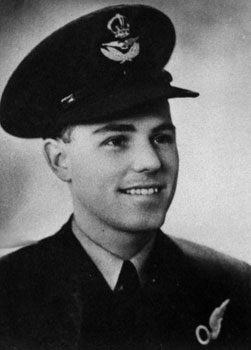
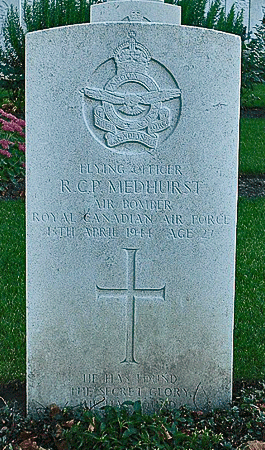
Reginald Medhurst was born on 26th August 1916 in Toronto, Ontario, Canada and was the son of Charles Richard and Vera Wardel (nee Bulcock) Medhurst. Both his parents were born in England but emigrated to Canada. As a young man Reginald worked for the Canadian National Railways as an invoice clerk between 1936 and 1942. He enlisted for RCAF service on 20th May 1942 in Toronto and trained as an air bomber, receiving his air bombers' flying badge and also a commission on 5th February 1943. He arived in the UK soon after and would train at 10 O.T.U. and 1652 H.C.U. before posting to 158 Squadron on 15th November 1943. He was then posted to 1663 H.C.U. on 29th February 1944.
Along with Reginald Medhurst serving at 158 Squadron, Oates, Pinfold and Owen had also been posted to 158 Squadron on 15th November 1943 and had flown together in the same crew. Their original pilot was Sgt Hubert Harald LeCren RCAF (R/12823) (later DFC). John Illingworth had also been posted to 158 Squadron from 1652 HCU on 15th November 1943 but served in a different crew. I guess that most were posted away to 1663 HCU from 158 Squadron because Hubert LeCren had begun his tour earlier than them and had completed it so the rest of his crew were pilotless.