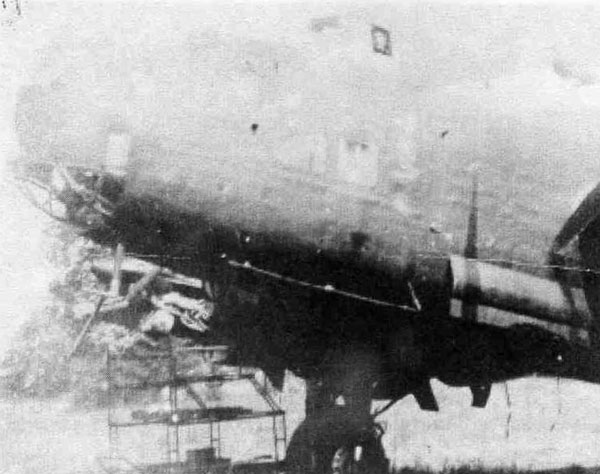
Halifax DT737 at Wombleton airfield.
Halifax DT737 undergoing maintainance earlier in its life with 192 Squadron as "DT-R".
On 30th April 1944 this 1666 Heavy Conversion Unit aircraft was in the process of taking off from Wombleton airfield at 17.25hrs for the pupil's initial flight in a Halifax with an instructor. On the take-off run the aircraft suffered a burst tyre, the aircraft became airborne and a ten minute fly around was carried out to allow the instructor and ground control time to consider the problem and make ready for an emergency landing. At 17.35hrs a landing was made with the instructor at the controls, he managed to stay off the effected wheel for much of the landing but had no option but to settle on it after the aircraft slowed down. The aircraft then ran off the runway and onto soft ground and the damaged wheel hub then dug into the ground. After two violent ground loops the aircraft's tail broke off. The two pilots were unhurt but the aircraft was deemed too badly damaged that it was not repaired. I list the pupil's crew below as it is likely that they were also in the aircraft at the time.
Instructor Pilot - S/Ldr Harry Gowan DFC & Bar RCAF (J/17015). Of Ottawa, Canada.
Pupil Pilot - Sgt Samuel Huston RCAF (R/160295).
Navigator - F/Sgt A F Adams RCAF (R/163742).
Bomb Aimer - Sgt I M Bernhardt RCAF (R/168299), of Preston, Ontario, Canada.
Wireless Operator / Air Gunner - Sgt L H Hartje RCAF (R/180208). Possibly from Cavalier, North Dakota, USA.
Air Gunner - Sgt D J Hill RCAF (R/168151).
Air Gunner - Sgt K S Grant RCAF (R/199276).
Flight Engineer - Sgt Frederick William Puttock RAFVR (1451383).
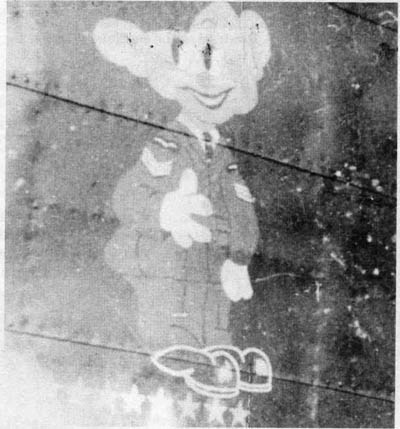
DT737's duties with Special Duties flights has been researched and is as follows; DT737 arrived with 192 Squadron on 9th January 1943 as a Series I (Special) and a brand new aircraft. It arrived with its sister DT735 built by E.E.C. to Contract B982938/39 (order no. 116/E11/39). DT735 had a similar life to DT737 having time with 192 Squadron but went to 1475 Flt prior to ending its days at 1666 HCU (and being lost on 19th November 1944). 192 Squadron was a specialist radio flight it probably spent some period of time being kitted out and it appears not to have been used on Ops at all in the UK before April 1943. The squadron was sent on detachment to North Africa in late April 1943, three Wellingtons left base at Feltwell on 27th April bound for Blida, Algeria along with DT737 which was used to carry ground crew and spares. The pilot for this flight was W/C Webster DSO DFC, Commanding Officer of the Bomber Development Unit which had only just moved into Feltwell from Gransden Lodge (at the same time as 192 Squadron had arrived there). This pilot was probably chosen as 192 Squadron had no crews experienced in flying Halifaxs. They landed at Portreath, then Gibraltar on 28th April and arrived in Blida on 30th April 1943. The detachment stayed in North Africa until September 1943 and with their three Wellingtons they completed over 50 operational flights. Halifax DT737 must have returned to the UK soon after delivering its load as it was being used again in UK in late June 1943 off the French coast. On 4th July it patrolled off the Spanish coast. It may have been used by 192 Squadron after this date but no record of it taking part in Ops has been found. 1473 Special Duties Flight took charge of the aircraft on 22nd July 1943 (which would later merge with 192 Squadron). It then passed over to 1666 HCU at Wombleton on 19th February 1944 who destroyed on 30th April 1944. Its sister DT735 also had a similar career. The photograph below shows the nose art which DT737 it carried with 192 Squadron. This may have been painted over by the time it arrived at 1666 HCU at Wombleton.
Harry Gowan was born in Jarvis, Ontario in November 1915 and enlisted for RCAF service in Hamilton, Ontario in February 1941. He later received his commission in 1943. He was awarded DFC for service with 405 Squadron, Gazetted in October 1943. The Citation reads..."As captain and pilot this officer has participated in very many sorties including attacks on Berlin, Dusseldorf, Cologne and Hamburg. On one occasion when attacking the latter city in July 1943, his aircraft was badly damaged by anti-aircraft fire. Despite this, Pilot Officer Gowan successfully completed his attack and afterwards flew the damaged bomber to base. This officer has set a high standard of skill and resolution." He was later awarded the Bar to the DFC after completing a second Tour with 405 Squadron, Gazetted in May 1944 but possibly awarded to him after he had been posted to 1666 HCU for a rest from operational flying. The Citation reads.."Squadron Leader Gowan has completed two tours of operational duty. He has attacked some of the enemy's most heavily defended targets including Berlin, Cologne and Hanover. At all times he has displayed courage, skill and determination of a high order. An exceptional pilot and organizer, he has played no small part in the successes achieved by his squadron." I thank S/Ldr Gowan's grandson Mr Jay Harwood for contacting me and for the additional information which has allowed this account to be as detailed.
Samuel Huston born in Toronto in 1918 and enlisted there in April 1942. He later received his commission and rose through the ranks to become F/Lt (J/19887), he was awarded the DFC for service with 428 Squadron, Gazetted on 16th February 1945. Hugh Halliday's research into RCAF awards has found the recommendation for the DFC when he had flown thirty three operational flights between 24th May 1944 and 4th November 1944 (just short of 194 hours flying time), it reads.. "As captain of aircraft this officer has shown exceptional coolness, great courage and determination coupled with fine leadership. His calm confidence and obvious ability have maintained a high degree of morale in his crew and he has set a praiseworthy example to all. On one occasion his Flight Engineer was injured immediately prior to take-off. He received a spare and, despite the loss of time, took off and bombed the target on time. His sorties include many major targets including Wesseling, Kiel, Stuttgart, Hamburg, Bremen, Russelheim, Stettin, Emden, Domburg, Dortmund, Duisburg, Cologne, Oberhausen and Bochum as well as many targets requiring great precision and timing such as St.Leu, Foret de Chantilly, Caen and Bois de Cassan." On 24th / 25th July 1944 he was undertaking Ops to Stuttgart when the starboard inner engine caught fire over the target, the fire was put out and the crew returned to base on three engines.
Frederick Puttock received a commission to the rank of P/O on probation on 16th August 1944 (183643). He remained in the RAF until 1970.
Halifax DT737 was built to contract B982938/39 by English Electric Co.Ltd. at Samlesbury. It was allocated to 1474 Special Duties Flight at Gransden Lodge prior to delivery on 9th January 1943 but in the mean time 1474 S.D.Flt had been renamed 192 Squadron on 4th January 1943. It remained non-operational (the explanation for which is given below) until June 1943. It later transferred to 1473 S.D.Flt. at Finmere, it moved with unit to Feltwell on 14th September 1943 and unit renamed 1473 R.C.M.Flt. It again moved with unit to Little Snoring on 28th November and then to Foulsham on 12th December 1943. The Unit disbanded on 1st February 1944. DT737 remained on site until allocated to 1666 HCU at Wombleton on 19th February 1944. Cat.E/FA damage was recorded on the aircraft after this incident at the top of the page and it was struck off charge and reduced to spares and produce, with parts perhaps being used to keep others at Wombleton in use.