Lancaster DS830 at East Moor airfield.
During the early hours on 2nd January 1944 the crew of this 432 Squadron aircraft undertook an operational flight, they took off from East Moor at 00.30hrs bound for Berlin. The crew reported cloud over the target area when they released their bomb load from 21,000 feet at 03.10hrs. On their return flight, at around 07.30hrs while they were over the Calais area, the pilot discovered the throttle on the port inner engine had jammed at cruising power. On arrival at East Moor a landing was attempted with three engines throttled back and the port inner jammed on a much higher power setting. The aircraft overshot the first attempt at landing and the pilot applied power and went around for another attempt at landing. At 08.26hrs on the second approach the aircraft touched down safely but because the port inner could not be throttled back the aircraft swung off the runway and across the grass. It narrowly missed flying control before being brought to a halt on an empty disperal pan at the northern end of the airfield near the end of runway 17/35. The aircraft came to rest having sustained minor damage. The crew were then debriefed and crawled into bed by 10.30hrs, they were woken at 17.00hrs and briefed that they were to return to Berlin on Ops the next night. Details of the incident on the flight the following night is listed below.
Pilot - P/O Thomas Benson Spink RCAF (J/18812).
Flight Engineer - Sgt John Albert Banks RAFVR (1834361).
Navigator - P/O Gerald Irwin Phillips RCAF (J/19065).
Bomb Aimer - F/Sgt Mark Proctor Bailhache RAFVR (1322954).
Wireless Operator / Air Gunner - Sgt John MacFarlane RAFVR (1140103).
Air Gunner - F/Sgt Donald Ryan RCAF (R/168315).
Air Gunner - F/Sgt W Leadley RCAF (R/120994).
The incident listed at the top of this page was the DS830's seventh operational flight and P/O Spinks ninth. DS830 went on to complete twelve Ops with 432 Squadron before transfer to 426 Squadron. The aircraft carried the nose art "Bobby Boy" with 432 Squadron, this was the name of Tom Spink's young son.
Thomas Spink was born in Vancouver in 1919 where he enlisted on 26th June 1941. He was flying Lancaster DS788 with the same crew (apart from a different bomb aimer) as listed above on 2nd / 3rd January 1944, they were involved in a more serious incident avoiding an attack by an enemy aircraft. The pilot of the Lancaster put the aircraft into a steep dive for 6,000ft he eventually levelled out. The crew then realised that the oxygen supply had been damaged. whilst over the target they then released that the electrics had also been damaged and this
prevented the bombs being released electrically. They were later dropped after being released by hand. On the return leg the pilot was hand fed oxygen by the flight engineer from a hand bottle where they made a landing at Coleby Grange. It was then discovered that the photo-flash had been rolling around the aircraft making a hole in the floor. For his actions on this night Thomas Spink was awarded a richly deserved DFC. While his DFC was awarded for the actions in January 1944 he was not actually given it until much later, possibly as he declined to accept it. It was posted to him in Canada in March 1949. He served in the RCAF post-war. The citation for his DFC reads... "This officer was a pilot of an aircraft detailed to attack Berlin one night in January 1944. On the outward flight the aircraft was hit by bullets from a fighter. The oxygen supply began to leak. Despite this Pilot Officer Spink continued his mission although the target was still some 200 miles distant. In spite of much physical discomfort caused by the lack of oxygen, Pilot Spink reached and bombed his objective and afterwards flew the damaged aircraft back to base. He displayed great determination, fortitude and devotion to duty." The photograph of him shown above is taken with a Lancaster parked on dispersal at East Moor looking towards the St.John's Well Plantation and the East Moor / Farlington Road across the northern end of the airfield.
John Banks received a commission on 7th February 1944 (171597) to the rank of P/O on probation (emergency). He remained in the RAFVR post-war until 1947 and then served in the ATC and was appointed to a commission in the Training Branch on 7th April 1957 to the rank of F/O. He relinquished his commission on 7th April 1961. I thank his father in law for contacting me in October 2015 and for the photograph of him shown above.
Lancaster DS830 was built to Contract ACFT/239 by Armstrong Whitworth Ltd at Baginton and taken on charge by 426 Squadron on 11th October 1943. It was then transferred to 432 Squadron on 15th October 1943. As a result of damage sustained at East Moor on 2nd January 1944 a damage assessment of Cat.A/FB must have been the assessment as any more serious would have been listed on the aircraft's AM Form 78. A repair on site would have been carried out and this was completed by 14th January 1944. The aircraft was then transferred back to 426 Squadron at Linton on Ouse on 9th February 1944 when 432 Squadron began converting to Halifaxes. It then transferred to 408 Squadron at Linton on Ouse in April 1944 when 426 Squadron began converting to Halifaxes. It was later transferred to 1668 Heavy Conversion Unit at Bottesford on 26th September 1944 when 408 Squadron again converted to Halifaxes. It completed it's service life with 1668 H.C.U. and was struck off charge on 20th March 1945.

Gerald Phillips was born in Selkirk, Manitoba in 1918 and enlisted into the RCAF in Winnipeg on 28th June 1941. He received his commission in 1943 and was later posted to 432 Squadron. For service with 432 Squadron he was awarded the DFC, effective from 11th April 1944. The recommendation for which as found by Hugh Halliday reads... "This officer has completed 25 1/2 successful operational sorties, sixteen of which have been over strongly defended targets in Germany. He has proven himself to be an outstanding navigator and an inspiration to the members of his crew. On all occasions he has shown outstanding fortitude and skill and has cheerfully filled every assignment given to him. For his fine record of achievement, his superb leadership and his devotion to duty, this officer is recommended for the award of the Distinguished Flying Cross." He was presented with the DFC on 30th October 1948.
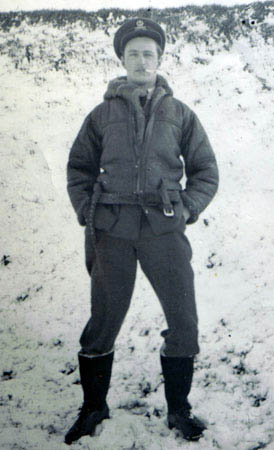
F/Sgt Leadley had survived the crash of 432 Squadron Wellington HE553 near Reeth in May 1943 that saw two of the crew killed.
Mark Bailhache was flying with a different 432 Squadron crew on 22nd January 1944 when Lancaster DS843 was badly damaged over Germany. He baled out and became a PoW.