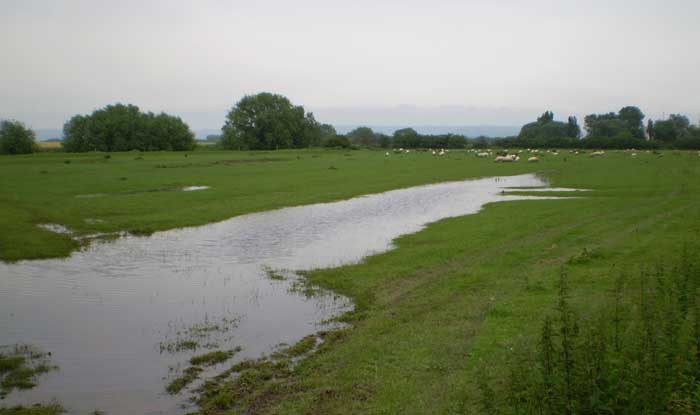
Lancaster DS705 at Dalton airfield.
On 23rd July 1944 the crew of this 408 Squadron Lancaster were delivering the aircraft to Dalton airfield so that it could be stored here. It was one of three 408 Squadron aircraft flown to Dalton on this date with others arriving at Dalton in the days that followed. There was no wind over Dalton during the time of landing, a head wind was normally used to slow the aircraft down on landing. The runway in use at that time was in the process of being switched to the longer one but because Dalton's Flying Control did not direct the pilot of Lancaster DS705 to land on the longer of the three runways the pilot landed at 14.45hrs on the shorter South to North runway. The aircraft was travelling too fast to stop in the available distance and continued off the end. It ran through the boundary hedge, across a road and came to rest in a field with the undercarriage collapsed, possibly also overturning. A fire developed and while the crew escaped, the navigator and flight engineer sustained minor injuries, the fire could not be brought under control so destroyed the aircraft. Sadly only the pilot's name is currently known.
Pilot - P/O Donald Leonard Snider RCAF (J/19789). Uninjured.
Crew - Names unknown.
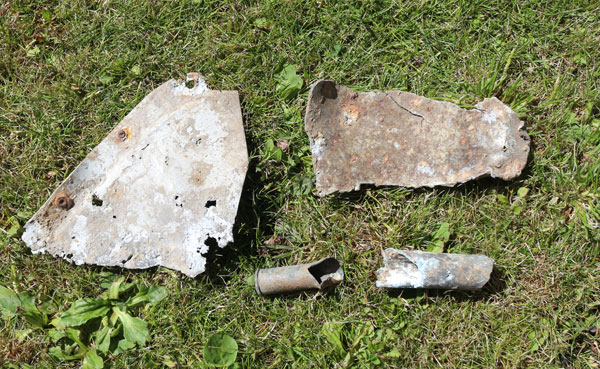
In June 2007 air historian Ken Reast showed me where this aircraft had crashed. Ken, Eric Barton and Albert Pritchard had located pieces on the surface some years before with permission from the landowner. The aircraft came to rest towards the centre right of the photograph but a scar in the field is not thought to have been caused by this incident and is believed natural. The photograph below shows small fragments located by Eric Barton during their visit and were retained by him.
Donald Snider was born in Brantford, Ontario, Canada in 1918 and worked for the Bank of Montreal before enlisting into the RCAF in October 1941 when he was already a member of the Royal Canadian Artillery. It is probable that while W/O D L Snider and his crew were training at 23 OTU he was involved in a previous accident to the one at Dalton, when, on 29th December 1943 Wellington HE366 crashed at Atherstone. He received a commission in 1944 and completed a Tour with 408 Squadron for which he was awarded the DFC, Gazetted on 5th February 1945 but not presented until 14th June 1949. Hugh Halliday's research into RCAF awards has sourced the recommendation for his DFC which reads.. "Flying Officer Snider has completed an operational tour as captain in four-engined bombers. Many of these trips took him to such heavily defended targets in Germany as Karlsruhe, Friedrichshafen, Wesseling and Kiel. On all occasions, Flying Officer Snider displayed great determination in pressing home his attacks in spite of anything the enemy had to offer in the way of defences. More recently, on precision targets requiring the utmost in skill, he has bombed the target, bringing back excellent aiming point photographs. Throughout his tour he has displayed exceptional keenness in operations and coming to grips with the enemy, and by his keenness has inspired his crew and all members of the squadron. Flying Officer Snider has, by his cheerful spirit and fine operational ability, been a great asset to this squadron, and I consider that his fine operational record fully warrants the grant of the Non-Immediate Distinguished Flying Cross." After the War he returned home to Brantford and continued to work for the Bank of Montreal. He died on 16th August 2008 in Brantford, Canada.