On 12th February 1944 the crew of this 1659 Heavy Conversion Unit took off from Topcliffe airfield at 18.53hrs to undertake a night-time Bullseye training exercise as part of their training course. Such flights were a normal part of heavy conversion unit training and involved the crew navigating to a U.K. town or city to make a simulated bombing run on a specifed target. The route or the destination for the flight has not yet been researched but in the course of the evening the crew had become lost for a period of time and therefore used more fuel in flying around to work out their position than would normally have been needed for the planned route. There also appears to have been dense fog over Topcliffe airfield that prevented them from landing at their home airfield. At around midnight the crew received permission to land at Leeming airfield, they made a normal approach to land until they were around 500 yards from the end of the runway and were flying at around 200 feet off the ground. Both the aircraft's staboard engines then failed. From this point the aircraft was seen to make a steady veer off to starboard and lost height, it then passed over buildings at Leeming airfield at a low level, crossed over the River Swale and crashed in a field at 00.07hrs near Rush Farm, Maunby. Sadly three members of the crew were killed while four survived. A fire broke out in the wreckage. The crash site was fairly close to Leeming airfield but as it was at the other side of the River Swale and there being no bridges close-by to allow them to cross the water it took them nearly half an hour to get there. By the time they arrived the farmer at Rush House, Mr Miles Raine, had seen the fire at the crash site and pulled three members of the crew clear. The lives of two airmen were saved by his actions. The midd upper gunner was found suffering from severe shock some time later wandering near Leeming Bar.
A detailed examination of the wreckage and documents followed to try and find out why both starboard engines failed when they did as the fuel levels recorded prior to take off from adequate for the planned flight. As part of normal flight the flight engineer's role was to switch between fuel tanks to allow even use of fuel and to ensure that there was always fuel there to supply the four engines. From documents on the aircraft it was found that at 22.00hrs he switched across to two fuel tanks that before taking off he was told were filled up. It later transpired that a little fuel had been put into these fuel tanks but that the ground crew "filled" them using only the fuel gauges in the aircraft to check the level and not a dipstick. The fuel in them was therefore much lower than would have been expected. The fuel that supplied the two starboard engines had run out causing them to stop.
Pilot - P/O Ernest Fairhead RCAF (J/88531), aged 23, of Edmonton, Alberta, Canada. Buried Harrogate Stonefall Cemetery, Yorkshire (F/A/1).
Navigator - F/Sgt John Bruce Fox RCAF (R/160403), aged 26, of Palermo, Ontario, Canada. Buried Harrogate Stonefall Cemetery, Yorkshire (F/A/2).
Wireless Operator / Air Gunner - Sgt Albert Edward Jennings RAFVR (1540656), aged 21, of Rochdale. Buried Rochdale Cemetery, Lancashire. Died of injuries.
Flight Engineer - Sgt Edward George Richard Gates RAF (650149). Seriously injured.
Bomb Aimer - Sgt Robert Edward Iggulden RCAF (Can.2293A). Seriously injured.
Mid Upper Gunner - Sgt A E Tasker RAFVR (1590052). Slightly injured.
Rear Gunner - Sgt E T Bennett RAFVR (1590311). Seriously injured. 1593011
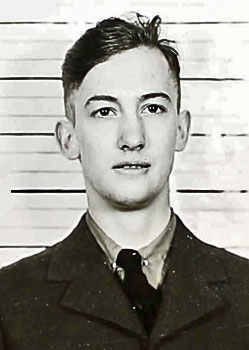
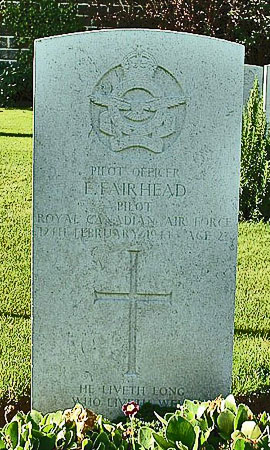
Ernest Fairhead was born on 4th September 1920 at Edmonton, Alberta, Canada and was the son of John and Florence (nee Smith) Fairhead. As a young man he left high school in 1939 and undertook a number of jobs for the next couple of years while studying commerce at Alberta College. He enlisted for RCAF service on 11th March 1942 at Calgary for aircrew duties and after training in Canada he was awarded his pilot's flying badge on 18th March 1943. He left Canada for service in the UK soon after and trained at 15 (P)AFU, 18 (P)AFU and 82 OTU before posting to 1659 Heavy Conversion Unit. He appears to have received a commission after his death backdated to 11th February 1944.
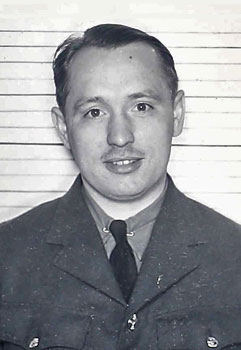
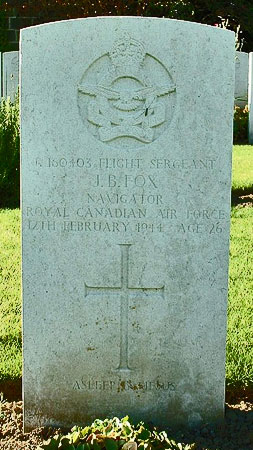
John Fox was born on 29th December 1917 at Palermo, Ontario, Canada and was the son of George Neil and Beatrice Mabel (nee McEwen) Fox. As a young man he worked as a druggist's apprentice. He enlisted for RCAF service on 15th April 1942 in Toronto for aircrew duties and after training in Canada he was awarded his air observer's flying badge on 5th March 1943. Just prior to heading overseas he married Donna Mary McIntyre in Toronto on 31st March 1943. In the UK he trained at 6 (O)AFU and 82 OTU before posting to 1659 HCU on 13th January 1944.
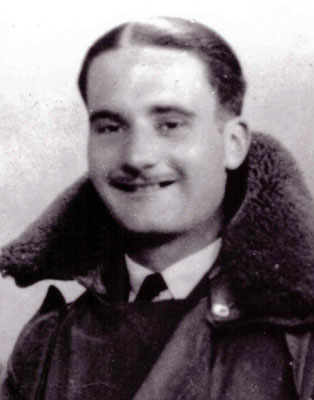
Sgt Albert Jennings. I thank his nephew Dave O'Donnell for kindly supplying this photograph.
Edward Gates must have recovered from his injuries and resumed flying duties. He received a commission to the rank of P/O on probation on 8th March 1945 and rose to F/O six months later.
Robert Iggulden was born on 23rd November 1919 at Halcourt, Alberta, Canada. He broke both legs and his left arm in the crash as well as sustaining head injuries. He recovered to some extent but returned home to Canada. He died in August 2011. I thank his son, Mr W.Iggulden, for contacting me in the early days of my research / website and many years before creating this webpage.