Halifax DG226 had earlier served with 10 Squadron as "ZA-H". On the night of 22nd / 23rd November 1942 it sustained battle damage while on an operational flight, following an attack by a Junkers Ju88 the fuselage, tail and wings were both damaged by it's fire. The Halifax's gunners returned fire and the Ju88 was lost to sight but five minutes later it was attacked by three Fw190s but evasive action was taken and no damage resulted. The crew managed to fly the aircraft back to base and landed at Melbourne in the early hours.
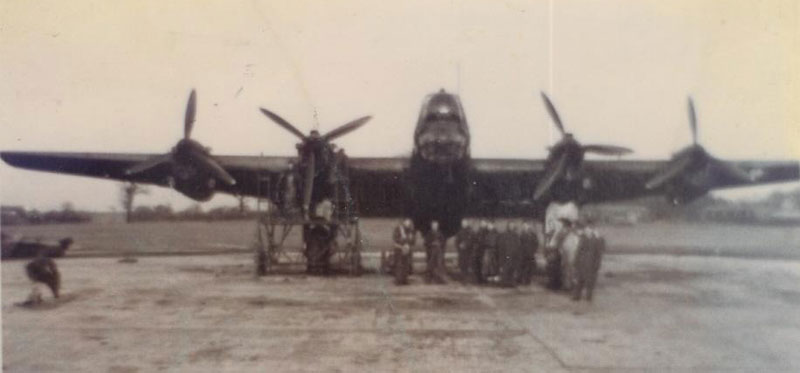
The pilot is quoted in other accounts of this incident as saying that on this flight the aircraft had flown so low across France to avoid search-lights that it had clipped the tops of trees and small branches became wedged in the front of the aircraft. It flew the rest of the flight with these embedded in the aircraft. The photograph above is believed to show Halifax DG226 when the repairs were complete after this damage in November 1942 but it did not fly operationally again with 10 Squadron.
At 14.29hrs on 24th August 1944 this 1652 Heavy Conversion Unit aircraft took off from Marston Moor for the crew to undertake a training flight. The aircraft climbed away as normal to around 1,000 feet but shortly afterwards the port outer engine failed and was seen on fire. It was felt that the pilot had been unable to feather the propeller on the damaged engine, the airspeed dropped and the aircraft stalled. At 14.35hrs the aircraft turned onto it's back and dived into the ground into a field near Wetherby Golf Course and all on board were killed. Following the crash it took some time to recover the bodies of the crew. The damaged engine was also recovered from the site and received a detailed examination, it was found that the A-block con-rod was broken and a piston inside the engine was missing (probably broken through the engine casing rather than missing when constructed). The time and effort it took to recover the crew and the damaged engine almost certainly resulted in the other three engines being left where they fell.
Halifax DG226 was built to contract ACFT/637/C4/C by Rootes Securities Ltd. at Speke and was awaiting collection on 7th June 1942. It was taken on charge by 35 Squadron at Linton on Ouse soon after completion but was transferred to 10 Squadron Conversion Flight on 24th September 1942 at Melbourne. On 19th October 1942 it was transferred to the parent 10 Squadron also at Melbourne and as a result of battle damage on 23rd November 1942 minor Cat.A(c)/FB damage became the damage assessment with a temporary repair on site at Melbourne beginning on 26th November 1942. It was returned to 10 Squadron charge on 2nd January 1943 but the following day it was test flown by P/O Brooksbank who deemed it in need of a major repair. On 13th January 1943 it was flown to Fairey Aviation Ltd. Civilian Repair Centre at Ringway for repair, with this complete on 7th February 1943 it was flown to 158 Squadron at Rufforth. 158 Squadron moved to Lissett at the end of February 1943 and took the aircraft. On 6th April 1943 it was transferred to 1658 HCU at Riccall and on 21st July 1943 it was transferred to 1652 HCU at Marston Moor. On 13th September 1943 it sustained Cat.A(c) damage when the tail wheel structure broke on landing at Marston Moor. A repair on site was carried out. On 28th October 1943 it was returned to 1652 HCU charge. On 24th August 1944 it crashed near Wetherby Golf Course with the loss of the then crew. The aircraft was destroyed and was struck off charge the same day with Cat.E2/FA damage recorded on the paperwork.
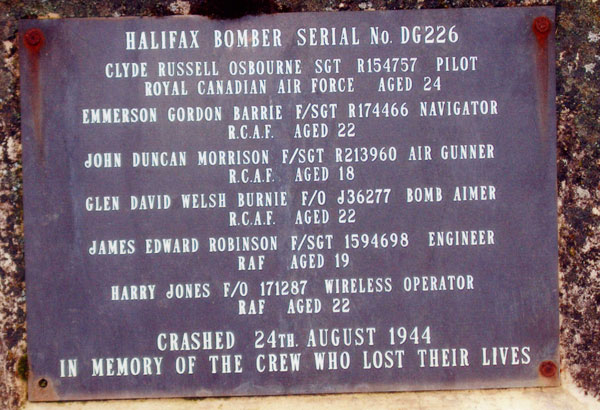
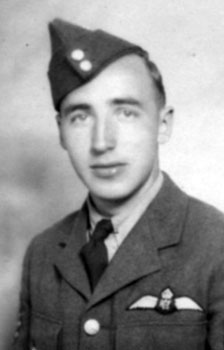
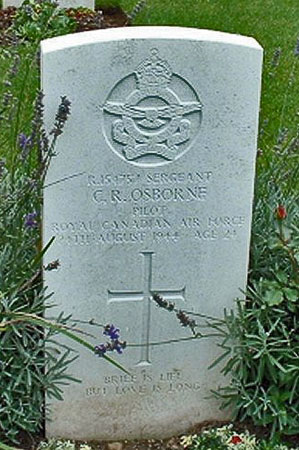
Pilot - Sgt Clyde Roswell Osborne RCAF (R/154757), aged 24, of St.Martins, New Brunswick, Canada. Buried Harrogate Stonefall Cemetery, Yorkshire (E/C/5).
Flight Engineer - F/Sgt James Edward Robinson RAFVR (1594686), aged 19, of Altrincham. Buried Hale Cemetery, Cheshire.
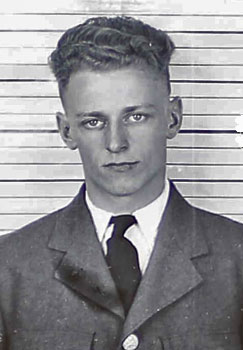
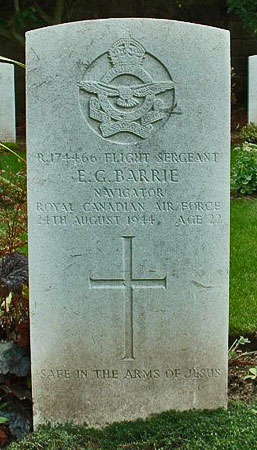
Navigator - F/Sgt Emerson Gordon Barrie RCAF (R/174466), aged 22, of Montreal, Quebec, Canada. Buried Harrogate Stonefall Cemetery, Yorkshire (E/C/3).
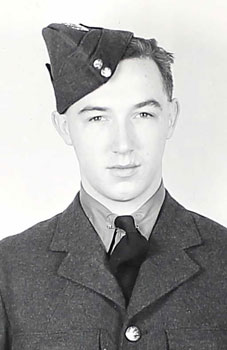
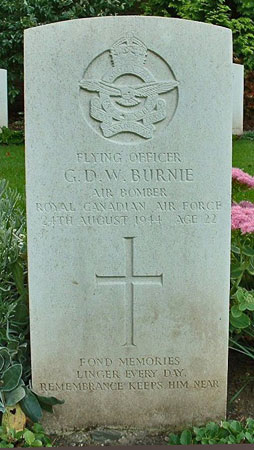
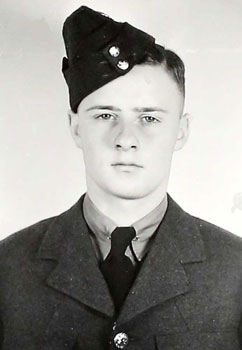
Bomb Aimer - F/O Glenn David Welsh Burnie RCAF (J/63277), aged 22, of Winnipeg, Manitoba, Canada. Buried Harrogate Stonefall Cemetery, Yorkshire (E/C/6).
Wireless Operator / Air Gunner - F/O Harry Jones DFM RAFVR (171287), aged 22, of Euloe Green, Hawarden. Buried Hawarden Cemetery, Flintshire.
Air Gunner - F/Sgt John Duncan Morrison RCAF (R/213960), aged 18, of Balcarres, Saskatchewan, Canada. Buried Harrogate Stonefall Cemetery, Yorkshire (E/C/4).
Clyde Osborne was born on 6th March 1920 and was the son of Ernest Vincent and Gertrude Hazel Osborne, of St.Martins, New Brunswick, Canada. Prior to going overseas he made married. His service file is not yet in the public domain.
Emerson Barrie was born on 30th August 1922 at Montreal, Quebec, Canada and was the son of William and Gertrude Ann (nee Pain) Barrie. He had just finished at high school when he enlisted for RCAF service on 7th July 1942 in Montral and after training in Canada he was awarded his navigator's flying badge on 1st October 1943. He left for service in the UK in early 1944 and trained at 3 (O)AFU and 20 OTU before posting to 1652 HCU around the start of August 1944. His brother William Fraser Clinton Barrie R/164541 served in the RCAF.
Glenn Burnie was born on 12th December 1921 at Dubuc, Saskatchewan, Canada and was the son of David Welsh and Mary (nee Abel) Burnie. Both his parents were born in Scotland but had emigrated to Canada and the family lived in Saskatchewan until he was around five years old before moving to Winnipeg. As a young man he left high school in 1941 and worked as a clerk for a company in Winnipeg. He enlisted for RCAF service there on 3rd October 1942 for aircrew duties and after training he was awarded his air bomber's flying badge and also a commission on 1st October 1943. Arriving in the UK before the end of 1943 he trained at 10 (O)AFU and 20 OTU before posting to 1652 HCU with the rest of his crew.
John Morrison was born on 23rd October 1925 at Balcarres, Saskatchewan, Canada and was the son of George and Jennie (nee Elder) Morrison. Both his parents were born in Scotland but had emigrated to Canada and his father served as a C.S.M. in WW2 with the Canadian Army overseas. As a young man he worked locally on a farm in Saskatchewan for a few months after finishing at high school. He enlisted for RCAF service on 26th April 1943 in Regina for aircrew duties. He trained as an air gunner and was awarded his flying badge on 14th January 1944. On arrival in the UK in March 1944 he trained at 20 OTU before posting to 1652 HCU around the start of August 1944.
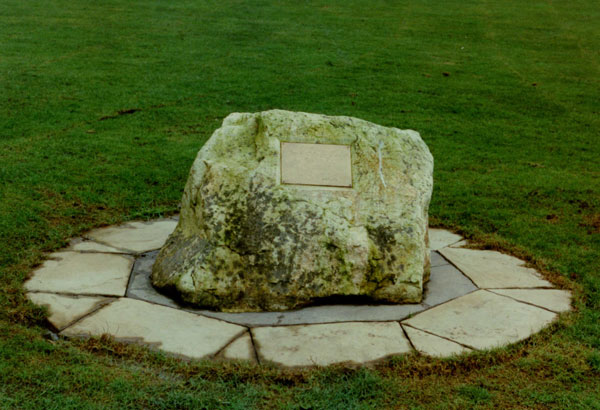
A memorial has been erected near the crash site.
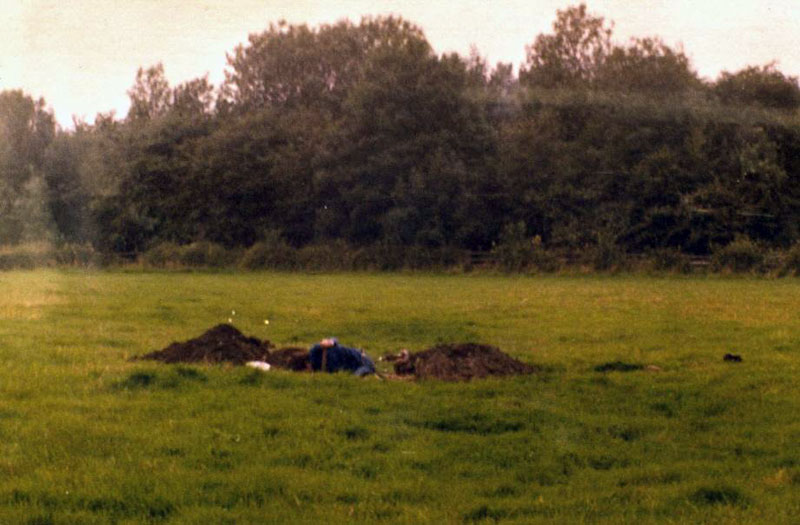
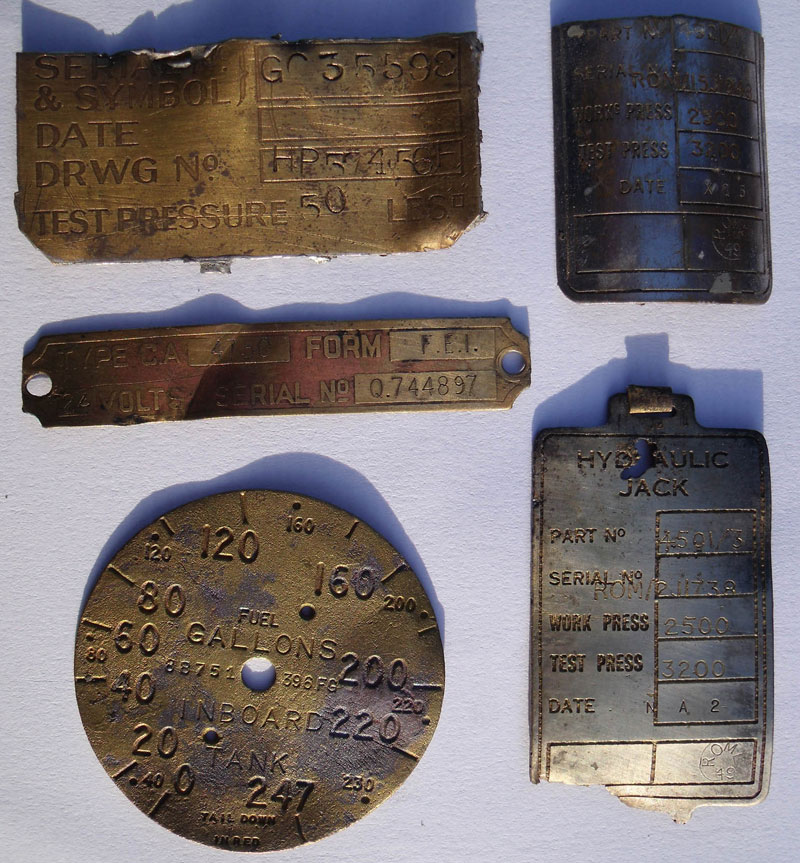
In the 1970s air historian Nick Roberts was contacted by the landowner Mr Hubert Robinson to explain that he believed that there were three engines still buried on the crash site. In August 1977 both starboard engines were recovered by Nick Roberts, Mr Robinson and a team of volunteers. The photograph above shows the site as the first trial dig began. The recovered engines were restored to museum standard by Robin Goodman and Mark Lewis. Nick took ownership of one of the engines while Mr Robinson retained the other. Nick's engine was the first to be displayed at, what was then, the newly formed Yorkshire Air Museum, but was later returned to him. Mr Robinson's engine was donated to the Yorkshire Air Museum in 1985 and is still on display there. In 1992 the port inner engine was recovered from the site and after the restoration was begun by Robin Byers it was completed to a running condition by Peter Grieve / Flight Engineering. The fourth / port outer engine was recovered at the time of the crash to try and discover why it had failed. During the dig in the 1970s a number of small finds were also recovered and photographs of some of the plates Nick kept are shown below. The field where the aircraft crashed has now been taken over by the expanded golf course and a road now covers the crash site.
A collection of items found at the crash site in 1977 when the wreckage was cleaned.
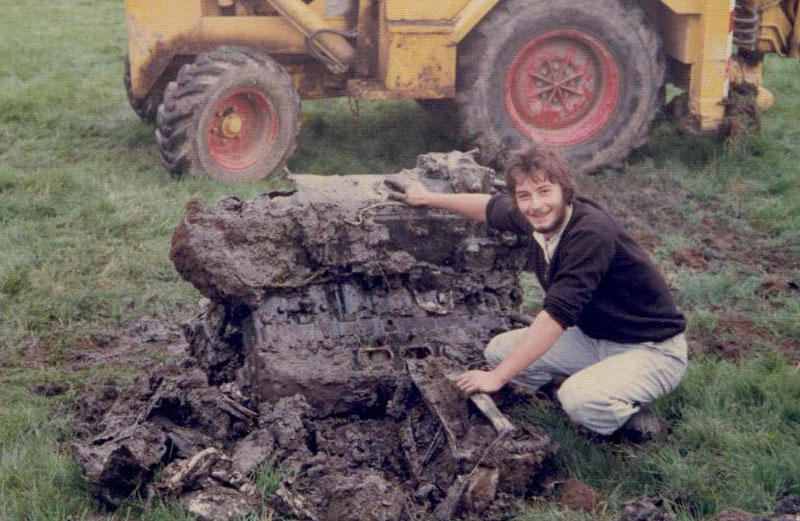
This is almost certainly the starboard outer engine of Halifax DG226 that was recovered from the crash site in August 1977. Nick Roberts (seen with it) obtained this engine after the dig and after full cleaning and restoration by Robin Goodman it was displayed at the Yorkshire Air Museum when it formed but was later returned to Nick Roberts. Where this engine is now is not known. Nick and I would love to learn what happened to it.
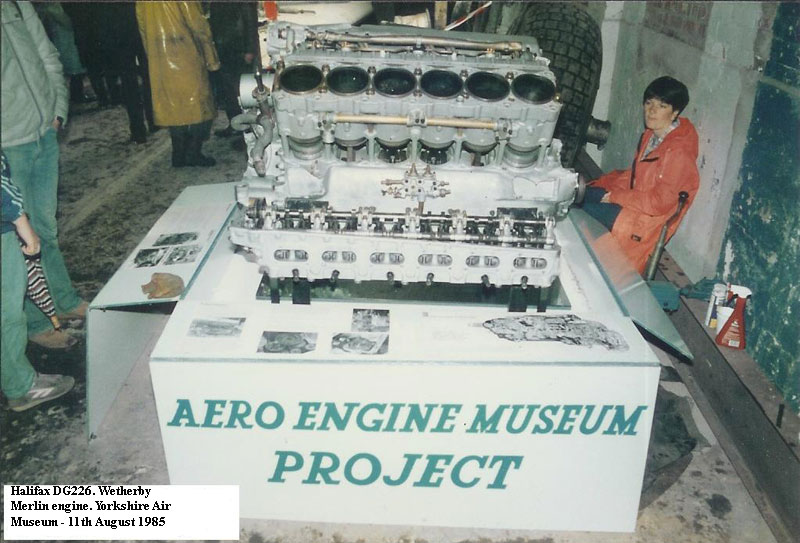
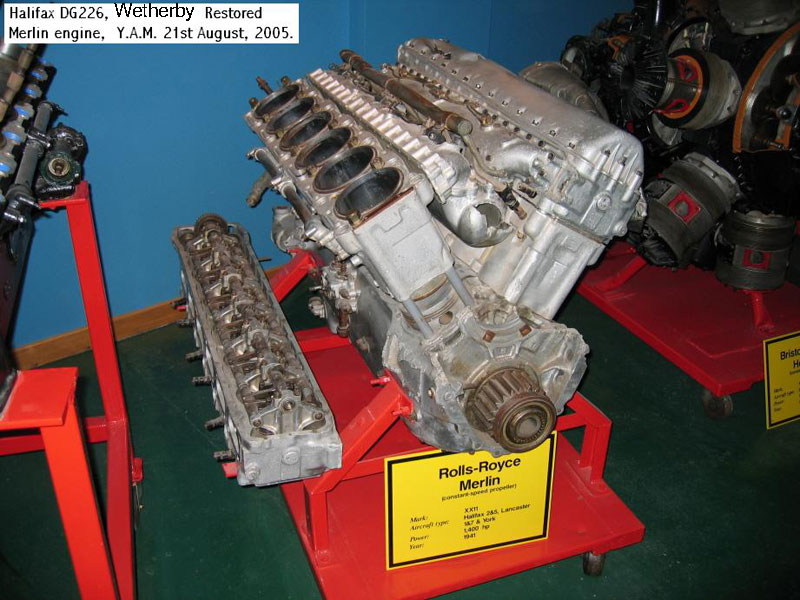
These two photographs show the starboard inner engine of Halifax DG226 (modelled by Lesley Sharpe to add scale), this was initially retained by the landowner and was cleaned and displayed to museum standard by Robin Goodman and Mark Lewis. It was later donated to the Yorkshire Air Museum in 1985 and is still on display there.

Harry Jones was awarded the DFM for service with 76 Squadron, Gazetted on 18th January 1944 for earlier service. By the time his DFM notification came through he had been granted a commission to the rank of P/O on probation on 3rd January 1944 and rose to F/O six months later.