On the night of 26th / 27th May 1944 the crew of this 1656 Heavy Conversion Unit took off from Lindholme airfield at 21.35hrs to undertake a night cross country training flight. The weather was good and the crew undertook the route of the training flight with success. At 02.45hrs they were roughly over Lindholme airfield and made radio contact with flying control to give their position. They were then instructed to descend from the 4,000 feet that they were flying to 1,000 feet and prepare to land. Nothing further was heard from the aircraft. Five minutes later it dived into a field, given in the accident documentation as being around half a mile west of "Broadway Stainforth", which is probably on land between Dunscroft and Barnby Dun. An explosion on impact followed by a fire destroyed much of the aircraft.
A detailed accident investigation followed to try to work out what exactly had happened to make it fall out of the sky. No firm proof of anything resulted, however a great deal of speculation was placed onto the fuel supply to the engines. It was found that, at the very least, both the starboard engines had failed just before or as it was making a turn to starboard (or the right). With the starboard wing lower than the port wing this resulted in the port/top engines applying power onto just one side of the aircraft and it making it swing towards the ground. This scenario was a common cause of Halifax crashes in training units. With no height left to do anything in it crashed. Prior to this crash the pilot of the aircraft received the instruction from flying control at Lindholme to descend from 4,000 to 1,000 feet and immediately afterwards the pilot probably informed the flight engineer to change the fuel tank selection from some tanks to others while he descended the aircraft quickly by cutting power to all engines. The flight engineer may not have completed the tank change-over by the time the pilot then re-applied power causing air to get into the fuel supply. A possibly incorrect way of changing the tank values was also suspected as that could effectively cause a brief period where the fuel supply to all the engines was cut off and air have got into the system. Because the aircraft was effectively throttled back and gliding from 4,000 to 1,000 feet a failure of the engines would not immediately have been noticed by the pilot. When the aircraft levelled out and began to make what was known as a gliding turn, as the pilot applied power in the banked turn the two engines on the low side of the aircraft effectively had no power so dragged the aircraft towards the ground. The engines on the port/upper side appear to have resumed running but with no height left to attempt to recover the aircraft it crashed.
This investigation and the final remarks of commanding officers went right to the top. AVM Rice (AOC No.1 Group) stated that the cause of the crash remained obscure but that he recommended that after this accident the wording of making fuel tank selection during training was changed during instructors briefings to crews, to ensuring that any fuel tank change-overs were complete before descending below 3,000 feet. The final words on the Court of Inquiry were made by someone part of A.O.C Bomber Command, they stated "the cause of this crash remains obscure. There is no evidence of fuel starvation owing to incorrect fuel cock manipulation". This may suggest that they thought that by changing the fuel tanks over at a height above 3,000 feet should a similar problem occur there was a chance that the pilot could recover control of the aircraft. Neither men pinned any blame on human error or the way the fuel system was operated.
Pilot - P/O Joseph Hetherington RAFVR (172423), aged 27, wife of Boxford. Buried Boxford Churchyard, Berkshire.
Flight Engineer - Sgt Philip Kindlen RAFVR (1365195), aged 23, of Dundee. Buried Dundee Eastern Necropolis, Angus.
Navigator - F/O William Samuel Garland RCAF (J/27487), aged 21, of Toronto, Ontario, Canada. Buried Harrogate Stonefall Cemetery, Yorkshire (B/D/16).
Bomb Aimer - Sgt Donald Robert Persse RAFVR (1238492), aged 30, of Stretford, Lancashire. Buried Harrogate Stonefall Cemetery, Yorkshire (B/D/14).
Wireless Operator / Air Gunner - Sgt Edward Garrod Joshua Bridgeman RAFVR (1393427), aged 23. Buried Harrogate Stonefall Cemetery, Yorkshire (B/D/13).
Air Gunner - WO Henry Leonard Walters DFM RAFVR (1351227), aged 23, wife of Edge Hill, Liverpool. Buried Hornchurch Cemetery, Essex.
Air Gunner - Sgt Gordon Long RCAF (R/89074), aged 20, of Toronto, Ontario, Canada. Buried Harrogate Stonefall Cemetery, Yorkshire (B/D/15).
Halifax DG219 was built to contract ACFT/637/C4/C by Rootes Securities Ltd. at Speke and was awaiting collection on 1st April 1942. It was immediately flown to 12 MU at Kirkbride where, on 16th April 1942, the aircraft sustained what was initially assessed as being Cat.B/FA damage of an unspecified nature. The aircraft was repaired on site and was eventually taken on charge by 460 Squadron Conversion Flight at Breighton in July or early August 1942. On 15th August the unit moved to Holme on Spalding Moor. As a result of the damage sustained there on 24th September 1942 the damage was assessed as being Cat.B/FA and it was repaired on site. Whilst being repaired 460 Squadron Conversion Flight were absorbed into 1656 Heavy Conversion Unit at Lindholme on 18th October 1942 so when repairs were completed it was flown to Lindholme where it continued to serve with 1656 H.C.U. On 27th May 1944 it crashed and was destroyed. Cat.E2/FA Burnt damage was recorded on the paperwork and it was written off.
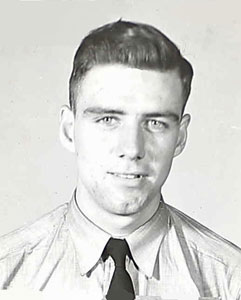
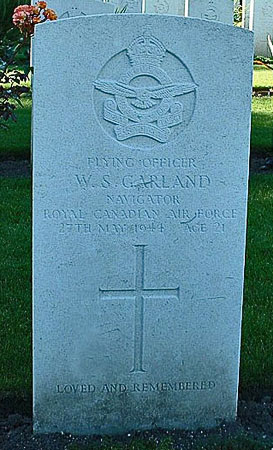
William Garland was born on 10th April 1923 at Toronto, Ontario, Canada and was the son of Harold and Bertha (nee Bown) Garland. He was still studying at technical college when he enlisted for RCAF service on 4th June 1942 in Toronto. After training in Canada he was awarded his air navigators' flying badge and also a commission on 25th June 1943. His postings in the UK are not yet known.
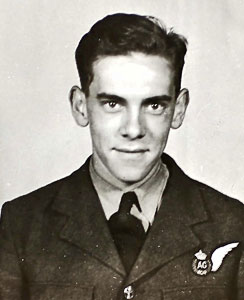
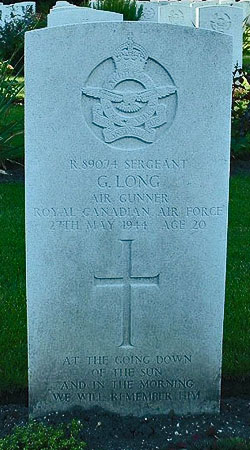
Gordon Long was born on 13th February 1924 in Toronto, Ontario, Canada and was the son of Hartley John and Margaret (nee MacLean) Long. After attending school he begun studying at college in Toronto but left in 1941 to enlist for RCAF service. In his service file it stated that he had "irregularly enlisted" for RCAF service to serve as an air frame mechanic. He served from February to December 1941 as he was too young to enlist at only sixteen and was forced to leave when his superiors found out. For most of 1942 he worked as a telephone installer for Northern Electric at Kitchener, Ontario. He re-enlisted for RCAF service on 16th November 1942 at Hamilton, Ontario to serve as aircrew. After basic training in Canada he was awarded his air gunners' flying badge on 3rd September 1943. On arrival in the UK he trained at 81 OTU and 28 OTU before posting to 1656 HCU in April 1944. His brother F/O Richard Hartley Long RCAF (J/19116) was killed flying with 409 Squadron on 16th March 1945.
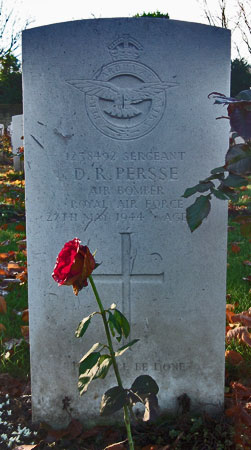

Donald Persse was the son of Thomas Robert Dudley and Hilda (nee Smith) Persse and was born on 23rd March 1914. He was educated at Gosport before emigrating to Canada in 1929. He returned to the UK ten years later.
Joseph Hetherington received a commission to the rank of P/O on probation on 28th February 1944. He was training with 1667 Heavy Conversion Unit on 19th March 1944 and flying Halifax EB149 on a training flight, the aircraft crashed near Crowle, Lincolnshire killing four of his orginal crew. He received injuries and was admitted to hospital. He had earlier trained at 18 OTU. When fit he was posted to 1656 HCU to resume his training.
Henry Walters had earlier served with and completed a Tour with 49 Squadron in F/O Fawke's crew. For service with them he was awarded the DFM, Gazetted on 18th May 1943. His medal set sold at auction in 1996.