During the afternoon of the 2nd May 1944 the crew of this 1659 Heavy Conversion Unit aircraft were undertaking training. There was a noticable gusty wind at the time. At 14.00hrs they had initially taken off from Topcliffe to begin a dual instruction short local flying exercise with F/O John Towse RCAF (J/17133) so that the instructor could assess them but also so that he could check that the wind was not too strong for them to then practice three engine flying. The wind was too gusty for the three engine flying at the height the aircraft was to be flying so they made a brief circuit of the airfield and landed. Prior to leaving the aircraft the instructor informed the trainee crew to then commence a local flying exercise to take in beam flying training, three engine flying (above 3,000 feet, where the wind would not be an issue) and a general local flying exercise. Across the runway in use at Topcliffe there was a noticable cross wind but this was not excessive. Minus the flying instructor the aircraft began to take off at 14.18hrs. It was seen to make a normal run down the runway to the point it left the ground. It then began to increase the angle of climb to around 90' and climbed sharply to around 400 feet off the ground, the airspeed then decreased, it then stalled, turned to port and dived into the ground with the airfield boundary. On impact with the ground near the base sewage works the aircraft exploded. With this being during the day and within the airfield site all of the brief flight and subsequent crash were witnessed by many people at the Topcliffe base. The base crash team and medics were immediately on the scene and cut their way into the rear of the aircraft, they managed to get to the rear gunner and dragged him clear but he was already dead. The rest of the aircraft was well alight so any rescue attempt for the other members of the crew was not possible. As there were numerous witnesses to the whole of the flight it was found that the aircraft had appeared to take off normally but that a problem must have been apparent immediately as the aircraft left the ground as no attempt to raise them was made. Because the undercarriage had not been raised led the investigation to suspect that the pilot and flight engineer must have been busy with some other situation. Due to the aircraft's forward part being destroyed by fire no firm reason for the crash was ever found. Nothing appeared to have been set incorrectly in the aircraft's control system so it was suggested that the pilot had become incapacitated as the aircraft left the ground, he had pulled back on the control column causing the aircraft to climb rapidly. The flight engineer would normally have been stood next to him at that time so it was suggested that he had then tried to grab the controls to level the aircraft out but this had not worked. This would then account for the undercarriage having not been raised by the flight engineer as he was busy fighting to control the aircraft instead.
Pilot - F/O John Lockwood McKinnon RCAF (J/27633), aged 20, of Port Arthur, Ontario, Canada. Buried Harrogate Stonefall Cemetery, Yorkshire (B/B/16).
Flight Engineer - Sgt Douglas William May Giles RAFVR (1605178), aged 20, of Trowbridge. Buried Trowbridge Cemetery, Wiltshire.
Navigator - F/O William Alexander Pope RCAF (J/28866), aged 32, of Halifax, Nova Scotia. Buried Harrogate Stonefall Cemetery, Yorkshire (B/B/17).
Bomb Aimer - F/O Malcolm Thomas Seabrook RCAF (J/28965), aged 28, of Kitscoty, Alberta, Canada. Buried Harrogate Stonefall Cemetery, Yorkshire (B/B/18).
Wireless Operator / Air Gunner - Sgt Edward John Donnelly RCAF (R/193801), aged 21, of Toronto, Ontario, Canada. Buried Harrogate Stonefall Cemetery, Yorkshire (B/B/13).
Air Gunner - Sgt Herbert Russell Davies RCAF (R/212758), aged 18, of Toronto, Ontario, Canada. Buried Harrogate Stonefall Cemetery, Yorkshire (B/B/15).
Rear Gunner - Sgt Harry Astrand RCAF (R/196182), aged 21, of Port Arthur, Ontario. Canada. Buried Harrogate Stonefall Cemetery, Yorkshire (B/B/14).
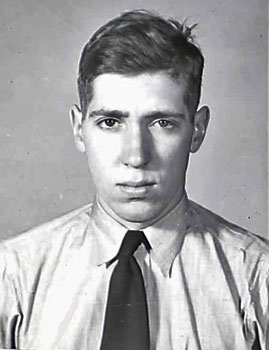
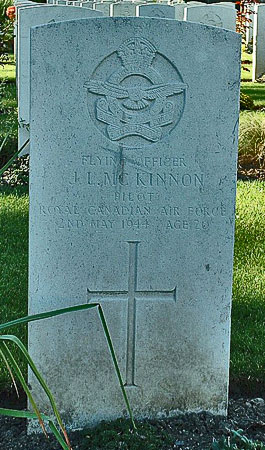
John McKinnon was born on 16th November 1923 at Port Arthur, Ontario, Canada and was the son of William Archibald and Mary Helen (nee Street) McKinnon. He was at still college when he enlisted for RCAF service on 24th April 1942 at Port Arthur. After basic training in Canada he was awarded his pilots' flying badge and also a commission on 25th June 1943. He was posted to the UK the following month and trained at 6 (P)AFU, 1517 BAT Flight and 82 OTU before posting to 1659 HCU on 17th April 1944.
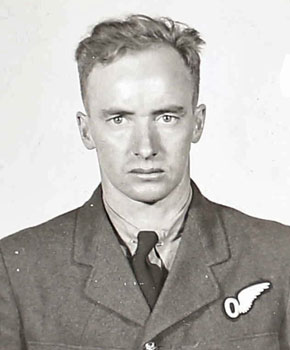
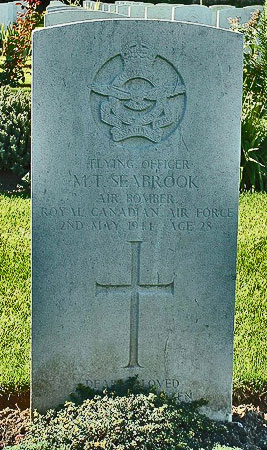
Malcolm Seabrook was born on 6th September 1915 at Stettler, Alberta, Canada and was the son of Frederick Charles and Millicent Jane (nee Till) Seabrook. As a young man he worked for a gold mining and smelting company, as a labourer for the Canadian National Railways and as a self-employed carpenter. He enlisted for RCAF service on 25th November 1940 for ground duties and served as an air frame mechanic until December 1942. He served in Canada at Patricia Bay and Coal Harbour with 120 RCAF Squadron. He then remustered for aircrew duties and after training was awarded his air bombers' flying badge and also a commission on 6th August 1943. On arrival in the UK he trained at 1 (O)AFU and 82 OTU before posting to 1659 HCU on 17th April 1944.
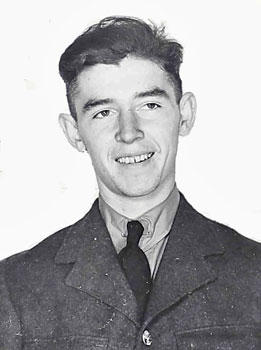
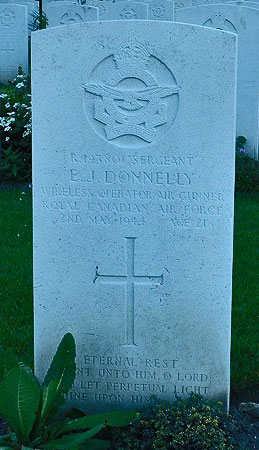
Edward Donnelly was born on 22nd August 1922 at Toronto, Ontario, Canada and was the son of Edward and Margaret (nee Doyle) Donnelly. Both his parents were born in Scotland but had emigrated to Canada. As a young man Edward left school in 1940 and worked at a number of jobs until enlisting for RCAF service on 24th September 1942. He trained as a wireless operator / air gunner, receiving his flying badge on 6th September 1943. On arrival in the UK he trained at 2 (O)AFU and 82 OTU before posting to 1659 HCU on 17th April 1944. His brother Charles Francis Donnelly RCAF (J/43427) served in the UK at the time of Edward's death.
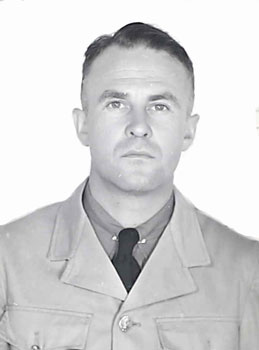
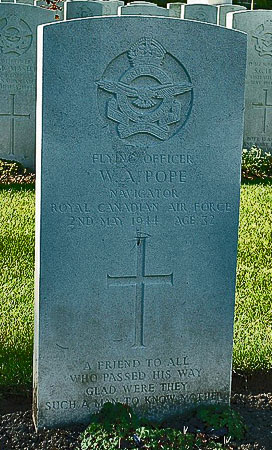
William Pope was born on 21st September 1912 at Halifax, Nova Scotia and was the son of Percy Clarmont and Edith St.Clair (nee Stephen) Pope. At the age of thirty two he would have been the old man of this crew. William left school in 1928 and begun working for the Royal Bank of Canada. He remained in the service of this bank for the next thirteen years reaching the position of assistant manager. He moved to Toronto to work in the Royal Bank, possibly having previously worked at Hamilton, Ontario and Montreal, Quebec prior to this. During his time with the bank he became a Fellow (Honors) of the Canadian Bankers Association. When he enlisted for RCAF service the President of the Royal Bank of Canada stood as one of his referees, he appears to have been a well respected young man in the banking industry. He enlisted for RCAF service on 30th July 1942 in Toronto and received basic training in Canada, being granted his air navigators' flying badge, and also a commission on 6th August 1943. On arrival in the UK he trained at 4 (O)AFU and 82 OTU before posting to 1659 HCU on 17th April 1944.
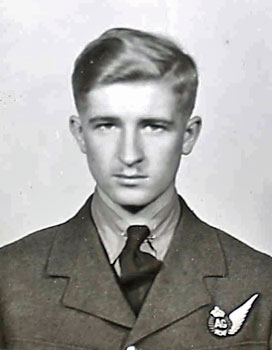
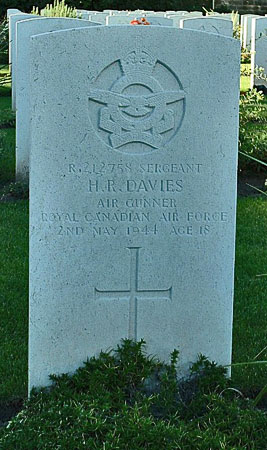
Herbert Davies was born on 19th May 1925 at Havelock, Ontario, Canada and was the son of Herbert and Ellen May (nee Wallbank) Davies. Both his parents were born in The Midlands of England and emigrated to Canada. After leaving school in 1941 Herbert worked at a service station and latterly as a salesman. He enlisted for RCAF service on 11th December 1942 in Toronto and after training in Canada was awarded his air gunners' flying badge on 15th October 1943. On arrival in the UK he trained at 82 OTU before posting to 1659 HCU on 17th April 1944.
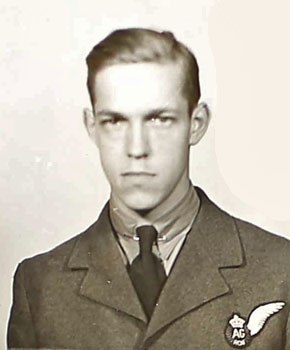
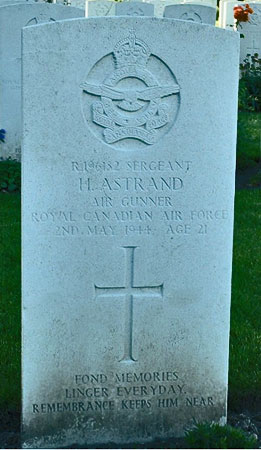
Harry Astrand was born on 28th February 1923 at Port Arthur, Ontario, Canada and was the son of Henry and Georgina (nee Berry) Astrand. As a young man he worked for the Canadian National Railways before returning to school. He later worked as an office clerk in a dairy and latterly for the Canadian Car and Foundary company at Fort William, Ontario. This company were involved in manufacturing for the War Effort with this including the production of Hawker Hurricanes on contract. Harry enlisted for RCAF service on 7th November 1942 at Port Arthur and after initial training in Canada was awarded his air gunners' flying badge on 15th October 1943. On arrival in the UK he trained at 82 OTU before posting to 1659 HCU on 14th April 1944. I would suggest that he and his pilot John McKinnon knew each other back home and formed part of the same crew when they met up in the UK. He is remembered at the Hillcrest High School on their "Stairway of Honour".