This 429 Squadron aircraft was being given an air test on 3rd April 1943 when it clipped high tension electric cables on a hillside in the Upsall area whilst flying roughly north west of Thirsk. The pilot attempted to regain control and turned the aircraft around back towards Thirsk. Height was lost and it eventually clipped trees and then crashed almost four miles away at 15.30hrs just east of Manor Farm, South Kilvington injuring all those on board. A small fire broke out after the crash. Some of those on board were lucky to survive having being rescued and treated on the scene of the crash by a nursing orderly who was on board for air experience. Sgt Nicoll is thought to have sustained the most serious injuries, he broke both right and left tibula and fibia and there is a suggestion that at least one leg was amputated. The location given in RAF records was Broad Farm, however there is no such location. A possible explanation of this could be that the Broadwith family owned Manor House Farm at the time of this accident and sometimes the RAF appear to have recorded the owners name rather than the actual farm name on the crash report.
No navigator is listed as being in this aircraft at the time however this crew's regular navigator was a Sgt Howard Allen Tennis RCAF. It would appear correct that he was not in Z1670 when ir crashed as the AM Form 1180 listed seven being in it at the time of the crash. The seven are named below. Sgt Tennis unfortunately lost his life on 13th May 1943 when Wellington HE423 was shot down on Ops to Duisburg.
Wellington Z1670 was built to contract B.97887/40 by Vickers Armstrong's Ltd. at Hawarden and on 14th April 1942 it was delivered to 38 MU at Llandow. On 1st December 1942 it was taken on charge by 196 Squadron at Driffield. The aircraft was transferred to 429 Squadron at East Moor on 5th December 1942. As a result of the crash near South Kilvington on 3rd April 1943 Cat.E2/FA damage was the damage assessment. It was struck off charge on 10th April 1943 and had clocked up a total of just over 136 flying hours.
Pilot - Sgt David MacMaster Smith RCAF (R/106305). Injured.
Bomb Aimer - F/Sgt Douglas Rae Nelson RCAF (R/114313). Injured.
Wireless Operator / Air Gunner - F/Sgt W J Nicoll RCAF (R/114016). Injured.
Air Gunner - F/Sgt Raymond Thomas Crimmins RCAF (R/131089). Injured.
Passenger / Fitter - Cpl Henry Edward Butler RAF (641177). Injured.
Passenger / Fitter - Cpl Thomas Charles Lane RCAF (R/62355). Injured.
Passenger / Nursing Orderly - Cpl John Lightfoot Maddox RCAF (R/90215). Injured.
John Maddox received a first Mention in Despatches on 27th July 1944 for his medical work in connection with aircraft casualities. He received a second Mention in Despatches on 1st January 1945 but this orginated as a recommendation for a British Empire Medal in August 1944 when he was a Wardmaster at Topcliffe airfield. This recommendation stated.."During the three and one half-years that this Non-Commissioned Officer has been in service in Great Britain he has proven to be an outstanding and reliable medical Non-Commissioned Officer. His experience has been varied, and has been instrumental in the opening up of new sick quarters, "R" Depot Warrington, RCAF Eastmoor, RCAF Tholthorpe, as well as the changing over of sick quarters at Linton Station. This involved the setting up of the administrative procedure, and in each instance the routine of the hospital was in efficient operation in record time. In April 1943, whilst a passenger in a Wellington aircraft, where he was injured himself, he was successful in removing two of the crew, resulting in their lives being saved. His knowledge and cool-headed performance in regard to aircraft casualties are outstanding, and his devotion to duty merits him worthy of the award of the British Empire Medal."
David Smith was born in Winnipeg in 1922 but lived at St.James, Manitoba when he enlisted in Winnipeg in May 1941. After training he (along with Nelson, Nicholl and Crimmins) was posted to 429 Squadron on 27th December 1942. This crew flew Wellington Z1670 on a handful of operational flights in the months leading upto the accident near Thirsk in April 1943. Sgt Smith was soon back in the air following his mishap near Thirsk and on the night of 25th/26th June 1943 he was the pilot of Wellington HF495 detailed to attack Gelsenkirchen when the aircraft was attacked by an Me110 which injured the wireless operator and bomb aimer (Sgt Nelson) and also set fire to the aircraft. Sgt Smith put the aircraft into a dive which eventually put the fire out and he was able to make a crash-landing at Hardwick on their return to England without further injuries to the crew. For his actions on this night he was awarded the DFM, Gazetted on 27th July 1943. Hugh Halliday's research into RCAF awards has found the citation for this award which reads.. "This airman was the pilot of an aircraft which attacked Gelsenkirchen one night in June 1943. On the return flight the bomber was attacked by an enemy fighter and sustained damage to the fuselage, the hydraulic system and the wireless equipment, while two of the crew were wounded. A fire broke out in the bomb bay but Sergeant Smith violently dived his aircraft and the flames were extinguished by the force of the wind. On reaching an airfield in this country he effected a successful crash landing. Sergeant Smith displayed great skill and resource in harassing circumstances."
Exactly a month later on the night of 25th/26th July when returning early from Ops to Essen with the navigation aids having failed when his aircraft overshot on landing at East Moor with slight damage to Wellington HE350. On the night of 3rd/4th August 1943 his Wellington was slightly damaged by flak from a ship but he was able to land safely without further damage. On 25th November 1943 WO2 Smith DFM and WO2 Nelson were in Halifax LK995 which was shot down on Ops and both men were taken PoW.
Douglas Nelson was born in May 1920 in St.Catharines, Ontario. His family moved to North Tonawanda, New York State, USA when he was young but he returned to his native Canada to enlist into the RCAF in 1941. While stationed at East Moor he would meet his future wife. After being liberated in 1945 he returned to England and married before returning to Canada together. Also of interest is that in 1955 they and their two children returned to Yorkshire to live where he started a motor mechanic buisness and later ran a service station at Green Hammerton, between York and Harrogate. Douglas Nelson died in North Yorkshire on 3rd May 1997.
Raymond Crimmins was born on 2nd May 1916 in Galena, Illinois, USA and was the son of Thomas and Lucy (nee Hourahan) Crimmins. Both his parents were natives of Iowa, USA but the family had moved to Cuba City, Wisconsin, USA by 1930 where Raymond attended school. In 1936 he was working as a clerk in Detroit, Michigan. He enlisted for RCAF service on 10th September 1941 in Hamilton, Ontario. After training in Canada he was awarded his Air Gunner's Badge on 11th May 1943. He was posted overseas the following month and trained at 7 AGS and 22 OTU before posting to 429 Squadron on 27th December 1942. He married Marie Finetta Williams, of Aberkenfig, Glamorgan, in Aberkenfig on 10th April 1943, just seven days after the crash near Thirsk in which he was injured and while he was on sick leave. Sadly WO2 Raymond Crimmins was to be killed on 14th May 1943 when Wellington HE423 was shot down by a nightfighter on Ops and crashed in Holland. He was twenty seven years old. He is buried in Amersfoort General Cemetery.
Thoms Lane received a Mention in Despatches on 14th June 1945 and was at that date serving at Skipton on Swale airfield.
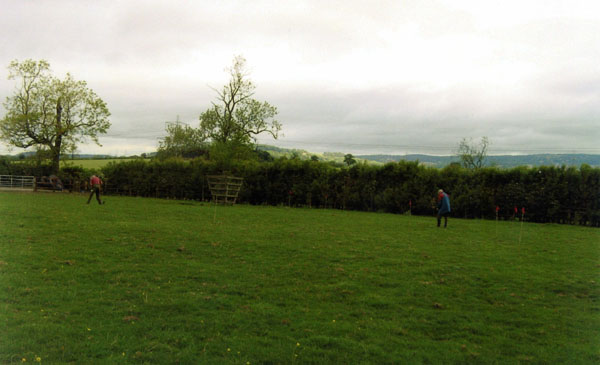
Historians Eric Barton, Ken Reast and Albert Pritchard sought permission from the landowner and located small fragments of the aircraft on the surface near Manor Farm, South Kilvington in May 2007 to confirm the location.