Halifax W7856 at Burn airfield.
On 6th April 1943 the crew of this 1658 Heavy Conversion Unit aircraft were about to undertake a daytime training exercise using Burn airfield (instead of their parent Riccall airfield) but just after leaving the ground at Burn the pilot attempted to reduce the revs on all the engines. The revs on the port outer engine did not reduce with the control being throttled back and the engine remained at full power. The flight engineer then reported a glycol leak in port outer engine and despite the pilot attempting to feather the propeller on the engine it had no effect. As the aircraft was still in the circuit of Burn airfield the pilot opted to fly a circuit and attempt a landing but as the aircraft turned the offending engine caught fire. The fuel was cut off and the fire extinguisher used but this had little effect so the pilot made a crash landing with engine on fire at 12.10hrs with the fire spreading. The undercarriage collapsed on landing and the aircraft skidded to a halt and caught fire. All on board escaped although the pilot sustained second degree burns. The port outer engine was later stripped and inspected, it was found to have had a fractured crankshaft. The pilot was commended for his actions in bringing the aircraft down safely and given a Green Endorsement in his logbook.
Pilot - Sgt Albert Thomas Fraser RAAF (416561), of Kilkenny, South Australia. Burns to hands and forehead.
Flight Engineer - Sgt Willie Morse RAF (622725). Uninjured.
Bomb Aimer - Sgt R N Brand RAFVR (1391823). Slightly injured.
Air Gunner - Sgt Ronald Frank Glass RCAF (R/180332). Uninjured.
Air Gunner - Sgt Harry Edwards RAF (618706). Uninjured.
Albert Fraser was born on 15th May 1920 to Thomas and Lilian Fraser of Whitburn, West Lothian, Scotland. His family moved to Australia when he was young. When he enlisted into the RAAF in Adelaide on 21st July 1941 he was working as a hardware salesman for a company based in Adelaide. He had already served in the Australia Army "27th Battalion" for over three years before enlisting into the RAAF. His parents were living in Kilkenny, South Australia at that time he enlisted. He was awarded his Wings on 2nd April 1942 and after completing his basic training he left Australia on 16th June 1942, he arrived in England on 25th August 1942, trained at 15 (P)AFU begining on 11th September 1942, 24 OTU begining 10th November 1942 and 1658 HCU begining 19th March 1942. He was admitted to the RAF hospital at Rauceby to have his burns treated following the mishap at Burn on 6th April 1943 and was released from Rauceby on 28th April 1943 to return to 1658 HCU but was immediately posted on sick leave until 19th May 1943. He appears to have rejoined his crew and on completion of his training at 1658 HCU he was granted eight days privilage leave before he was posted with all of the above named to 102 Squadron on 22nd June 1943. F/Sgt Fraser was twenty three years old when he was killed.
Halifax W7856 was built to contract B.73328/40 by Handley Page Ltd. at Radlett and was taken on charge by 78 Squadron at Linton on Ouse at 17th September 1942. On 11th December 1942 this aircraft was being flown on an operational flight to Turin when, on the return journey over Switzerland the aircraft iced up and all the engines cut out. The then pilot ordered the crew to abandon the aircraft as it went into a spin. Almost immediately the engines picked up again and control was regained. The rest of the crew landed at Manston airfield. Unfortunately the rear gunner, P/O Wilby, had already attempted to leave the aircraft over Switzerland but become stuck by his right leg. His parachute opened and dragged him out of the aircraft but broke his leg. He subsequently landed near Marboz, France. He was found and taken to a French hospital but some weeks later was helped to escape and managed to evade capture. P/O Thomas Richard Wilby RCAF (J/15138) was later awarded the DFC, Gazetted on 6th July 1943. Returning to the history of the aircraft, on 21st December 1942 it was transferred to 77 Squadron at Elvington. On 28th February 1943 it was transferred to 1658 Heavy Conversion Unit at Riccall. As a result of the crash near Burn on 6th April 1943 Cat.E2/FA Burnt damage was the damage assessment. The aircraft was struck off charge on 14th April 1943, it had clocked up a total of 196 flying hours.
All of the above named were posted to 102 Squadron on completion of their course at 1658 H.C.U. and began working up to being an operational crew. On the night of 9th/10th July 1943 all were flying in Halifax BB249 tasked with an operational flight to bomb Gelsenkirchen, their aircraft was attacked by a night fighter and shot down, sadly Fraser, Morse and Glass on were killed when the aircraft crashed in Belgium. All are now buried in Florennes Communal Cemetery, Belgium. Three of the crew survived including Edwards and Brand and became PoW's. The following link has further details about this incident. "mellorview.wordpress.com/2012/06/28/per-ardua-ad-astra/".
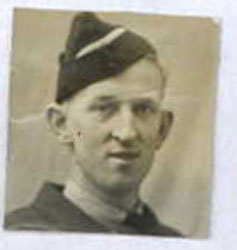
Ronald Glass was the son of Hilliard Clarke and Laura Edith Glass, of Kirkfield Park, Manitoba, Canada and was born on 20th July 1922. He was twenty years old when he died as a result of the crash of Halifax BB249 in Belgium.
Harry Edwards was killed in the crash of Wellington BK214 at Hutton Cranswick on 27th June 1946 while serving with the CGS at Leconfield. He is buried at Buried Streatham Park Cemetery, Sussex.