On the night of 27th / 28th September 1943 the crew of this aircraft were undertaking a training exercise as part of their training at 1667 Heavy Conversion Unit. 1667 H.C.U. had just moved to Faldingworth airfield from Lindholme airfield some days earlier. The crew of this aircraft took off from Faldingworth at 20.10hrs to undertake what was known as a Bullseye training flight. This would involve the crew navigating a route to a British town or city and undertake a simulated bombing run over a selected target, not only would it test the aircraft's crew but also military personnel on the ground would be given an opportunity to test their equipment in range setting and tracking the aircraft. Four hours into the flight the aircraft flew from the south and passed towards the western side of York and was flying in cloud, the weather conditions were found to have caused the eventual crash. At ground level it was raining heavily but at between 4,000 and 10,000 feet in the air icing conditions would have effected the aircraft's flying and control surfaces. It was believed that because the aircraft had iced up the pilot had lost control and the aircraft then entered a steep and very fast dive from which the pilot was not able to recover the aircraft from. At the very high speed attained in a fast dive the early Lancaster was known to suffer structural failure, it was thought in this case that the speed the aircraft reached caused the total break-up of the aircraft in the air. At around 00.08hrs various sections and parts of the aircraft crashed over a two mile track in fields around Cock Hill area. The break-up may have started on the northern side of the Rover Ouse. Wing parts fell near Red House; on the south side of the River Ouse just south of Beningbrough. Other parts came away and it finally crashed either into or very close to a wooded area nearer Cock Hill with the loss of the whole crew. A detailed investigation followed to find the cause of the structural break-up of the aircraft and the Accident Investigation Branch compiled a full report on this incident (now located in the UK National Archives as AVIA5/22 : Report No.1670) concluding that there was little the inexperienced pilot could have done once control was lost in such weather and flying conditions.
Pilot - Sgt Lawrence Richard William Turley RAFVR (1387018), aged 22, of East Finchley. Cremated East Finchley, London.
Flight Engineer - Sgt Martin Raymond Pearce RAFVR (1808544), aged 19, of Hampton, Middlesex. Buried Camberwell New Cemetery, London.
Navigator - Sgt Arthur Howell RAFVR (1395412), aged 20, of Paddock Wood. Buried Paddock Wood Old Churchyard, Brenchley, Kent.
Bomb Aimer - F/Sgt Adam William Joseph Mullen RCAF (R/154030), aged 28, of Upper Darby. Pennsylvania, USA. Buried Harrogate Stonefall Cemetery, Yorkshire.
Wireless Operator / Air Gunner - Sgt Roger Pickering Weston RAFVR (1131503), aged 22. Buried Sunderland (Ryhope Road) Cemetery, Durham.
Air Gunner - Sgt Douglas Roy Brown RCAF (R/194139), aged 21, of Plaster Rock, New Brunswick, Canada. Buried Harrogate Stonefall Cemetery, Yorkshire.
Air Gunner - Sgt Reginald Eric Butler RAFVR (1388968), aged 20. Buried Harrogate Stonefall Cemetery, Yorkshire.
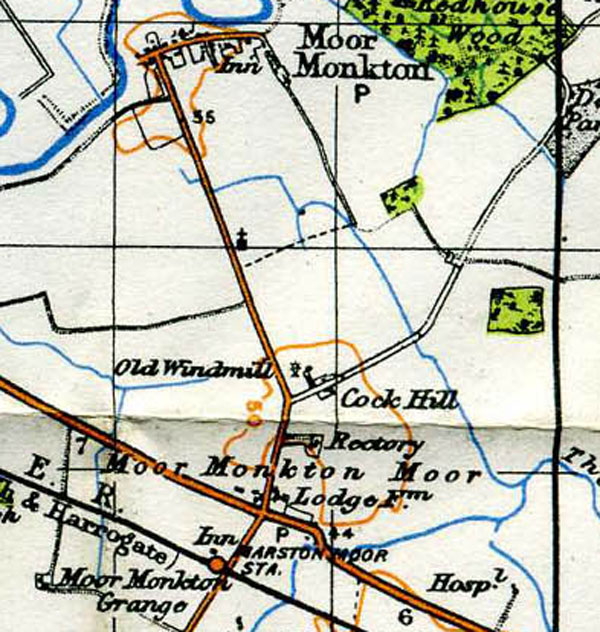
The extracts of the various documents and accident records shown here give a good example of how serious fatal accident's location can be researched. The incident is also recorded briefly in the 1667 H.C.U. and Faldingworth station records as crashing in the Marston Moor area. The map above shows the general area of the crash, Cock Hill, Moor Monkton and Marston Moor railway station all shown. Extract from the war series map of the correct date for the accident.

An extract from the "A.M.Form 765c" given in Adam Mullen's service file stating it crashed near Marston Moor.
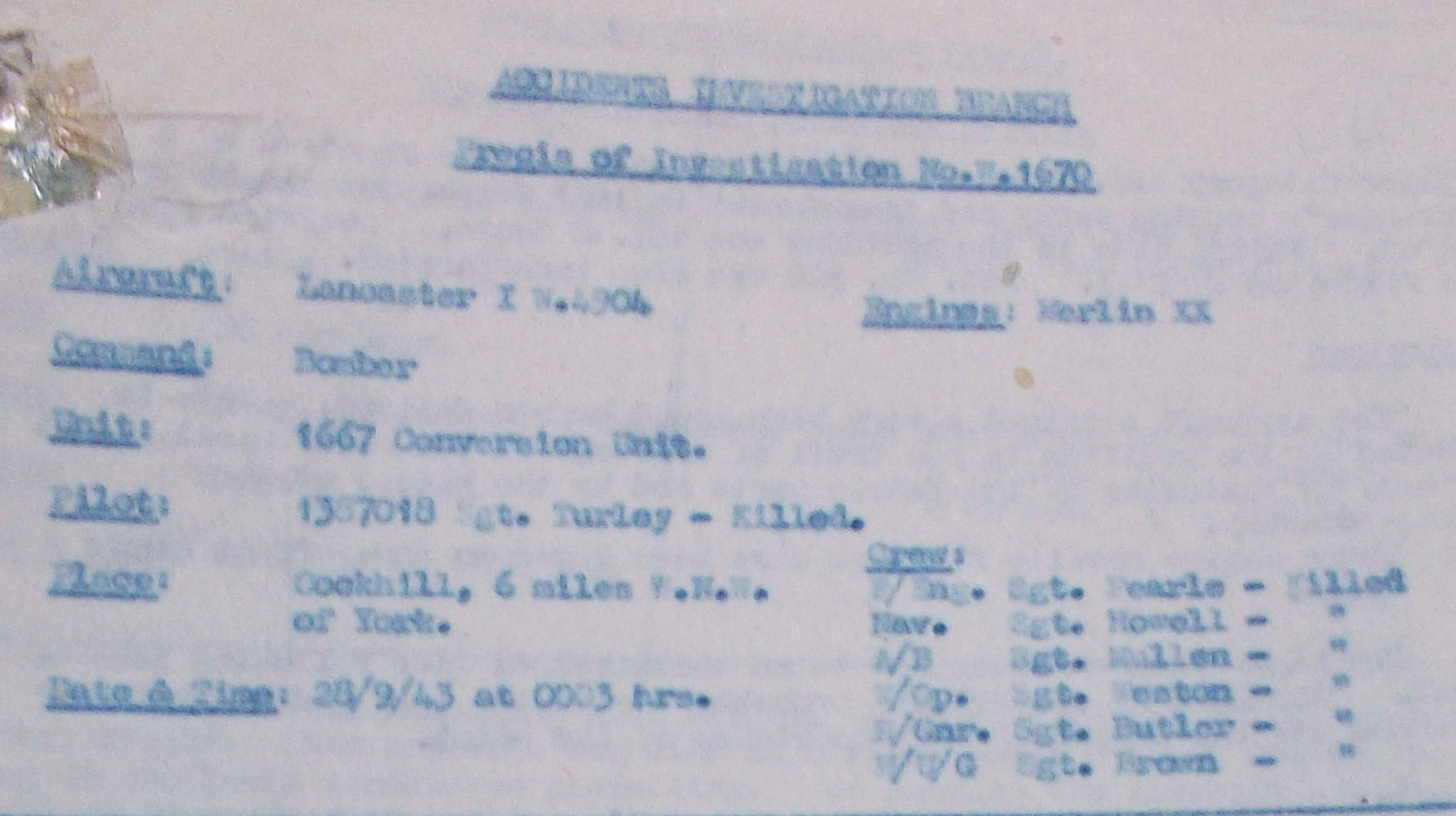
An extract from the AIB report "AVIA5/22, Rep.No.1670" stating "Cockhill, 6 miles W.N.W. of York".
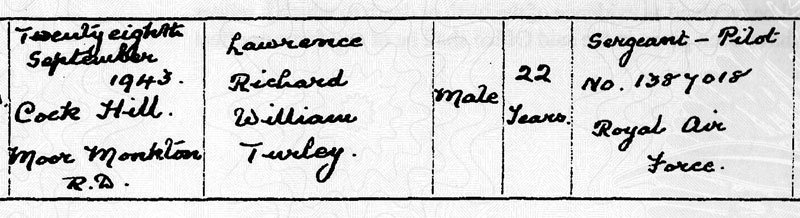
An extract from the pilot's death certificate stating "Cock Hill, Moor Monkton R.D." (R.D being Rural District). Registered in the Whixley sub-dictrict of the Great Ouseburn registration district.

Sgt Reginald Butler's gravestone in Harrogate Stonefall Cemetery.
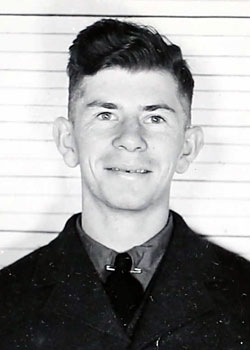
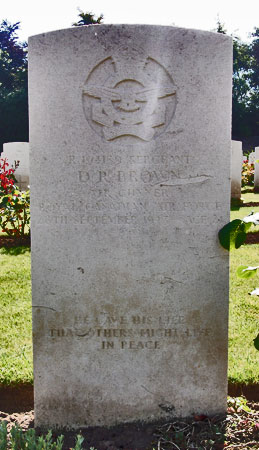
Douglas Brown was born on 17th June 1922 at Plaster Rock, New Brunswick, Canada and was the son of Alexander and Verlie (nee Campbell) Brown. After leaving high school he worked for Canadian Vickers in Montreal as an office clerk, possibly in their ship building branch of buisness, before enlisting for RCAF service. After enlisting into the RCAF on 22nd September 1942 in Montreal he trained as an air gunner and received his flying badge on 11th June 1943. He was then posted to the UK soon after and had trained at 81 OTU before posting to 1667 Conversion Unit on 10th August 1943.
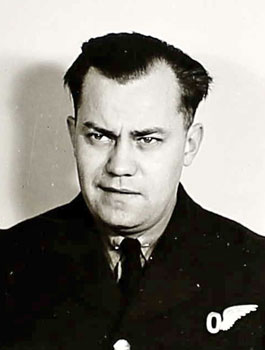
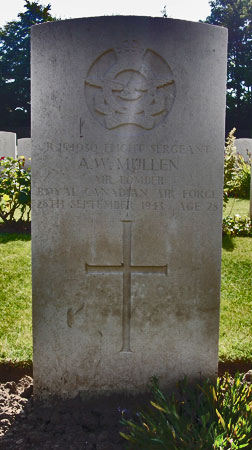
Adam Mullen was born on 9th May 1915 in Philadelphia, Pennsylvania, USA and was the son of Adam William (Snr) and Jane V (nee McElwee) Mullen. Having left high school in 1934 he undertook a number of different jobs locally, with the last being as an assistant manager at an automotive accessory store. He enlisted for RCAF service before the USA entered the war in Europe, enlisting on 28th January 1942 in Montreal, Canada. He enlisted for aircrew service and appears to have initially trained as an observer but was later transferred for bomb aimer training. He was awarded his Air Bomber's flying badge after basic training in Canada on 23rd December 1942. After a period of leave he left for the UK in January 1943 and on arrival in the UK trained at 4 AOS and 81 OTU before posting to 1667 on 1667 HCU on 11th August 1943.
Information found in both the Canadian service files of Adam Mullen and Douglas Brown have been used in compiling this webpage.
According to the AM. Form 78, Lancaster W4904 was built by Metro Vickers to contract 69275/40. It was flown to A.V.Roe Ltd on 17th February 1943 and then on to 5 MU on 28th February 1943 for preparation for operational use. The AM78 states it was then taken on charge by 83 Squadron on 13th April 1943 and it appears in their unit records as being coded "-C". On the night of 11th / 12th June 1943 while on an operational flight to bomb Dusseldorf it was coned in searchlights over Krefeld and received flak damage across the tail of the aircraft. The pilot was able to return safely to base of Wyton. The damage may have taken some time to repair as it was replaced by Lancaster EE175 as "C" by mid-July 1943 and W4904 was not used operationally during this period. The AM78 gives the date of the Cat.Ac damage as being on 13th July 1943 and if this is correct then it was damaged again non-operationally. Repairs were carried out on site and it was returned to 83 Squadron on 30th July 1943. I think what actually happened is that it sustained the damage on 12th June 1943 but the damage was not repaired possibly due to lack of parts. It was then re-assessed on 13th July 1943 once the parts arrived, repaired and returned to 83 Squadron. Their record book is hard to read for early August 1943 though it does appear to list it being used once operationally on 7th / 8th August 1943. It then passed to 1667 HCU on 28th August 1943 and sustained Cat.E2/FA damage as a result of the crash on 28th September 1943. It was struck off charge on 10th October 1943 once the paperwork went through. It had flown just over 158 hours.
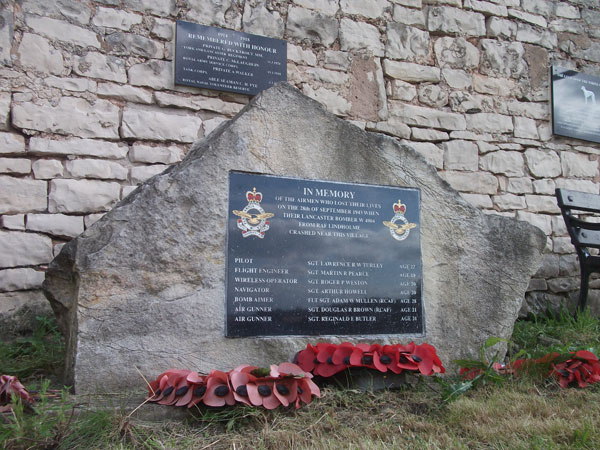
Unfortunately due to the aircraft's AM Form 1180 only stating that the crash occurred at "Cock Hill, Yorkshire" this was later misidentified as being the Cockhill, near Old Edlington, South Yorkshire when William Chorley created his Bomber Command Losses H.C.U. book. I would suggest because he made a quick check on an atlas and came up with Cockhill, Edlington as being the only one listed. While his series of books were generally superb and a turn-to reference there are the odd error within them and anyone researching any a specific incident does need to do their own research not just read a book there by claiming the book as fact. This error was copied into Guy Jefferson's old database on crashed aircraft in Yorkshire (housed at the Yorkshire Air Museum, though now taken off public display). The error also found it's way into the new I.B.C.C. database though their archivist has told me that he simply copied Chorley's book and believed it as fact without checking himself and has corrected the I.B.C.C. records having seen the source documentation. Having used death registrations (which state the deaths occurred in the Moor Monkton rural district of the wider Great Ouseburn district of Yorkshire), the accident report A.M.Form 765c (which states it crashed "one mile north west of Marston Moor railway station" and also that it was heard by flying control at Rufforth airfield), an ARP record (although rather brief, in stating "British plane crashed and on fire" near Marston Moor), the AIB report referenced above (which gives the location as being "Cock Hill, 6 miles WNW of York"), the 1667 H.C.U. orb and Faldingworth airfield station record book I am firmly in the belief that it absolutely DID NOT crash near Cockhill, Old Edlington, South Yorkshire.
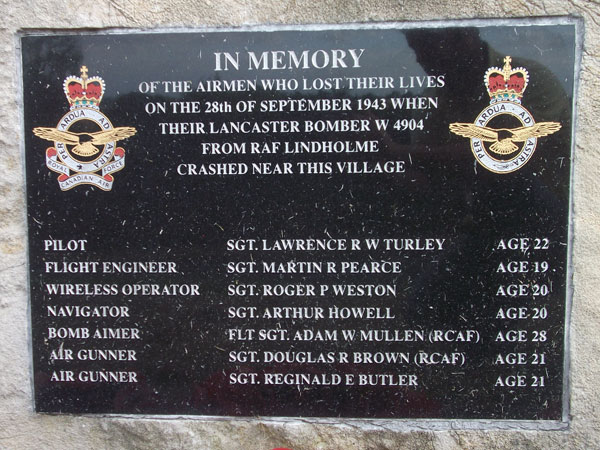
For whatever reason when an Old Edlington resident came to enquire about creating a memorial to the crew of Lancaster W4904 the local council and also the district council carried out no research of their own before granting funding. So through the superb efforts of this Edlington resident funding was received and a memorial was erected and dedicated in 2012 in Cockhill, Old Edlington. Caroline Flint MP was in attendance and the BBMF Lancaster gave a flypast. The story was also covered in Flypast magazine. A fantastic achievement by the individual concerned. I expressed my concerns to the local council not long after the well publicised memorial dedication happened and received a negative response from the council. Some years later other people local to Edlington began to research the accident properly and between us the council finally came to accept our research. I photographed the memorial in it's original position during the first years of it being in the wrong village and the photographs are shown here. Please note; to any potential visitors, the memorial plaque was removed during early 2020 and was donated to Moor Monkton council later in 2020 once Covid-19 restrictions lifted. The plaque is due to be re-dedicated at Moor Monkton close to the eightieth anniversary of the accident in September 2023.
The memorial base at Edlington was retained and a superb plaque to the village's WW1 casualties is a worthy replacement.