On 8th January 1943 this 1659 Heavy Conversion Unit aircraft was being flown on a cross country training flight when poor weather at Leeming resulted in it being diverted to land at Catfoss. Fog prevented any return of the aircraft until 13th January 1943. On 13th January 1943 an instructor and flight engineer of the unit were ferrying it back to Leeming from Catfoss airfield when both port engines failed in the Pickering area, the weather was also poor so the pilot was flying at 300 feet to keep the ground in sight. Unable to maintain height on two engines it was force landed with the wheels down in a small field at 15.55hrs in the vicinity of Normanby Manor, 1.5 miles North of Little Barugh and near to Riseborough Hall. Just prior to landing in the field the pilot noticed a house at the end of a longer field he had selected so had to land in a shorter field and overran through a hedge into a very wet ploughed field. No serious injuries occurred after the aircraft tipped up onto it's nose and sustained some damage. There was no navigator or wireless operator in the aircraft for this flight. The cause of the incident was put at there being little fuel in the tanks when it took off and when these ran dry the engines on the port side failed.
Pilot - P/O Murray Stanley Fuller Schneider RCAF (J/16432). Uninjured.
Flight Engineer - Sgt William Nicholas Bingham RAF (613654). Slightly injured.
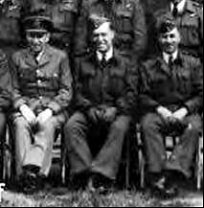
Murray Schneider was born in Oak River, Manitoba, Canada to Monague and Annie Schneider on 3rd March 1921. He enlisted into the RCAF in August 1940 and left Canada in May 1941 after initial training. After arriving in England he continued his training at 10 OTU before posting to 10 Squadron at Leeming in August 1941. He was involved in a more serious accident near Northallerton on 15th January 1942 when Halifax L9622 crashed just north of the town on return from an operational flight to bomb Hamburg, the aircraft suffered engine trouble and crashed. All on board suffered very serious injuries including Sgt Scheider who sustained serious head injuries. His crew would not survive the night and all six died. After a lengthy period in hospital Schneider returned to flying and involved in instructing at 1659 HCU when this incident at Riseborough occured. On 26th June 1943 he was still instructing with 1659 HCU when again he had to force land after a multi-engine failure in Halifax V9984 at Brafferton, Yorkshire. The aircraft was written off. He was later posted back to operational flying and was lost on 9th October 1943 when 405 Squadron Lancaster JA980 was shot down by a night fighter. Five were killed and there were two who became PoW's. Schneider is buried in Hannover War Cemetery. His age on the CWGC database is not given. Also on this aircraft was the flight engineer from 408 Squadron Halifax JD174 which crashed on the North Yorkshire Moors in 1943 near Hawnby. Both had been posted to 405 Squadron for Pathfinder duties.
William Bingham was granted a commission in November 1943. He was later posted to 156 Squadron as their squadron engineering leader. He flew eight operational flights with them before being killed on 30th December 1944 when Lancaster PB621 failed to return from an operational flight to Cologne. He is buried in Rheinberg War Cemetery. He was twenty five years old.
Halifax W1150 was built to contract B982938/39 by English Electric Co.Ltd at Samlesbury and delivered directly to 78 Squadron at Croft on 2nd June 1942. It was used by 78 Squadron on operations for the first time on 22nd June 1942. On 25th June 1942 it was lent to 76 Squadron to be used on the Thousand Bomber raid. 76 Squadron and 78 Squadron were sharing Middleton St.George airfield at the time. When it was returned to 78 Squadron after this is not yet known but it was then formally transferred to 78 Squadron on 1st August 1942 and it was used on operations with 78 Squadron on 5th August 1942 and also 11th August 1942. It received battle damage on 11th / 12th August 1942 that saw a Cat.Ac/FB damage assessment made on 12th August 1942. A repair on site was carried out and it was returned to 78 Squadron charge on 21st November 1942. On 25th November 1942 it was transferred to 1659 Heavy Conversion Unit who formed at Leeming on 7th October 1942. It suffered Cat.B/FA damage in the incident at Riseborough on 13th January 1943. It was then removed by road and repaired in works by Handley Page. Upon completion of repairs it was flown to 48 MU on 4th May 1943 where it was stored until being issued to 1661 H.C.U. at Winthorpe on 26th October 1943. It was transferred to 1662 H.C.U. at Blyton 3rd December 1943. The aircraft remained at 1662 H.C.U. for the next year. On 18th December 1944 it was flown to 48 MU but on 25th January 1945 it was deemed to have deteriorated beyond repair during an inspection so was struck off charge.