Halifax V9988 near Kelfield.
At 22.08hrs on 26th February 1943 the crew of this 1658 Heavy Conversion Unit aircraft took off from Riccall airfield so the crew could undertake a night time local flying training flight. It was believed that one of the port engines failed as it was taking off and the aircraft would not climb after becoming airborne. It continued to fly at a low height until crashing into trees near Manor Farm, Kelfield at 22.10hrs. Three of the died as a result of the accident and at least two others were injured. An investigtion found that the spark plugs on the engines had oiled-up due to the engines being left idling for too long on the ground before take off.
Pilot - Sgt Thomas Melville Law Dingwall RAFVR (1344874), aged 28, of Kirkcaldy. Buried Bennochy Cemetery, Kirkcaldy, Fife.
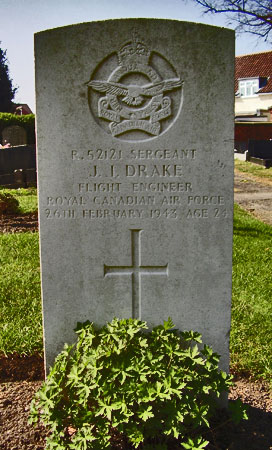
Flight Engineer - Sgt James Isaac Drake RCAF (R/52121), aged 24, of Strathroy, Ontario, Canada. Buried Selby Cemetery, Yorkshire.
Navigator/Bomber - Sgt Edward John Wood RAFVR (1331631), aged 20, of Kensal Rise, London. Buried Willesden New Cemetery, Middlesex.
Wireless Operator / Air Gunner - Sgt Ifor Davies Williams RAFVR (1128921). Injured.
Air Gunner - Sgt Ronald James Ball RAFVR (1321859). Injured. Burns to hands and face.
Any other crew - Names unknown.
Sgt James Drake's grave in Selby Cemetery. He was born on 30th August 1918 in Caradoc, Ontario, Canada and was the son of Isaac N and Eliza Columbus Drake. The family later moved to Strathroy, Ontario, Canada. He was working as a cabinet marker and carpenter after leaving school. He enlisted for RCAF service on 18th October 1939 in London, Ontario for ground duties and trained as an air frame mechanic joining 112 Squadron on 21st May 1940 in Canada but went overseas with them on 20th June 1940. He later saw service with 110 Squadron (beginning) on 31st July 1940, 400 Squadron and 407 Squadron (beginning) on 7th November 1941. He was attached to 220 Squadron briefly at the end of 1941 returning to 407 Squadron on 11th December 1941. He was one of a number of Canadian ground crew who remustered as flight engineers when the need for this trade arose with the introduction of heavy bombers, he trained at No.4 School of Target Towing beginning 24th September 1942 receiving his flight engineer's badge on 11th January 1943. He was then posted to 1658 HCU on 16th January 1943.
Ronald Ball was initially taken to Riccall airfield sick quarters but then transferred to RAF Hospital Rauceby. In August 1943 he was further transferred to East Grinstead Hospital for treatment to the partially healed burns to his face and hands, he became one of the famous Guinea Pig patients. Having recovered from his injuries he was later posted to 138 Squadron in the SOE effort. He died on 9th February 1945 but has no known grave and is commemorated on the Runnymede Memorial.
Halifax V9988 was built to contract B.982938/39 by English Electric Co.Ltd. at Samlesbury and was awaiting collection on 20th November 1941. It was allotted to 45 MU on 26th November 1941 and was received by 45 MU on 8th December 1941. The aircraft was taken on charge by 10 Squadron at Leeming on 6th January 1942. It appears to have been used by them in a training role for their aircrew as it was never used operationally in 1942. It was probably one of the aircraft used by 10 Squadron's training unit; 10 Conversion Flight although no information of when this transfer happened is recorded on the aircraft's AM Form 78. As a result of minor damage at Skipton on Swale on 15th June 1942 Cat.Ac/FA damage was the assessment and it was repaired on site (the AM Form 78 gives the date of 18th June 1942 which is possibly when the repair was started). Once repaired it was returned to 10 Conversion Flight on 13th July 1942 and the AM Form 78 now reflects the transfer. 10 Conversion Flight moved to Melbourne on 26th August 1942. On 17th October 1942 10 C.F. was disbanded and aircraft would have been transferred to 1658 Conversion Unit at Riccall but the AM Form 78 gives the date of 31st December 1942. It was destroyed on 26th February 1943 when it crashed near Kelfield, Selby with three of it's then crew being killed. Cat.E damage was recorded and the aircraft was struck off charge on 12th March 1943.