Dornier Do217 U5+KT near Out Newton.
On 3rd January 1943 the crew of this Luftwaffe aircraft were tasked along with other aircraft of the same unit with bombing Hull docks. The weather over East Yorkshire was very poor and only one aircraft dropped it's bombs
over Hull. The published records say that many of these aircraft released their bombs over farmland east of Hull and in the sea but this may have been partly British propaganda rather than truth. During the subsequent
interogation of the crew of this aircraft they revealed that they were due to have been escorted from Deelen by two Junkers Ju88s that each carried several bombs and incendiaries. Their Dornier became bogged down while
taxying to an assembly point prior to taking off from Deelen and they were the last to take off. They flew over the North Sea at low level before climbing to 7,000 feet when they reached the convoy lanes that
ran up the east coast of England. They also stated that over Grimsby they were picked up by searchlights and soon after their aircraft was struck by anti-aircraft fire which damaged the fuselage and also the port engine that
then had to be shut down. The pilot jettisoned the bomb load and turned around with the intention of flying back to base. The pilot then found that the controls had also been damage and that icing conditions were
affecting flying so that the aircraft lost height rapidly. By which point the aircraft was over the North Sea so the pilot then turned back toward the English coast and then made a forced landing soon after making landfall in
a field near Out Newton at 21.30hrs. The crew of four survived. After making the belly landing they set their aircraft on fire and they succeeded in destroying the cockpit before being found and taken P.O.W. The remaining
wreckage was recovered by 60 M.U and placed on public display in Queen's Gardens, Hull for several weeks after the incident, this included most of the rear fuselage and tail of the Dornier, outer wing sections and an engine.
A photograph of the wreckage on display in Hull appeared in the Hull Daily Mail two weeks after it had been shot down. As with all Luftwaffe losses in Yorkshire I would direct anyone with an interest to Bill Norman's book "Broken Eagles". There is also a good account of this incident in Paul Bright's exceptional book "Air War over East Yorkshire in World War II".
Pilot - Uffz Anton Reis. PoW.
Observer - Obgfr Horst Kuster. PoW.
Wireless Operator - Uffz Arno Salz. PoW.
Mechanic - Uffz Alfred Muschiol. PoW.
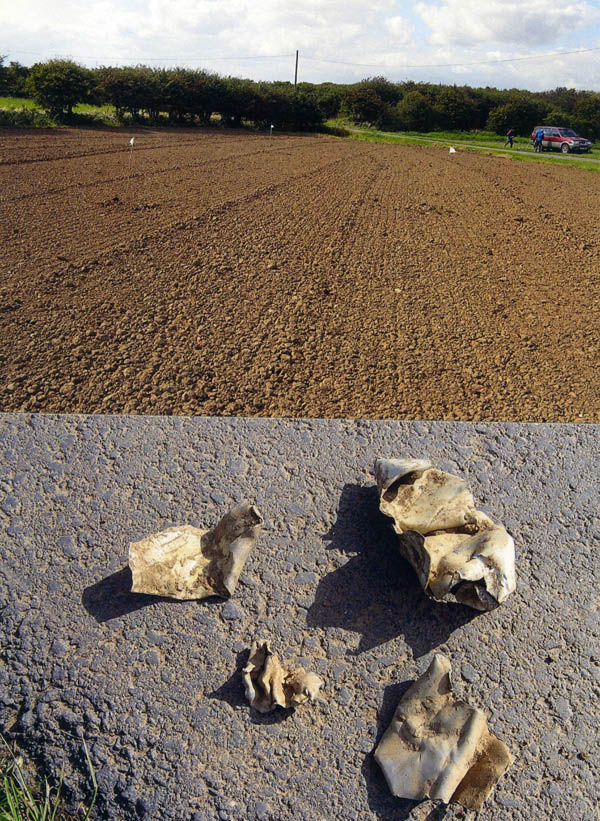
Historians Albert Pritchard, Eric Barton and Ken Reast sought landowner permission in September 2011 to pinpoint the location of where this aircraft crashed and located a few small fragments in the topsoil but enough to confirm the location. Unfortunately this leg-work prior to their joint visit was done by Eric and old age was catching up with him. He made a minor error in explaining which field the aircraft was believed to have crashed in to what was believed to have been the landowner so sought permission from the wrong landowner for the field. A few scraps of the aircraft were then found on the surface before the mix-up became apparent when the actual landowner came to see who was on his land and quite understandably asked them to leave. Hardly suprising given the field shown in Eric's photograph appears to have just been planted with the next season's crops. The photographs shown above are were taken by Eric Barton.