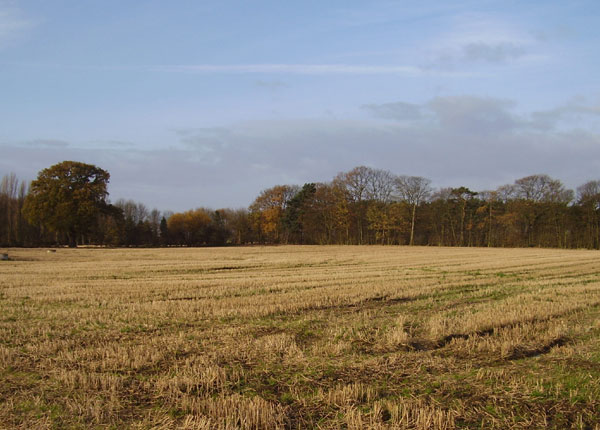
Halifax R9448 at Crockey Hill.
During the morning of 18th April 1943 this 1659 Heavy Conversion Unit aircraft took off from Topcliffe with eight airmen on board, it was not a regular crew but a mixture of four pilots, two flight engineers and a wireless operator and air gunner filling the remaining seats. The exact circumstances of the flight is not yet fully known but during the flight engines were being deliberately shut down as part of the training exercise. The pupil pilots would then practice flying on less than four engines and also then practice restarting the stopped engines. Whilst doing so and while flying on two engines, control of the aircraft was lost, the starboard elevator was seen to break off, the aircraft rolled at 1500 feet and then dived towards the ground. It crashed not far from Crockey Hill, to the south of York at 10.08hrs sadly killing all eight airmen on board. Research after the crash believed that a Halifax design fault, rudder over-balance, was probably to blame for the crash. Halifax R9448 had seen service with 35 Squadron and took part in a raid on the massive German ship the Tirpitz before being passed to 1659 H.C.U. where it was coded "L-London".
Halifax R9448 was built to contract 692649/37 by Handley Page Ltd. at Radlett and was taken on charge on 8th February 1942 by 35 Squadron at Linton on Ouse where it carried the squadron code "TL-E". On 9th September 1942 the aircraft was transferred to 405 Squadron Conversion Flight at Topcliffe. On 31st December 1943 it was transferred to 1659 Heavy Conversion Unit at Topcliffe and as a result of the crash on 18th April 1943 Cat.E2/FA Burnt damage was the damage assessment. It was struck off charge on 21st May 1943.
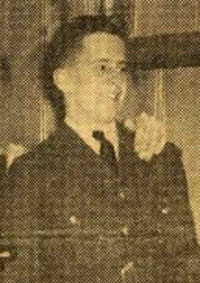
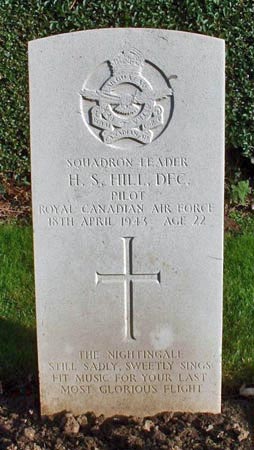
Instructor Pilot - S/Ldr Howard Stephenson Hill DFC RCAF (J/15522), aged 22, of Montreal, Quebec, Canada. Buried Dishforth Cemetery, Yorkshire.
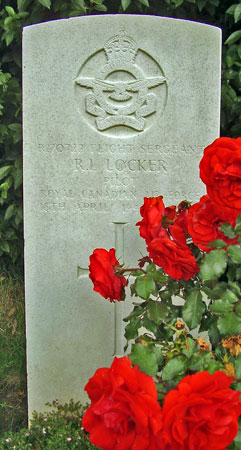
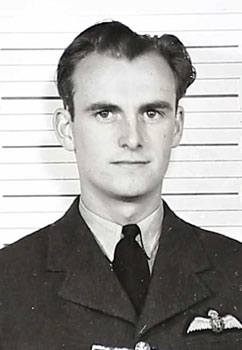
Pupil Pilot - WO2 Robert Lorne Locker RCAF (R/70722), aged 23, of Hudson Bay, Saskatchewan, Canada. Buried Dishforth Cemetery, Yorkshire.
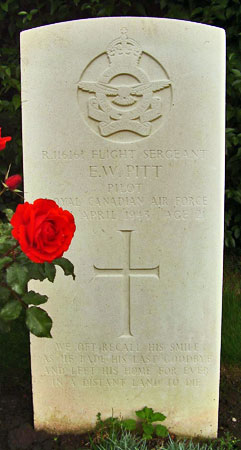
Pupil Pilot - F/Sgt Ernest William Pitt RCAF (R/116161), aged 21, of Winnipeg, Manitoba, Canada. Buried Dishforth Cemetery, Yorkshire.
Pilot (passenger) - F/O Brian Tristram Davies RAFVR (125498), aged 21, of Weston-super-Mare. Buried Weston-super-Mare Cemetery, Somerset.
Flight Engineer - Sgt Frank Oliver Bonham RAFVR (904699), aged 22, of Hartley Wintley. Buried Hertfordbridge Cemetery, Hertfordshire.
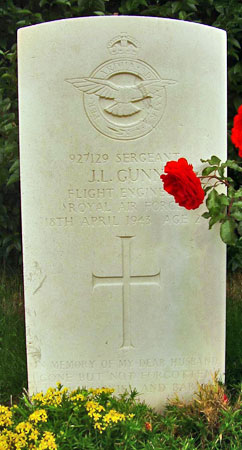
Flight Engineer - Sgt John Leonard Gunn RAFVR (927129), aged 27, of Kingsby, Middlesex. Buried Dishforth Cemetery, Yorkshire.
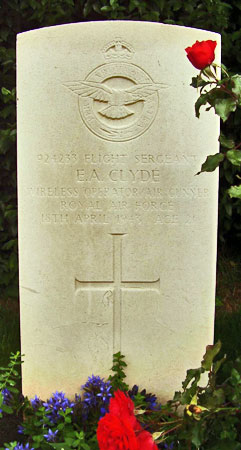
Wireless Operator / Air Gunner - F/Sgt Eric Alston Clyde RAFVR (924233), aged 21, of Alkham, Kent. Buried Dishforth Cemetery, Yorkshire.
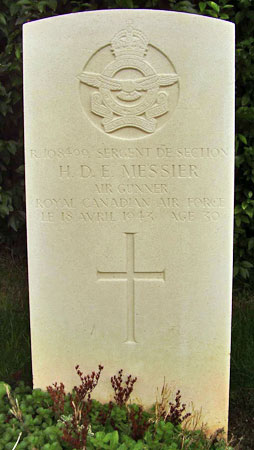
Air Gunner - F/Sgt Horace Daniel Eugene Messier RCAF (R/108499), aged 30, wife of Cowansville, Quebec, Canada. Buried Dishforth Cemetery, Yorkshire.
Howard Hill was born in Montreal, Quebec, Canada on 21st March 1921 and was the son of Rowland and Annie (nee Brook) Hill. Both his parents were born in Leeds, Yorkshire, England but emigrated and received Canadian nationality in 1912. After leaving school Howard worked as a cashier and clerk in Montreal and he enlisted for RCAF service there on 9th October 1940. He undertook initial training in Canada and was awarded his Pilot's wings on 3rd July 1941. On arrival in the UK in August 1941 he trained at 22 OTU before posting to 405 Squadron on 2nd November 1941. He received a commission on 30th May 1942 to the rank of P/O. With 405 Squadron converting from Wellingtons to Halifaxes in the Summer of 1942 he was posted to 405 Squadron Conversion Flight on 22nd July 1942 probably to be an instructor. This unit was merged with 408 Squadron Conversion Flight and became 1659 HCU on 28th October 1942. He was then an instructor with 1659 HCU and rose through the ranks of Temporary F/O, Temporary F/Lt and to Acting S/Ldr all on 9th November 1942. I would guess that he was selected to be in charge of one of the Flights at 1659 HCU and his rank of P/O was not high enough so he was deemed suitable for promotion to a much higher "acting" rank.
He must have been recommended for the DFC in the Summer of 1942 after completing a Tour with 405 Squadron and this was later granted. He was awarded the DFC for service on 31st December 1942 and it appeared in the London Gazette two weeks later. The citation for his DFC (as researched by Hugh Halliday) stated.. "This officer has shown a fine offensive spirit and in all his attacks he has displayed initiative and determination of a high order. On one occasion on returning from an operation his captain and navigator fainted owing to oxygen failure and the aircraft went out of control. He lifted the captain from the pilot's seat, righted the aircraft and piloted it until at a lower height the captain recovered and was able to take over the control. Pilot Officer Hill has set an excellent example of courage and initiative".
His brother Wireless Operator / Air Gunner WO2 Raymond Hepton Hill RCAF was serving with 419 Squadron in early 1943 when Halifax DT630 was shot down on Ops to Hamburg on 3rd February 1943. He was 23 years old and is buried in Sleen General Cemetery, Holland.
Robert Locker was born in Cando, Sakatchewan, Canada on 30th May 1919 and was the son of Robert Milton and Anna Katherine (nee Heiliger) Locker. The family lived at a homestead near the Red Pheasant reserve in Sonningdale but moved to Prairie River and then to Hudson Bay Junction, Saskatchewan while he was still of school age. He was working as a garage labourer in Hudson Bay when he enlisted for RCAF service in Regina on 12th September 1940. After undertaking pilot training in Canada he was awarded his Pilot's badge in July 1941. On arrival in the UK he was posted to 16 OTU to continue his training on 23rd September 1941. On 26th March 1942 he was the pilot of Hampden AE199 undertaking a training flight when he was forced to make a hurried landing at Croughton airfield with a problem with the aircraft. Croughton was used by 16 OTU who were technically based at Upper Heyford. Hampden AE199 overshot the runway and struck a lorry parked near a crashed aircraft (Hampden P1197?) on the perimeter of the airfield and the port undercarriage collapsed when it struck this lorry. He completed his training and was posted to 408 Squadron at Syerston on 3rd March 1942 and flew operationally with them. He began a period of unspecified sick leave from August 1942 and in the weeks he was sick 408 Squadron had moved to Leeming, upon being passed as fit he returned to 408 Squadron at Leeming in January 1943. He was then immediately posted to 22 OTU days later. Although his service records do not state this I suspect he was posted to 22 OTU straight away as 408 Squadron had converted to Halifaxes from their Hampdens while he was sick and he had had no heavy bomber training. He was then posted to 1659 HCU on 10th April 1943. The Locker Lake in Saskatchewan is named in his honour. His parents were living in Flin Flon, Manitoba, Canada when Robert Locker died.
Ernest Pitt was born on 24th May 1924 in Winnipeg, Manitoba, Canada and was the son of Ernest and Dora (nee Sharpe) Pitt. As a young man he studied commerce and then worked as a clerk in Winnipeg, lastly for the Northern Electric Company. He enlisted for RCAF service on 7th July 1941 in Winnipeg and after training in Canada was awarded his pilot's wings on 28th August 1942. He was then posted to the UK in Summer 1942 and then trained at 19 (P)AFU and 23 OTU before posting to 1659 HCU on 10th April 1943.
Horace Messier was born on 17th April 1943 at East Farnham, Quebec, Canada and was the son of Eugene and Melina (nee Daniel) Messier. His father died when he was young. As a young man he worked as a time keeper and later as an office manager for a silk mill in Cowansville, Quebec. He enlisted for RCAF service on 8th July 1941 in Montreal and after training in Canada was awarded his air gunner's flying badge on 17th July 1942. He married Marie Madeleine Bonin in Montreal six days later. Arriving in the UK in Autumn 1942 he trained at 22 OTU before posting to 1659 HCU on 10th April 1943. He died the day after his thirtieth birthday.
Gravestones of the other members of the crew who were buried at Dishforth Cemetery, Yorkshire surrounded by some very red roses.
Brian Davies received his commission on 7th February 1942 to the rank of P/O on probation (emergency) rising to F/O on probation (war subs) on 1st October 1942.
Eric Clyde was born on 26th December 1920 and was born in Scotland but his father was working as a vet in Dover around the time of his death.
I would like to thank Mr Leonard Gunn for contacting me with regard the loss of his uncle in this incident during the early stages of my research.
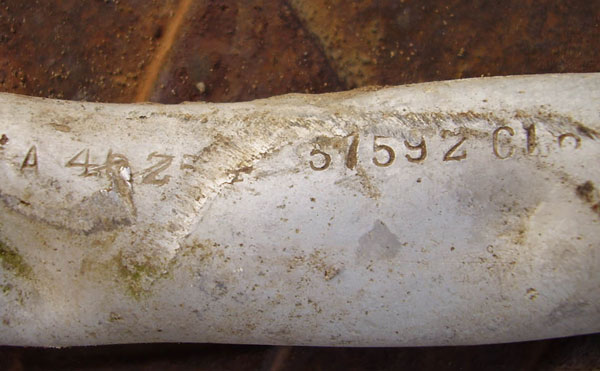
I was invited to search for the site by air historians Ken Reast, Albert Pritchard and Eric Barton in November 2008. Their efforts in speaking to the land owner, witnesses and the farm manager had roughly confirmed the location although one previous search some years before was in slightly the wrong area and had only yielded a large number of military service buttons. November 2008 saw the site located with enough remains located on the surface to be able to identify the aircraft type and manufacturer through part numbers and small parts of an engine. We would like to thank Ms Jane Cooper (Hobson's Farm Manager) for her time and allowing the visit. This was infact a very interesting site to have located, there were many interesting items located on the surface including an amount of "jablow" (a composite wooden propeller covering), small engine components and other small parts.
One of the first pieces located confirming we were in the right area.
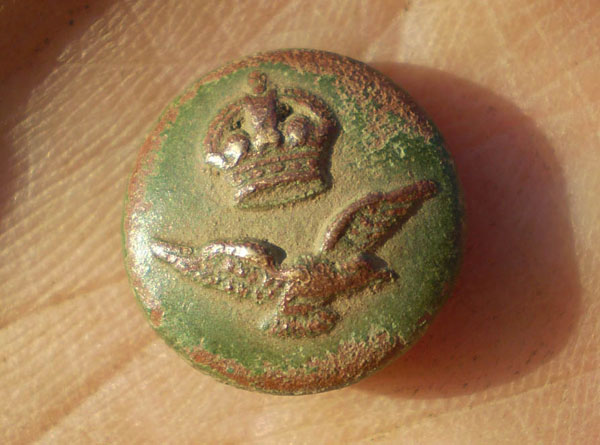
A number of service buttons were found during our visit, some were RAF but others found were Army related.
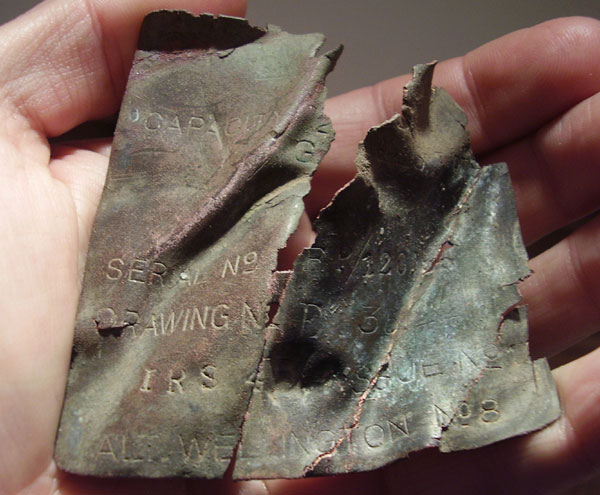
A rather bent identification plate from a tank, warmed up and slightly un-bent.