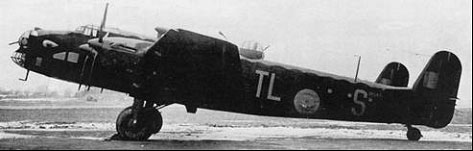
Halifax R9441 at Marston Moor airfield.
On 4th April 1943 those on board this 1652 Heavy Conversion Unit aircraft were undertaking a training flight and took off at 18.15hrs from Marston Moor airfield. As the aircraft left the ground the starboard inner engine failed but the pilot accidently shut down the starboard outer engine. The aircraft lost height and control was lost, it crash landed on the western side of Marston Moor airfield and was badly damaged but all on board survived. It was only airborne for twenty seconds. The photograph above shows R9441 whilst serving with 35 Squadron.
Pilot - F/Sgt Haydon Bronte Frisby RAAF (416421), of Novar Gardens, South Australia.
Pilot - Sgt Kenneth Allen Myers RAAF (406866), of Subiaco, Perth, Western Australia.
On the night of 23rd / 24th August 1943 he was flying Halifax HR725 on Ops to Berlin when the aircraft was attacked by a night fighter and it eventually crashed near Soltau, Germany, two of his crew died but he escaped and became a PoW. He was held at Dulag Luft between 25/8/43-28/8/43, Stalag Luft III at Sagan between 1/9/43-28/1/45 and Stalag IIIa Luckenwalde between 4/2/45-May 1945. While at Stalag Luft III he gained a reputation as a very skillful forger and map maker and much of his work was used in March 1944 during what became known as the Great Escape. He was eventually liberated by advancing Russian forces and arrived in UK on 26th May 1945. He left the UK on 8th August 1945 and was de-mob'ed in Australia on 5th December 1945. Post-war he returned home and married in the years that followed.
Kenneth Myers was born Subiaco, Western Australia on 8th January 1918, he enlisted into the RAAF in Perth and at which time he was working in the accounts branch of the Western Australia Government Railways. A newspaper cutting found on the internet states that he he baled out of an aircraft on his first operational flight while over the English Channel but the date and reasons surrounding this were not known when this webpage was created. Kenneth Myers went on to complete a Tour with 76 Squadron and was awarded the DFC for service with them, Gazetted on 10th December 1943. Nothing more is known about his service.
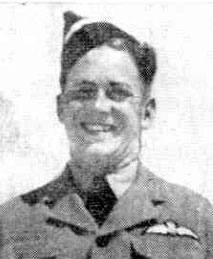
Haydon Frisby was born on 4th September 1921 in Adelaide, South Australia to Harry Clements Frisby. Through searching the internet it seems likely that his father Harry Frisby had served in WW1 and was injured as a notice in a hospital letter now PDF'ed on the internet states that his wife was Myrtle Frisby and that he was working as a railway porter before WW1 and living on Wattle Street, Fullerton, South Australia. A further newspaper cutting on "trove.nla.gov.au" mentions an accident in which he was injured whilst working as a railway guard when he was trapped between two wagons in the 1930s. His brother John Colin Frisby also served in the Australian Forces in WW2. Haydon Frisby was educated at St.Leonards Public School and Adelaide High School. He worked as a letting clerk for an estate agent E.J.Palk's Land Agency, Glenelg prior to enlisting into the RAAF on23rd June 1941 in Adelaide. After basic training in Australia he gained his Wings on 8th January 1942 and left Australia 16th May 1942 by ship. He
arrived the UK on 15th August 1942 and trained at 3 (P)AFU begining 29th August 1942, 24 OTU begining 20th October 1942. Part of his service record appears to suggest that he had flown as a second pilot with 76 Squadron in early March 1943 but was then posted to 1652 HCU on 8th March 1943 and following completion of his training here was posted to 158 Squadron on 29th April 1943. He later had a brief detachment to 1502 BAT Flight from 7th to 13th August 1943 and returned to 158 Squadron. He received his commission to the rank of P/O on 30th June 1943 and was later promoted to F/O on 30th December 1943 but was in captivity by then (as detailed below) and F/Lt on 30th June 1945.
Halifax R9441 was built to contract 692649/37 by Handley Page Ltd. at Radlett and was awaiting collection on 27th January 1942. It was taken on charge by 35 Squadron at Linton on Ouse on 8th February 1942 where it carried the squadron code "TL-C". On 9th April 1942 it was transferred to 102 Squadron at Dalton. On 21st May 1942 a major repair commenced at Dalton which lasted until 26th August 1942 when it was returned to 102 Squadron who were now based at Pocklington. On 5th September 1942 it was transferred to 1652 Heavy Conversion Unit at Marston Moor. On 15th March 1943 damage was declared as Cat.A(c) during a major repair and it was repaired on site at Marston Moor. On 31th March 1943 it was returned to 1652 H.C.U. at Marston Moor. As a result of the crash on 4th April 1943 "Cat.E2/FA Partly Burnt" was the damage assessment recorded on the AM Form 78 ! A new one for me. Normally Cat.E2/FA Burnt was the way of recording it. It was struck off charge on 15h April 1943 having clocked up a total of 213 flying hours from new.