At 01.09hrs on 13th August 1943 this 1658 Heavy Conversion Unit aircraft took off from Riccall airfield to undertake a basic night circuits and landings exercise but on the take off run the port tyre deflated. Five minutes later and having flown a circuit of the airfield, the pilot landed but the initial touchdown at 01.14hrs was heavy. The aircraft ground-looped and the undercarriage collapsed. The damage was assessed and the aircraft was deemed beyond repair.
Pilot - Sgt Kenneth Herbert Whittington RCAF (R/133936).
Crew probably..
Navigator - P/O William Robert McKinnon RCAF (J/21892).
Wireless Operator / Air Gunner - F/Sgt T Wallace.
Air Gunner - Sgt R Pay.
Air Gunner - Sgt Douglas William John Russell RAFVR (1811596).
Flight Engineer - Sgt S J Banks.
Bomb Aimer - P/O Harry Scott Horsfall RAFVR (138327).
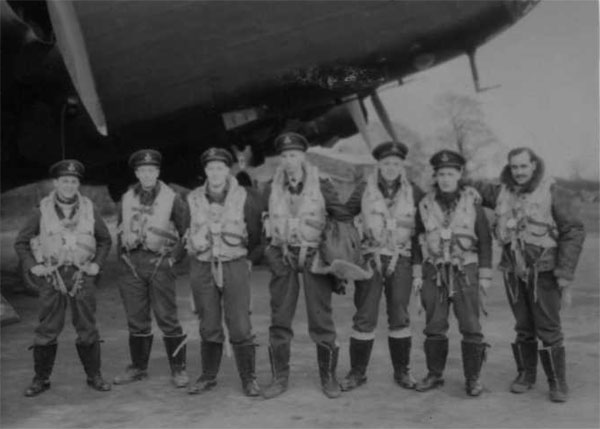
Kenneth Whittington's Halifax crew at 102 Squadron.
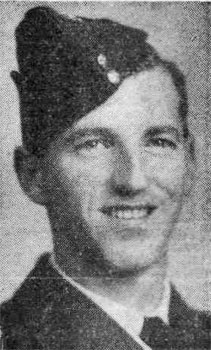
Kenneth Whittington was born in Burk's Falls, Ontario in September 1916 but moved to Oshawa at the age of four. He was working with his brother in a radio repair buisness when he enlisted for RCAF service in Toronto in October 1941. I link him to being the pilot of Halifax R9387 damaged at Riccall in August 1943 as he was training there at the time. After completing his training at 1658 H.C.U. he was posted to 102 Squadron based at Pocklington. He begun operational flying on 27th August 1943. For service with them he was awarded the DFC, Gazetted on 27th June 1944. The citation for his award reads.."This officer has completed a tour of operational duty during which he has taken part in attacks on a wide variety of targets in Germany and France including such heavily defended objectives as Berlin, Hanover and Frankfurt. In December 1943, while on the way to the target, he encountered strong opposition from enemy fighters. The rudder of his aircraft was damaged and Flight Lieutenant Whittington had great difficulty in keeping to course. Nevertheless he flew on and successfully completed his mission. This officer's tour has been marked by the courage and skill he has displayed and the determination with which he has always pressed home his attacks." He was presented with his DFC on 22nd November 1948.
William McKinnon was born in Albert, Canada in 1923 and enlisted for RCAF service in Calgary in 1941. His first operational flight with 102 Squadron was on 27th August 1943 and for service with 102 Squadron he was also awarded the DFC, Gazetted on 30th June 1944.
Harry Horsfall received a commission to the rank of P/O on probation on 23rd March 1943 and was promoted to F/O on 23rd September 1943. He was also awarded the DFC for service with 102 Squadron, Gazetted on 15th September 1944. He was probably promoted to F/Lt on 23rd March 1945 although I have not yet located the entry in the London Gazette to confirm this.
Halifax R9387 was built to contract 692649/37 by Handley Page Ltd. at Radlett and was initially taken on charge by the A. and A.E.E. at Boscombe Down for test work on 9th December 1942. It was transferred (on paper) for a short period of time to 10 Squadron at Leeming on 8th February 1942. The aircraft was then taken on charge by 76 Squadron on 17th March 1942 at Middleton St.George. I strongly suspect that it was immediately loaned to 76 Conversion Flight, also at Middleton St.George. On 30th May 1942 it was used on the Thousand Bomber raid on Cologne with it being flown by a 76 Squadron crew, although almost certainly a Conversion Flight aircraft. On 25th June 1942 it was used on the Thousand Bomber raid on Bremen but this time a scratch crew, flown by S/Ldr Charles Calder MiD DFC, he was an instructor with 76 Conversion Flight at the time. Unfortunately the crew of a Wellington opened fire on R9387 and put the starboard outer engine out of action. Unable to continue to the target they turned around and made for England but later the Halifax was attacked by a twin engine aircraft. Two members of the crew were injured in the attack. A landing was made at Coltishall. Minor damage, Cat.A/FB, to the aircraft resulted and it appears to have been repaired on site there before being flown back to join 76 Conversion Flight. The transfer to 76 Conversion Flight is then properly reflected on the aircraft's AM Form 78 on 29th July 1942, probably the date when the repair was finished and it was returned to them. On 16th September 1942 76 Conversion Flight moved to Riccall. On 7th October 1942 it was absorbed into 1658 Heavy Conversion Unit at Riccall though the aircraft was not officially transferred until 31st December 1942 (almost certainly because of slow paperwork). As a result of loosing the tail wheel on 25th March 1943 minor Cat.Ac/FA damage was the damage assessment and it was repaired on site. On 13th August 1943 a tyre burst on landing at Riccall and the undercarriage collapsed. The aircraft was deemed not worth repairing so was written off with Cat.E/FA damage being the damage assessment.