Halifax R9369 at Leeming airfield.
On 15th January 1943 this 1659 Heavy Conversion Unit aircraft landed at Leeming airfield at 21.50hrs following a night circuit training flight but with the undercarriage still retracted. The aircraft was badly damaged following a belly landing and after being assessed was written off.
Pilot - F/O Arnot Andrew Stewart RNZAF (NZ.413502).
Pilot - Sgt Arthur Stanley Green RCAF (R/107004).
Flight Engineer - Sgt John Allan Hammond RCAF (R/81832).
Flight Engineer - Sgt Francis Albert Dunn RCAF (R/76929).
Flight Engineer - Sgt Philip Harcourt Clifton RAFVR (1376348).
Wireless Operator / Air Gunner - Sgt William Edward Hamilton RAFVR (1105515).
Wireless Operator / Air Gunner - Sgt Laurence Stanley Marsden RAFVR (1268458).
Arthur Green was born on 15th May 1916 in Raymore, Saskatchewan, Canada and was the son of William Arthur and Mary Ellen (nee Lammin) Green. His parents moved from London, England to Canada around 1915 and the family later moved to Delisle. When he enlisted for RCAF service in Saskatoon on 15th May 1941 he was working with his father as a tinsmith. After training in Canada he was awarded his pilot's flying badge on 10th April 1942 and was posted to the UK days later, training at 3 (P)AFU and 11 OTU before posting to 1659 HCU on 10th December 1942. Following the mishap at Leeming in January 1943 he and Sgt Dunn completed their training and were posted to 419 Squadron. On the night of 23rd / 24th May 1943 he was the pilot of Halifax JB862 flying Ops to Dortmund when his aircraft was shot down by flak and after damage by a night fighter. He and many of his crew were killed and he is now buried in Rheinberg War Cemetery. He was twenty seven years old. The Green Lake in Saskatchewan is named in his honour. Sgt Frank Dunn survived and became a PoW, earlier in the War he had served as ground crew with 410 Squadron before remustering as a flight engineer.
Halifax R9369 was built to contract 692649/37 by Handley Page Ltd. at Radlett. It was taken on charge as new by 10 Squadron at Leeming on 1st November 1941 when the unit began conversion to Halifax MkII's. It was coded "ZA-B" and flew the first 10 Squadron operational flight on 18th December 1941 to bomb the German battleships Scharnhorst and Gneisenau at Brest Harbour with the pilot on this occasion being Sgt Murray Schneider RCAF. It was used operationally by 10 Squadron until 3rd March 1942. On 23rd March 1942 the aircraft was transferred to 78 Conversion Flight at Croft. The aircraft was transferred to 405 Conversion Flight at Pocklington on 23rd April 1942. On 7th August 1942 405 Conversion Flight moved to Topcliffe and on 7th October 1942 it was absorbed into 1659 Heavy Conversion Unit at Leeming. On 13th October 1942 it was taxying at Topcliffe airfield when the tail unit collapsed. Metal fatigue of the casting of the tail oleo was found to blame. Cat.A/FA damage resulted and it was repaired on site. As a result of the mishap at Leeming on 15th January 1943 the damage was initially assessed as being Cat.Ac/FA but three days later it was deemed necessary for a repair in works to be carried out by Handley Page. On 2nd March 1943 the aircraft's damage was reassessed as being more serious so was upgraded to Re.Cat.E and it was struck off charge on 16th March 1943.
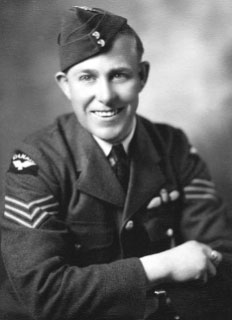
Stewart, Marsden and Hammond were soon posted to 408 Squadron. On the night of 11th / 12th March 1943 they were flying Halifax HR656 on Ops to Stuttgart when the aircraft was shot down by a night-fighter. All escaped the aircraft. Stewart and Marsden were eventually captured and became PoWs while Hammond managed to evade capture.
Philip Clifton was awarded the DFC for service with 408 Squadron, Gazetted on 13th April 1945. He also received a Mention in Despatches on 14th June 1945.