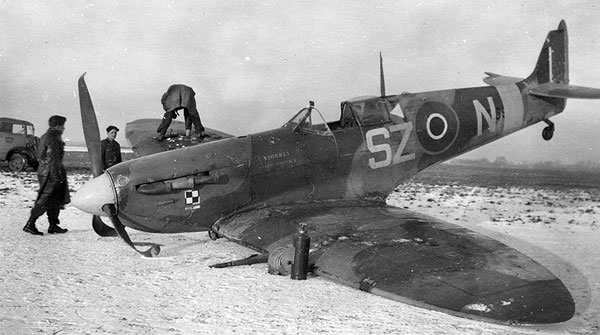
Spitfire R6960 at Hutton Cranswick airfield.
At 15.45hrs on 8th January 1943 the pilot of this 316 Squadron aircraft was about to take off when he was forced turn to port to avoid a collision with the lead aircraft on a formation take-off, the aircraft struck a pile of frozen snow at edge of runway and port oleo broke away. The pilot continued with the take off run but on his return to Hutton Cranswick he made a crash landing on one wheel. This aircraft was presentation aircraft and carried the words of "Owerri Province of Nigeria". It was later repaired. The photograph above shows Spitfire R6960 after the January 1943 mishap at Hutton Cranswick.
Pilot - Sgt Stefan Sztuka PAF (P/782831).
Stefan Sztuka was born in the Warsaw area of Poland, he joined the PAF at the age of 21 in Poland and escaped to France flying there until France fell. He arrived in England in 1940 and flew throughout the War but is not listed as being a Battle of Britain pilot so must have been undergoing training during this period in 1940. He later transferred to the RAF but left in 1940 to become an accountant but during his service he was awarded the Polish Cross of Valour and the French Croix du Guerre. In 1971 he moved to North Wales to run a restaurant in Capel Curig. He died in January 2002 aged 86 and is buried in Chedworth, Cheltenham.
Spitfire R6960 was a long service history and it has been reseached by Graham Sharpe. It was built to contract B.19713/39 by Vickers Armstrong's (Supermarine) Ltd. at Eastleigh as a Mk.Ia variant. It was first test flown on 15th July 1940 and was flown to 6 MU at Brize Norton the following day where it remained in storage until 5th February 1941 when it was flown to Rolls Royce Ltd. at Hucknall for fitting of a Merlin Mk.45 engine and conversion to Mk.Vb status. On 28th February 1941 it was taken on charge by A.F.D.U. at Duxford. On 26th March 1942 it was transferred to 92 Squadron at Biggin Hill but three days later it was transferred to 91 Squadron at Hawkinge. It was back with Rolls Royce Ltd on 8th April 1941 for further modifications before returning to 91 Squadron at Hawkinge. It was slightly damaged on 15th May 1941 (Cat.A(c)/FB) but no details are yet known how. It was deemed that a repair in works was necessary so it was transported or flown to General Aircraft Ltd. at Hanworth for repair. On completion of repair it was placed in MU storage until 25th July 1942 when it was taken on charge by 234 Squadron at Portreath. It then moved with 234 Squadron a number of times, on 23rd August 1942 to Charmy Down, on 29th August 1942 back to Portreath, on 28th October 1942 to Perranporth and on 26th November 1942 to Portreath. On 12th December 1942 it was transferred to 316 Squadron at Hutton Cranswick and on 8th January 1943 sustained minor Cat.A/FA damage. It was repaired on site and returned to 316 Squadron use. On 12th March 1943 they moved to Northolt but on 4th April 1943 it was transferred to 306 Squadron and flown back to join them at Hutton Cranswick. On 26th May 1943 tipped up onto it's nose on landing at Hutton Cranswick and sustained Cat.B/FA. From there it was taken to and repaired by De Havilland's at Hatfield. On completion of repair it was once again placed in MU storage. On 12th October 1943 it was taken on charge by 453 Squadron at Sumburgh. They then moved to Detling on 19th January 1944, Ford on 18th April 1944 and was then flown over the France after D-Day. The squadron moved to Lungues LG B.11 on 25th June 1944, Lingevres LG B.19 on 13th August 1944, Beauvais LG B.40 on 2nd September 1944, Vitry-en-Artois LG B.52 on 5th September 1944 and then to Deurne LG B.70 on 17th September 1944. On 29th September 1944 453 Squadron moved unit back to the UK at Coltishall and then to Matlask on 18th October 1944. On 6th December 1944 the Spitfire was transferred to 57 OTU at Eshott. On 16th December 1944 it's undercarriage collapsed on landing at Boulmer and after this it was not repaired. Cat.E/FA damage was the assessment and it was written off.