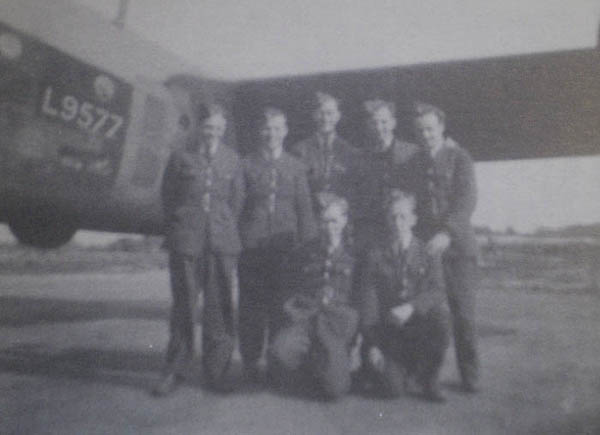
Halifax L9577 at Clifton airfield.
During the morning of 25th January 1943 this 1658 Heavy Conversion Unit aircraft was being flown on a training flight when the pilot noticed there was a problem with the hydraulics. A precautionary landing at Clifton / Rawcliffe at 11.34hrs, the crew having managed to hand pump the undercarriage down but the aircraft suffered the tail wheel collapsing on landing.
Pilot - S/Ldr Charles Cranston Calder DFC DSO RAFVR (62699).
"This officer has completed a second tour of operations and has displayed the highest qualities of skill and gallantry throughout. He has displayed the greatest determination in pressing home his
attacks and has achieved much success. On one occasion, in an operation against Frankfurt, two
engines became unserviceable. In spite of this, Wing Commander Calder flew the aircraft back to
this country after cleverly outmanoeuvring a fighter which had closed in to attack. This officer
is an efficient and forceful squadron commander, whose genius for leadership has contributed in
good measure to the success of the formation he commands."
Having completed his second Tour he was posted to a training instructional role for a while but later served with 617 Squadron in the later months of the War. He piloted the aircraft that dropped the first of the 22,000lb Grand Slam bombs - the biggest high-explosive bomb developed by any country during the war - to wreck the Bielefeld
railway viaduct in Germany. He was awarded the Bar to the DSO for service with 617 Squadron, Gazetted on 5th June 1945. The citation
reads..
"Since being awarded the Distinguished Service Order, this officer has completed many sorties. Throughout these operations he has shown the greatest resolution and the successes obtained are a splendid tribute to his great skill and courage. Wing Commander Calder led the squadron on the operation when the first 22,000 Ib. bomb was dropped over Germany. The target was the viaduct at Bielefeld and complete success was achieved. This officer has rendered much loyal and devoted service."
He remained in the RAF post-War and received a Queen's Commendation for Valuable Service in the Air on 1st January 1957.
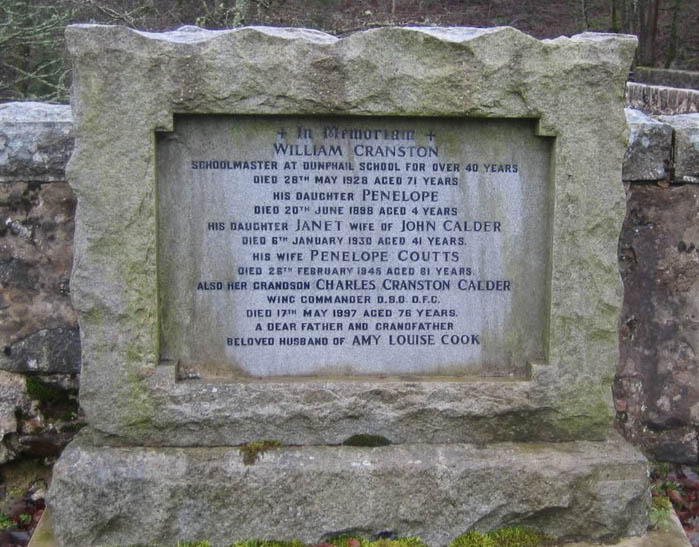
He died on 17th May 1997 aged seventy eight years old. He is buried with his grandfather and other members of his family
in Edinkillie Churchyard, at Glenernie, south of Inverness. The photograph shown above was found on an internet forum.
A poor copy of a photograph showing part of Halifax L9577 in the background. The crew shown remain unidentified.
Charles Calder begun his RAF career at the bottom and worked his way up. He received a commission on 27th March 1941 to P/O on probation from the rank
of Sergeant. He rose through the ranks holding a number of more senior Acting ranks while at least two ranks lower. He first flew with 78 Squadron and later
76 Squadron. For service with 76 Squadron he was awarded the DFC for completing his Tour, this appeared in the London Gazette on 13th February 1942 as the rank of Acting F/Lt. No citation has yet been located for this DFC. He was Mentioned in Despatches for the first time on 2nd June 1943. He was Mentioned in Despatches for
a second time as Acting W/Co on 14th January 1944. On 13th June 1944 the London Gazette published the notification that he was to be awarded the
DSO for service with 158 Squadron. The citation for this reads..
Halifax L9577 was built to contract 692649/37 by Handley Page Ltd at Radlett. This aircraft is history is an unusual one; it was used as a pattern airframe by the London Passenger Transport Board Ltd at their Chiswick factory from 30th June 1941 before being passed on to English Electric Co.Ltd. at Samlesbury for similar purposes on 18th March 1942. After English Electric had finished using it the aircraft was returned to Handley Page at their York depot on 13th May 1942 before being issued to 76 Conversion Flight on 26th June 1942 at Middleton St.George and then moved with the unit to Riccall on 16th September 1942. 76 Conversion Flight was absorbed into 1658 Heavy Conversion Unit at Riccall on 7th October 1942. The aircraft sustained Cat.Ac/FA damage at Clifton on 25th January 1943 and was repaired on site, it was perhaps handy this damage occurred at Clifton as Y.A.R.D. were based there and it probably made for an easy recovery for them. Once servicable it did not return to 1658 H.C.U. but went to 8 MU on 12th April 1943. It remained in store until being taken on charge by 1662 H.C.U. on 1st January 1944. On 25th March 1944 it was damaged in a flying accident that initially saw Cat.Ac/FA damage be the damage assessment. A month later on 25th April 1944 the aircraft was struck off charge so the damage must have been reassessed and found more serious than first thought.