Halifax L9571 at Marston Moor airfield / Tockwith.
On 25th May 1943 this 1652 Heavy Conversion Unit aircraft had just taken off so the instructor could fly with a trainee pilot on a dual control training flight but while flying in the ciruit of Rufforth airfield the port inner engine burst into flames. The instructor took control and attempted to fly a shortened circuit of the airfield but in the time this took the fire took told, the aircraft stalled and lost height, clipped the roof of Tockwith vicarage at 09.55hrs and then crashed. Sadly three of the crew died as a result of this incident. The faulty engine was later stripped to investigate the failure and it was found that faulty manufacturing was to blame, the engine fire had then burnt through the elevator and the rudder just prior to the crash which, in the opinion of the investigator, was the cause of control being lost. The accident investigation also stated that the instructor had already experienced a similar incident whilst instructing at Marston Moor but had been able to land safely.
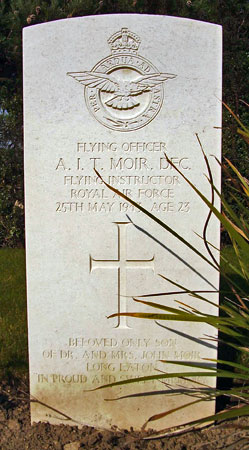
Instructor Pilot - F/O Alastair Ian Taylor Moir DFC RAFVR (137208), aged 23, of Long Eaton, Derbyshire. Buried Stonefall Cemetery, Harrogate, Yorkshire.
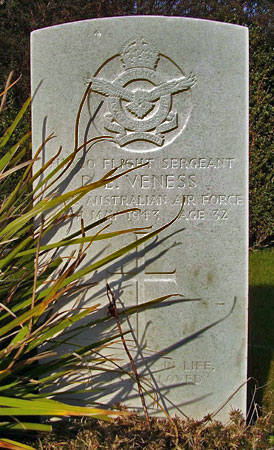
Pupil Pilot - F/Sgt Daniel Edward Veness RAAF (411620), aged 32. Buried Stonefall Cemetery, Harrogate, Yorkshire.
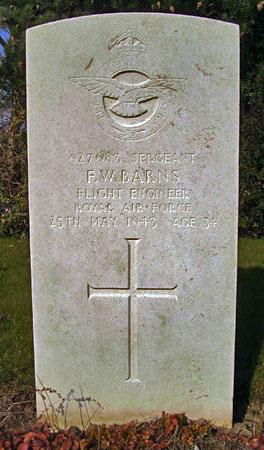
Flight Engineer - Sgt Frederick William Barns RAFVR (927683), aged 34. Buried Stonefall Cemetery, Harrogate, Yorkshire.
Air Gunner - Sgt Thomas Fairweather King RAFVR (1557902). Injured.
Air Gunner - Sgt James Winchester RAF (549420). Injured.
The graves of the other airmen who lost their lives as a result of this incident and who are also buried at Harrogate Stonefell Cemetery. Their joint funeral took place on 28th May 1943.
Daniel Veness was born on 15th September 1910 in Manilla, New South Wales, Australia. He enlisted into the RAAF on 24th May 1941 in Sydney and after basic training he left Australia in June 1942.
Alastair Moir had been involved in what could have been a more serious incident than it actually turned out to be, on 31st August 1942 he was serving with 102 Squadron and the pilot of Halifax BB196 undertaking a training flight when the aircraft suffered an engine failure, he crash landed at Catfoss airfield but struck a parked Blenheim and both aircraft was seriously damaged. He received his commission to the rank of P/O on probation (emergency) on 1st November 1942 and was awarded the DFC for service with 76 Squadron, Gazetted on 14th May 1943 having been promoted to F/O (war subs) on 1st May 1943. Having completed a Tour with 76 Squadron he was posted to 1652 HCU at Marston Moor where the accident which cost him his life occurred. The citation for his DFC reads..
"As a captain of aircraft this officer has flown on a large number of operational sorties. He took part in a low-level attack on Flensburg through the heaviest and most intense enemy opposition. He has also participated in attacks on Berlin, Duisberg. Bremen and Dusseldorf."
Alastair Moir's father was Dr. John Hay Moir DSO MC & Bar, who's parents lived in Aberdeen though he was living in Derbyshire when his son died. John Moir had served in the WW1 with the R.A.M.C. He was awarded the Military Cross, Gazetted 14th November 1916, the citation reads.. "Although wounded he tended the wounded under very heavy fire, displaying great courage and determination and refusing to be relieved until all the wounded had been evactuated". He was later awarded the Bar to the Military Cross, Gazetted on 26th July 1918, the citation reads.. "For conspicuous gallantry and devotion to duty. During a withdrawal he repeatedly went out into the open, under heavy fire, to attend to the wounded. Throughout the withdrawal seven officers of the battalion were wounded. That only one was left in the hands of the enemy was largely due to the magnificent courage which he displayed." He was later Mentioned in Despatches twice and later awarded the DSO, Gazetted on 2nd April 1919, as Temporary Captain R.A.M.C., attached to 17th Btn Royal Fussiliers. No citation for his DSO has been located.
Sgt James Winchester may well have been posted to 78 Squadron and was possibly involved in the crash of Halifax JD370 near Bubwith on 17th August 1943.
Halifax L9571 was built to contract 692649/37 by Handley Page Ltd. at Radlett and was received by 8 M.U. at Little Rissington on 9th August 1941. The aircraft was initially taken on charge by 35 Squadron at Linton on Ouse on 1st October 1941. On 11th January 1942 it was transferred to 35 Conversion Flight at Linton on Ouse. 35 C.F. moved to Dalton on 12th June 1942, Marston Moor on 5th September 1942 and Rufforth on 21st September 1942. On 7th October 1942 35 C.F. was absorbed into 1652 Heavy Conversion Unit at Marston Moor but the official transfer of the aircraft did not take place until 31st December 1942. As a result of the accident at Marston Moor on 25th May 1943 Cat.E2/FA damage was the damage assessment. The aircraft was struck off charge on 31st May 1943 having clocked up an impressive 343.55 hours flying from new.