Halifax JB892 damaged by flak, returned to Elvington airfield.
On the night of 30th April / 1st May 1943 the crew of this 77 Squadron aircraft were tasked with flying an operational flight to bomb Essen. They took off from Elvington at 00.03hrs and they bombed the target area from 19,000ft on PFF markings but the aircraft was hit by flak while over enemy territory. The crew were able to make a safe landing at base at 05.32hrs.
Pilot - Sgt Reginald William Frederick Munns RAFVR (1337170).
Flight Engineer - Sgt William Cecil Smirk RAFVR (983888).
Navigator - Sgt William Walter Smith RAFVR (1338175).
Bomb Aimer - Sgt Clifford Wyatt Tomlinson RAFVR (1233323).
Wireless Operator / Air Gunner - Sgt Richard Reginald Wilson RAFVR (1125318).
Air Gunner - Sgt Eric Alic Fedi RCAF (R/172702).
Air Gunner - Sgt Donald William Dufton RCAF (R/119305).
Reginald Munns received a commission to the rank of P/O on probation (emergency) on 17th June 1943. A detailed biog of Reginald Munns' life is shown on "www.chelmsfordwarmemorial.co.uk/WW2/WW2_MUNNS,_Reginald_William_Frederick.html".
William Smith received a commission to the rank of P/O on probation (emergency) on 26th August 1943.
When Sgt Eric Fedi was killed on 7th September 1943 he was just seventeen years old, he was one of the youngest members of aircrew in the RCAF to be killed in the whole of the Second World War. He was born on 3rd March 1926 at Moore Park, Manitoba, Canada and was the son of William Mark and Frances Alexandria (nee MacFarlane) Fedi and while his service record states he was employed as a mechanic when he enlisted for RCAF service on 13th July 1942 in Winnipeg he lied about his age to enlist into the RCAF. He probably lied about working as a mechanic and was probably still at school; he forged his Grandmother's signature and a friend helped to falsify his birth certificate which claimed he was born two years earlier. His mother would find out he had enlisted but she went along with his wish to enlist but believed that he would not go overseas, his older brother, who was serving in the Canadian Army in the UK, later bumped into him in London while serving in the UK but Eric convinced his brother not tell his mother. Eric trained as an air gunner in Canada receiving his air gunner's flying badge on 4th December 1942, he left for service overseas the following month and trained at 7 AGS and 1652 CU before posting to 77 Squadron on 26th March 1943 (only days after his seventeenth birthday).
Halifax JB892 was built to contract ACFT/1808/C4 by English Electric Co. Ltd. at Samlesbury and was taken on charge by 77 Squadron at Elvington on 31st March 1943. As a result of the battle damage sustained on 1st May 1943 Cat.A/FB damage was the assessment and it was repaired on site. On 14th May 1943 the aircraft failed to return from Ops to Bochum that saw seven airmen killed. Cat.E(m) damage was the damage assessment and it was struck off charge on 16th May 1943 having clocked up just over 67 hours total flying time from new.
The first six named airmen above were all flying together on 7th September 1943 on Ops to bomb Munich in Halifax DT793, the aircraft failed to return to base and all on board were listed as missing. All are commemorated on the Runnymede Memorial.
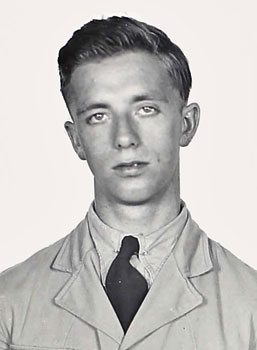
Donald Dufton was born on 10th December 1922 in Toronto and enlisted into the RCAF in July 1941. He had served with 10 Squadron during the latter months of 1942. WO2 Donald Dufton was killed on 13th August 1943 flying Ops to Milan in Halifax JD125, the aircraft crashed in France with the loss of the whole crew. The body of WO2 Dufton was unable to be identified by the post-war war graves investigation team although the remains of all but one of those who died are known to be buried locally in Verneuil-sur-Avre, France. WO2 Dufton is one of four of the crew of JD125 to be commemorated on the Runnymede Memorial. A memorial plaque has now been erected on the grave site in his honour. He was just twenty. His father living in Toronto when he death was notified in the Canadian newspapers.