Halifax JB865 damaged by flak, returned to Elvington airfield.
On the night of 30th April / 1st May 1943 the crew of this 77 Squadron aircraft were tasked with flying an operational flight to bomb Essen. They took off from Elvington at 23.59hrs and released all but one bomb onto the PFF markers from 19,000ft but ust before their first run on the target the aircraft was damaged by a flak burst near one of the two starboard engines. The crew shut down the damaged engine and made a second run on the target from 17,000ft to release the final bomb. They made a safe landing at base at 06.05hrs. The pilot was later awarded an immediate DFC for his actions on this night.
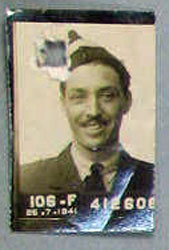
Pilot - F/O Thomas Archibald RAAF (412606), of North Sydney, New South Wales. Australia.
Flight Engineer - Sgt C Hewitson RAF (535057/535857), later made poW.
Navigator - Sgt John Gerry RAFVR (1438258?).
Bomb Aimer - Sgt Gerard Scully RAFVR (1219445).
Wireless Operator - Sgt George Edward Marlow RAFVR (1085425).
Air Gunner - Sgt Frederick Kenneth Smith RAFVR (1433744).
Air Gunner - Sgt J Currie RAFVR (1573760).
Thomas Archibald was born 11th September 1910 in Hamilton, Scotland but had moved to Australia with his family when he was young. He was working as a salesman when he enlisted into the RAAF in Sydney on 21st July 1941, after receiving basic training he was awarded his Wings on 27th February 1942. On arrival in the UK he trained at 6(P)AFU from 11th September 1942, 20 OTU from 3rd November 1942 and 1658 HCU from 2nd March 1943 prior to posting to 77 Squadron on 7th April 1943. He received his commission on 30th April 1942 and was promoted to F/O on 30th October 1942. He was awarded the DFC for service with 77 Squadron and the citation refers to the battle damage sustained at the top of this page, the citation reads.."One night in April 1943, this officer captained an aircraft which attacked Essen. Whilst over the target area the aircraft was repeatedly hit by fire from the ground defences, and one engine was put out of action. It was then discovered that one bomb had failed to release. Displaying great determination, Flying Officer Archibald made a second run over the target and released the bomb successfully. His aircraft sustained much damage but he flew it back to base with one engine unserviceable. This officer displayed great courage and outstanding devotion to duty." As a result of the accident at Bishop Wilton he was killed, he is buried at Barmby on the Moor Churchyard, near Pocklington and was thirty two years old.
Sgt Scully was also killed, he was twenty one years old and is buried in Olton Cemetery, Solihull, Birmingham.
All of the above crew were flying together on 12th / 13th May 1943 in Halifax JB865 (the same aircraft which sustained the battle damage at the top of this page for which Archibald received his DFC). The aircraft crashed near High Bellthorpe Farm, Bishop Wilton, on the edge of the Yorkshire Wolds and F/O Archibald and Sgt Scully were killed. The others survived and it appears that, now short of a pilot, some may have been posted to other squadrons in No.4 Group.

George Marlow was awarded the DFM for service with 51 Squadron, Gazetted on 14th January 1944. He was killed serving with 51 Squadron on 21st January 1944 when Halifax LV775 was shot down on Ops to Magdeburg. He was twenty five years old and is buried in Berlin War Cemetery.
Frederick Smith was later posted to 35 Squadron PFF and was killed on 24th March 1944 when Lancaster ND597 was attacked by a night-fighter and exploded in the air. He is buried in Berlin War Cemetery and was thirty years old.
Halifax JB865 was built to contract ACFT/1808/C4 by English Electric Co.Ltd. at Samlesbury and was taken on charge by 77 Squadron at Elvington on 16th March 1943. As a result of battle damage on 4th April 1943 and then on 1st May 1943 Cat.A/FB damage was the damage assessment each time that saw it was repaired on site each time. On 13th May 1943 it crashed at Bishop Wilton on return from an operational flight to bomb Duisburg. Cat.E2/FA damage was the damage assessment and it was struck off charge on 5th June 1943 having flown a total of 70 hours 40 minutes total.