Halifax JB865 near Bishop Wilton.
On the night of 12th / 13th May 1943 the crew of this 77 Squadron aircraft were tasked with flying an operational flight to bomb Duisburg. The navigator made a very detailed report on the accident which is now held in the National Archives of Australia and this account has been drawn upon for this webpage. He stated that the crew had had difficulty in opening the bomb doors as they approached the target but they were eventually opened using the emergency system, but having opened the doors and dropped the bomb load the bomb doors would not shut. The crew made for base but because the bomb doors were left open this effected their airspeed and fuel consumption, as they crossed the Yorkshire coast roughly in the Hornsea area the pilot descended safely into low cloud, after attempting to locate a beam to direct them to Melbourne airfield without success they opted to head north in the cloud and locate a beam to direct them to Driffield airfield. They contacted Driffield on the wireless but the reply was unclear but knowing they were close to Driffield the crew set a course for Pocklington. On arrival in the Pocklington area the weather was still poor and the crew could not see the airfield so it would appear that they then flew in a large circle across the Vale of York before locating a beacon near Dishforth. Again the crew set course for Pocklington which appears to have been successful, they received a radio message from Pocklington airfield asking if they wished to land, having accepted this the pilot instructed a number of his crew to the rest position in the rear of the aircraft. The pilot and bomb aimer were at the front of the aircraft when they arrived over Pocklington the poor weather meant they still could not see the runway lighting. Although the navigator's report does not mention the aircraft was running out of fuel this then must have been an issue. The navigator reported that the pilot then warned his crew that they should prepare to bale out but before they were able to get their parachutes he changed the instruction to prepare for a crash landing and the crew were to get into their crash positions. As this was happening the aircraft clipped the top of Garrowby Hill while flying in a north-easterly direction which slightly damaged the port wing tip and the port outer propeller. The pilot immediately feathered this damaged propeller and would appear to have turned the aircraft around but appears to have begun to lose control. The aircraft began to lost height and the damaged wing dropped as far as vertical by the time it crashed at 06.20hrs near High Bellthorpe Farm, Bishop Wilton. As it crashed it struck the ground with the damaged port wing just over the vertical and was about to be flying inverted had the crash not occurred. On impact with the ground with the port wing it appears to have cartwheeled onto its nose and the rest of the aircraft tipped over and was left in large sections. The nose of the aircraft was very badly damaged and the two crew in that section were sadly killed. Remarkably given the damage the rest of the crew, who were in the rear of the aircraft, survived with what would appear to have been minor injuries.
The crash investigation blamed numerous errors for this incident occurring from poor weather forecasting, failure of ground staff to direct the aircraft away from the area to land, problem with the bomb door mechanism, errors made by other ground staff and the crew of the aircraft. The survivors, now short of a pilot, may have been posted to other squadrons within No.4 Group. This same crew had sustained battle damage two weeks earlier in this same aircraft for which the pilot was awarded the DFC.
There is a record of this in Civil Defence records for Derwent District and it states "Aircraft reported down at 06.40 hrs. at Belthorpe in parish of Bishop Wilton. No fire. 4 crew injured, 2 killed. Assume British."
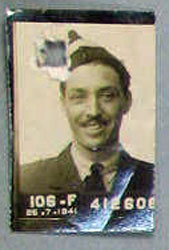
Pilot - F/O Thomas Archibald RAAF (412606), aged 32, of North Sydney, New South Wales. Australia. Buried Barmby Moor Churchyard, Yorkshire.
Bomb Aimer - Sgt Gerard Scully RAFVR (1219445), aged 21, of Edgbaston, Birmingham. Buried Olton Franciscan Cemetery, Solihull, Birmingham.
Flight Engineer - Sgt C Hewitson RAF (535057/535857).
Navigator - Sgt John Gerry RAFVR (1438258).
Wireless Operator / Air Gunner - Sgt George Edward Marlow RAFVR (1085425).
Air Gunner - Sgt Frederick Kenneth Smith RAFVR (1433744).
Air Gunner - Sgt J Currie RAFVR (1573760).
Thomas Archibald was born 11th September 1910 in Hamilton, Scotland but had moved to Australia with his family when he was young. He was working as a salesman when he enlisted into the RAAF in Sydney on 21st July 1941, after receiving basic training he was awarded his Wings on 27th February 1942. On arrival in the UK he trained at 6(P)AFU from 11th September 1942, 20 OTU from 3rd November 1942 and 1658 HCU from 2nd March 1943 prior to posting to 77 Squadron on 7th April 1943. He received a commission on 30th April 1942 and was promoted to F/O on 30th October 1942. He was awarded the DFC for service with 77 Squadron and the citation refers to the battle damage sustained on 31st April 1943, the citation reads.."One night in April 1943, this officer captained an aircraft which attacked Essen. Whilst over the target area the aircraft was repeatedly hit by fire from the ground defences, and one engine was put out of action. It was then discovered that one bomb had failed to release. Displaying great determination, Flying Officer Archibald made a second run over the target and released the bomb successfully. His aircraft sustained much damage but he flew it back to base with one engine unserviceable. This officer displayed great courage and outstanding devotion to duty." As a result of the accident at Bishop Wilton he was killed, he is buried at Barmby on the Moor Churchyard, near Pocklington and was thirty two years old.

George Marlow was awarded the DFM for service with 51 Squadron, Gazetted on 14th January 1944. He was killed serving with 51 Squadron on 21st January 1944 when Halifax LV775 was shot down on Ops to Magdeburg. He was twenty five years old and is buried in Berlin War Cemetery.
Frederick Smith was later posted to 35 Squadron PFF and was killed on 24th March 1944 when Lancaster ND597 was attacked by a night-fighter and exploded in the air. He is buried in Berlin War Cemetery and was thirty years old.
Halifax JB865 was built to contract ACFT/1808/C4 by English Electric Co.Ltd. at Samlesbury and was taken on charge by 77 Squadron at Elvington on 16th March 1943. As a result of battle damage on 4th April 1943 and then on 1st May 1943 Cat.A/FB damage was the damage assessment each time that saw it was repaired on site each time. On 13th May 1943 it crashed at Bishop Wilton on return from an operational flight to bomb Duisburg. Cat.E2/FA damage was the damage assessment and it was struck off charge on 5th June 1943 having flown a total of 70 hours 40 minutes total.