Wellington JA451 damaged by a night-fighter, returned to East Moor airfield.
On the night of 7th / 8th October 1943 this aircraft was one of ten 432 Squadron Wellingtons tasked with a minelaying operational flight. At around 00.25hrs on 8th October this aircraft was attacked by an Me110 night-fighter which inflicted damage to the flaps, hydraulics and fuel tanks. The Wellington was able to return to East Moor airfield and land safely.
The rear gunner's combat report has been located and adds a lot of detail to this incident, it reads.."...While gardening off Neuwerk Island, Wellington aircraft "C" was attacked by two Me110s. Just at the end of our D.R. run I saw an aircraft below us with navigation lights burning. The bomb aimer observed a plane climbing toward us. The bomb doors were opened, the vegetables dropped, doors closed and the pilot put the aircraft into a violent dive to port, leaving the enemy aircraft in close range of my guns, directly below and astern. I opened fire and he flew through the cone and exploded into flames, falling through the clouds 1000 feet below. A flash of explosion was observed by (the wireless operator) in the astro-dome, and (those) in the cockpit. Approximately 1000 to 1200 rounds were fired at the enemy aircraft. A few seconds later an aircraft workeing in conjunction with the decoy opened fire dead astern at 30 to 50 yards range with cannon and machine gin fire. Our aircraft was hit on the starboard side and (the pilot) made another dive to port as I opened fire at close range. Hits on our aircraft resulted in loss of air speed indicator, damage to the flaps and hydraulics. The starboard tail plane and wing were badly damaged and various other hits were scored by connon and machine gun fire." Signed Sgt Quesnel.
Pilot - Sgt Peter Woodrow Dennis RCAF (R/14066), of Fort William, Ontario, Canada.
Navigator - Sgt Gordon Atkins RCAF (R/157069), of La Riviere, Manitoba, Canada.
Bomb Aimer - P/O John Francis O'Gorman RCAF (J/26089), of Perth, Ontario, Canada.
Wireless Operator / Air Gunner - Sgt Peter Billie Woolfenden RAFVR (1318244), of London.
Rear Gunner - Sgt Joseph Herve Leon Quesnel RCAF (R/136383), of Parry Sound, Ontario, Canada; late of Reading, Berks, England.
Gordon Atkins. Nothing more is known about him yet.
Later in the year this crew had converted to flying Lancasters with 432 Squadron. For their actions on Ops on 26th November 1943 F/Sgt Dennis and Sgt Quesnel were each awarded DFM's when Lancaster LL632 was attacked by a night-fighter on Ops to Berlin. F/Sgt Dennis brought the badly damaged aircraft home safely and Sgt Quensal directed his pilot as to the whereabouts of the night-fighter after his turret was rendered unservicable.
Peter Dennis was born in 1923 in Fort William, Ontario where he worked as a clerk until enlisting in Winnipeg on 13th November 1941. He was awarded his Wings on 18th December 1942. He was awarded the DFM for service with 432 Squadron, the award appearing in the London Gazette on 25th January 1944. The citation reads.. "Flight Sergeant Dennis has completed numerous sorties and has displayed great skill, determination and devotion to duty. One night in November 1943 he piloted an aircraft detailed to attack Berlin. Whilst over the target area his aircraft was attacked on three occasions by enemy fighters. Nevertheless, he skilfully evaded the enemy aircraft and successfully
attacked the target, afterwards flying his badly damaged aircraft to base. His effort was highly commendable." He later received a commission and he and his crew completed twenty one operational flights with 432 Squadron before being posted out in mid-March 1944.
Joseph Quesnel was born in 1922 in Parry Sound, Ontario, Canada but later came to the UK and worked in Reading as a lathe operator. He returned home and enlisted in Toronto on 27th October 1941 and finished his basic training in Canada in January 1942. He survived the War and received his DFM by post in 1950! The citation for his DFM reads.. "As rear gunner Sergeant Quesnel has taken part in several sorties and has proved himself to be a cool and reliable member of aircraft crew. During a sortie one night in December 1943, his aircraft was attacked by enemy fighters. In the engagement Sergeant Quesnel fought with great resolution and destroyed one of the attackers. On another occasion in November 1943, his aircraft was attacked three times by enemy fighters. His turret was rendered unserviceable but he coolly directed his pilot's combat manoeuvres and the attacker was evaded. This airman has set a very fine example."
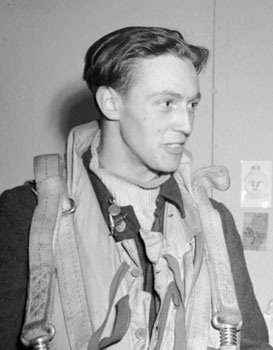
John O'Gorman was born in 1918 in Perth, Ontario and enlisted in Ottawa in May 1942. He was awarded the DFC for service with 432 Squadron, with notification appearing the London Gazette on 12th December 1944. The recommendation for his award adds more detail that the citation. When recommended on 12th September 1944 he had flown 32.5 operational flights with 432 Squadron between 2nd September 1943 and 4th August 1944 (186 hours flying time). The recommendation reads.."This officer has completed a long operational tour most successfully. His trips include Berlin (eight), Hanover, Frankfurt (twice), Stettin, Brunswick, Magdeburg, Stuttgart (twice). His co-operation, coolness and devotion to duty contributed in a large measure to the success of these operations. Flying Officer O'Gorman's cheerful confidence, reflected in the high standard of morale in his crew,
has inspired the whole unit. For his splendid record and high degree of technical ability, this officer is recommended for the Distinguished Flying Cross." Hugh Halliday's superb RCAF awards research has been used to compile this biography.
Peter Woolfenden received a commission to P/O on probation (emergency) on 2nd April 1944 (173999). His flying came to an abrupt end on the night of 28/29th June 1944 when Halifax MZ591 was shot down over France and he became a PoW. He rose to F/O (war subs) on 2nd October 1944.
Wellington JA451 was built to contract 92439/40 by Vickers Armstrong's Ltd at Blackpool and was delivered to 432 Squadron at East Moor on 14th September 1943. Following damage sustained on 8th October 1943, Cat.A/FB, the aircraft was repaired on site by a team from Vickers at Weybridge. On completion of repair it was returned to 432 Squadron on 12th November 1943. It was transferred to 300 Squadron at Ingham on 23rd November 1943 before being transferred to 16 OTU at Upper Heyford on 21st March 1944. It remained on charge with them until 16th December 1944. The aircraft was then transferred to 12 O.T.U. at Chipping Warden on that date and remained with them until 17th June 1945, just before the unit disbanded on 22nd June 1945. From there it was flown to MU store, it remained there until it was struck off charge and scrapped on 12th May 1947.