On the night of 13th / 14th May 1943 this 10 Squadron aircraft left Melbourne airfield at 23.55hrs to undertake an operational flight to bomb Bochum. Inbound between Cologne and Dusseldorf at around 02.00hrs the aircraft became caught in search lights and the pilot had to take violent evasive action to try and escape them, during this a flak burst near the tail caused the rudder to enter an over-balanced condition, control was lost and the aircraft turned over on to its back. The nose then dropped and the aircraft then dived down to 7,000 feet before the pilot could regain control. When the aircraft levelled out it was found that the mid upper gunner had left the aircraft. Shortly after this the aircraft was again caught in searchlights and further evasive action was taken with the pilot ordering the bomb load be released at 02.13hrs. The crew then turned for home taking a direct route back, while over Zuid Beveland at 03.10hrs two Junkers Ju88's were spotted close to the Halifax, one of the enemy aircraft attacked and the rear gunner of the Halifax returned fire, seeing bullets strike the starboard wing of the Ju88. Further attacks were made by both enemy aircraft and a further return of fire was made which hit the port engine and nose of one of the Ju88s. During the attacks the Halifax sustained damage to the port tail plane, elevator, rudder and a fuel tank. The Halifax then evaded any further Junkers Ju88 attack and made the safe return to base, landing at Melbourne at 05.03hrs. Unfortunately the mid upper gunner who baled out did not survive and he has no known grave. For his actions the rear gunner, Francis Compton, was awarded a DFM, Gazetted on 4th June 1943, for which the citation states..
"One night in May 1943, this airman was the rear gunner of an aircraft detailed to attack Duisburg. During the operation his aircraft was attacked and damaged by an enemy fighter Sergeant Compton resolutely returned fire and, following an accurate burst, the enemy aircraft stalled and then fell towards the ground, disappearing out of sight through the clouds. Half-an-hour later, the bomber was again attacked by enemy fighters. In the ensuing action Sergeant Compton coolly and skilfully used his guns while giving his captain directions which enabled him to evade the attackers. The following night during an operation against Bochum his aircraft which had been damaged by anti-aircraft fire, was attacked by two enemy aircraft. Displaying great skill and determination, Sergeant Compton shot one of them down. Although his guns were rendered useless, he gave his captain commentary which enabled him to evade the remaining fighter. On both occasions this airman displayed great courage and determination and contributed materially to the safe return of the aircraft." The battle damage incident prior to this one involved Halifax JB974 and I have a made a webpage specifically for that incident.
Mid Upper Gunner - Sgt Allan Frank McCoy RCAF (R/123498), aged 21, of Toronto, Ontario, Canada. Commemorated Runnymede Memorial.
Pilot - P/O Graham Thomas Beveridge RAFVR (146337).
Naviagtor - Sgt Stanley Kiran Gordon-Powell RAFVR (1332785).
Bomb Aimer - Sgt H C Billett RAFVR (1318497).
Wireless Operator / Air Gunner - Sgt R J Taylor.
Flight Engineer - Sgt Leslie Ernest Carey RCAF (R/125005).
Air Gunner - Sgt Francis Cyril Compton RAFVR (1322681).
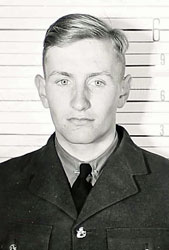
Allan McCoy was born on 23rd June 1922 in Toronto, Ontario, Canada and was the son of Frank and Winnie Edith (nee Farquharson) McCoy. He lived in Toronto until he was six then moved to Chicago, USA but later returned to Toronto. His parents appear to have split up and his mother moved back or remained in Toronto and would re-marry while his father remained in Chicago. As a young man he attended high school at Danforth, Illinois, USA and then worked as a clerk in a jewellers. He enlisted for RCAF service on 11th August 1941 in Toronto and after training in Canada he was awarded his air gunner's flying badge on 16th February 1942. On arrival in the UK he trained at 7 AGS, 24 OTU and 10 Squadron Conversion Flight before posting to 10 Squadron on 22nd November 1942.
This crew received a new air gunner and were later posted to 35 Squadron. They were flying Halifax HR812 on 28th June 1942 on Ops to Cologne when the aircraft was shot down by a night fighter over Belgium. Beveridge, Carey and Compton DFM were killed while the others survived and became PoWs.
Graham Beveridge received a commission to the rank of P/O on 10th May 1943.
Halifax HR695 was built to contract 1688/42 by Handley Page Ltd, at Radlett. On 30th January 1943 it was taken on charge by 10 Squadron at Melbourne. As a result of battle damage on 26th February 1943, 12th March 1943 and 1st May 1943 minor Cat.A/FB damage assessments took place and repairs on site were carried out each time. As a result of further battle damage on 14th May 1943 Cat.Ac/FB damage was the assessment. On 28th May 1943 and then 26th June 1943 minor Cat.A/FB battle damage occurred with a repair on site being made each time. On 29th November 1943 the aircraft was transferred to 1658 Heavy Conversion Unit at Riccall. On 24th September 1944 it was transferred to the newly formed 1669 H.C.U. at Langar. On 19th February 1945 it must have failed a major inspection so was sent for a repair at a works factory at Doncaster but on 6th March 1945 a further assessment saw it struck off charge.