Mosquito HJ918 near Cawood.
During the afternoon of 5th February 1943 the crew of this aircraft were one of two 25 Squadron aircraft that took off from Church Fenton airfield to carry out a training exercise. Around ten minutes after taking off and having climbed to 9,000 feet as individual aircraft they approached each other with one aircraft then due to begin a simulated target attack on the other aircraft. At 15.00hrs both aircraft then made climbing turns. At this point the crew of the second aircraft lost sight of other aircraft in cloud. A short time later witnesses on the ground saw this aircraft falling to the ground with no tail. It continued to break up and lost its starboard wing and engine, and the remaining forward fuselage and port wing before crashing near Primrose Hill, Cawood. Sadly both airmen in the aircraft were killed. The other portions of the aircraft crashed over a wide area on land both sides of the flooded River Wharfe. It appeared that the tail broke off while in a tight turn, or while being pulled out of a high speed dive.
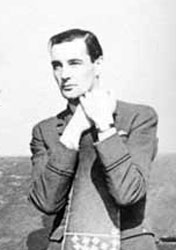
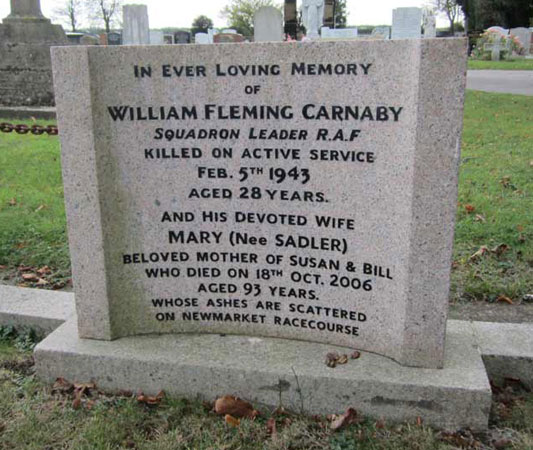
Pilot - S/Ldr William Fleming Carnaby RAF(aux) (90157), aged 28. Buried Newmarket Cemetery, Suffolk.
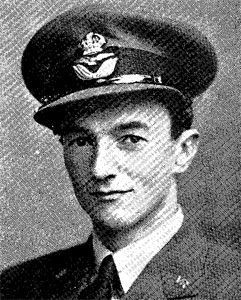
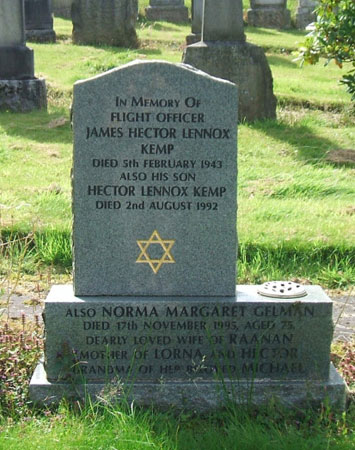
Navigator - F/O James Hector Lennox Kemp RAFVR (125946), aged 26. Buried Newkilpatrick (or Hillfoot) Cemetery, Glasgow.
William Carnaby was born in Dulwich, London on 24th November 1913 and was educated at Uppingham School and later Christ's College, Cambridge where he studied Economics and Law. While at Cambridge he learned to fly with the University Air Squadron. After leaving Cambridge he returned to London to study as a chartered surveyor to join his father's company. He originally joined the RAF in 1935 as a member of 601 Auxilliary Squadron and received a commission to the rank of P/O on 3rd January 1936. He later relinquished this commission and was granted a commission in the Auxillary Air Force Reserve of Officers on 1st March 1938. He is believed to have served with 601 Squadron in France after the start of the War and he later served with 264 Squadron during the Battle of Britain flying Defiants. He later joined 85 Squadron before a posting to 25 Squadron. He was promoted to F/O on 3rd September 1940 and F/Lt on 3rd September 1941, he was almost certainly in the rank of Acting S/Ldr when he died. Both photographs shown above were found on "http://www.bbm.org.uk".
James "Hector" Kemp was born on 6th April 1915 in Marylebone, London but attended Hillhead High School in Glasgow leaving in 1931. He joined the RAFVR before the War and initially served as an air gunner before re-training as a radio operator/observer. He received a commission on 7th May 1943 to the rank of P/O on probation (emergency), he was promoted to F/O on probation (war subs) on 7th November 1942.
Mosquito HJ918 was built by De Havilland at Hatfield and was received by 30 MU on 21st October 1942. The aircraft was taken on charge by 25 Squadron on 23rd December 1942. As a result of the crash on 5th February 1943 Cat.E/FA damage was the damage assessment and it was struck off charge on 11th February 1943 having clocked up just over 38 hours total flying time.