Wellington HF600 damaged by flak, returned to East Moor airfield.
On 7th July 1943 the crew of this 429 Squadron aircraft were tasked with mine-laying and bombing U-Boat pens at Brest, France when it was hit by flak from a flakship before the target area was reached. The damage was serious in that it knocked out the aircraft's hydraulic system which which operated bomb doors and the doors were also bent in the attack. The crew were unable to locate the target area and returned safely to East Moor. The aircraft was repaired.
Pilot - F/Lt Byron Frederick Norman Rawson RCAF (J/10982), of Hamilton, Ontario, Canada.
Navigator - F/O John Williamson Kerr RCAF (J/11940), of Port Credit, Ontario, Canada.
Bomb Aimer - F/O Ian Finlay MacIntosh RCAF (J/11962), of Lindsay, Ontario, Canada.
Wireless Operator / Air Gunner - F/Sgt Jim Smith RAFVR (953413), of Bradford, Yorkshire.
Air Gunner - Sgt Jim S Jakeman RCAF (R/93894), of Calgary, Alberta, Canada.
The few lines written here cannot fully express what a brilliant young man, officer, tactician and leader Byron Rawson was. He rose to become the youngest ever RCAF Wing Commander at the age of twenty one years old and became commanding officer of No.8 Group's Pathfinder Wing. In total he completed fifty three operational flights. He was born on 3rd December 1922 in Smooth Rock Falls, Ontario and attended McMaster University, Hamilton prior to enlisting in May 1941 aged eighteen. He completed his initial training and graduated with distinction and was commissioned the following year just after gaining his Wings in April 1942. On arrival in the UK he was posted to 6(P)AFU and in September 1942 to 22 OTU. He rose to F/O in December 1942 and was posted to 429 Squadron. On 17th April 1943 he was the pilot of Wellington HF912 which was tasked with Ops to Mannheim, he landed at Wattisham on return but the aircraft overshot and was damaged. F/O Rawson received slight injuries as a result but was soon back flying again. Rawson
was promoted to F/Lt the day after this incident. His time at 429 Squadron was broken with a spell at a tactics school for Bomber Command
but he returned to 429 Squadron to complete his Tour. For his service with 429 Squadron he was awarded the DFC, the notification appeared
in the London Gazette on 15th October 1943. He received his DFC in August 1944 and was presented by King George VI. The citation reads..
"Flight Lieutenant Rawson has taken part in operations against the enemy on some of the most heavily defended targets in Germany. As
acting Flight Commander and captain of aircraft, he has at all times set a fine example of courage, enthusiasm and devotion to duty."
After completing his first Tour he was posted as a Tactics Officer to 6 Group Headquarters in January 1944 for a "rest" from operational
flying but he managed to get in five operational trips while carrying out this duty. It is known that he flew to Boulogne as second pilot
in a daylight raid on the day after D-Day in June 1944 and later to the Ruhr Valley in a second daylight attack. He was later posted to become
Operations Officer at 6 Group Headquarters and was promoted to Acting W/Co. He later posted as operational commander of 8 Group Pathfinder Wing and a
posting to 405 Squadron which he commanded. He flew his fifty third operational flight on 19th April 1945 and for his work with the Pathfinders he
awarded the Bar to the DFC, Gazetted on 21st September 1945, the citation for this award
reads.. "This officer has now completed his second tour of operations, participating in attacks against major targets in Germany
and occupied territory. By his courage and determination to press home his attacks, despite enemy opposition, he has contributed
highly to the success of the squadron. Since the award of the Distinguished Flying Cross, Wing Commander Rawson has continued to
set a splendid example of skill and devotion to duty."
He returned home to Canada soon after the end of the War to his native Hamilton and enrolled at Osgoode Hall,
Toronto to study law in Autumn 1945. Although he should have already have held a degree to gain admission his was
waived in his case. In the months that followed his return home his mental health became effected and he suffered
a nervous breakdown. He took his own life just weeks after his twenty third birthday on 23rd December 1945.
Of note is that one of the Pallbearers at his funeral service was F/Lt Jack Kerr; who was with him for
many of his operational flights with 429 Squadron. His Bar to the DFC was presented to his mother at
Government House, Ottawa in 1948. His father Rev.Capt. Norman Rawson had first served in WW1 and had
also served in WW2, in 1944 he was in the UK and met with his son on an offical trip to 6 Group
Headquarters. On the same trip after D-Day he spent time in Northern France with Canadian troops.
He returned to Canada and his Ministry by the end of 1944.
21st January 1943 - Sea Sweep
16th/17th February 1943 - Lorient - (Damaged by friendly fire after being shot up by a convoy.)
19th/20th February 1943 - Wilhelmshaven
25th/26th February 1943 - GARDENING, Juist (returned early unable to locate target area.)
26th/27th February 1943 - Cologne
3rd/4th March 1943 - Hamburg
5th/6th March 1943 - Essen
26th/27th March 1943 - Duisburg - (Returned on port engine.)
28th/29th March 1943 - St.Nazaire - (Landed at Stanton Harcourt on return.)
4th/5th April 1943 - Kiel
8th/9th April 1943 - Duisburg - (Damaged by flak, landed at Downham Market on return.)
10th/11th April 1943 - Frankfurt
16th/17th April 1943 - Mannheim - (Crash landed at Wattisham)
4th/5th May 1943 - Dortmund
12th/13th May 1943 - Duisburg
13th/14th May 1943 - Bochum
23rd/24th May 1943 - Dortmund
25th/26th May 1943 - Dusseldorf
11st/12th June 1943 - Dusseldorf
21st/22nd June 1943 - Krefeld
22nd/23rd June 1943 - Mulheim
6th/7th July 1943 - GARDENING, Brest - (The incident recorded at the top of this page.)
13th/14th July 1943 - Aachen
25th/26th July 1943 - Essen
27th/28th July 1943 - GARDENING, Scharborn
29th/30th July 1943 - Hamburg
He returned home to Canada and worked in the Canadian electrical industry holding senior positions with Canada Wire and Cable,
Triangle Conduit and Cable and General Cable. He was also President of the Canadian Electrical Manufacturers Association. He died in February 2004.
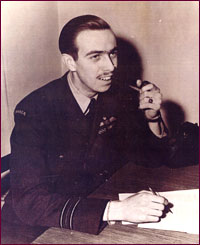
Jack Kerr was born in Ontario in November 1916 and enlisted in Toronto in May 1941, receiving his commission in 1942.
He almost certainly flew many of his twenty five operational flights of his Tour with 429 Squadron with Byron Rawson. Hugh Halliday's
research into RCAF awards has located the recommendation for his DFC, dated 26th October 1944 (1943?) by which time Jack Kerr was serving as
Radar Navigation Officer at 1659 HCU based at Topcliffe having been posted out of 429 Squadron on 2nd November 1943.
The recommendation reads.. "As navigator, Flight Lieutenant Kerr has made many attacks against the enemy's most heavily defended targets,
as well as having carried out mine-laying operations. His navigation at all times has been of an exceptionally high standard which
contributed largely to his crew completing their missions without serious mishaps. His keenness, courage and devotion to duty have been
most outstanding and he is recommended for the award of the Distinguished Flying Cross." He was presented with his DFC after war on 2nd June 1949.
The list of his 429 Squadron operational flights reads..
Ian MacIntosh was born in October 1911, he was the son of Dr. F.H. MacIntosh and Mrs. MacIntosh of Lindsay, Ontario. He attended Queen’s University in Kingston, Ontario, and had worked in the pulp and paper industry in New Brunswick and British Columbia but was living in Lindsay, Ontario when he enlisted in Montreal in May 1941. He received his commission in 1942.
He was recommended for the DFC on 8th October 1943 when he had flown 25.5 operational flights between 21st January 1943 and 27th September 1943, it reads..
"This bomb aimer has been outstanding in the performance of his duties. His coolness under fire and his exceptional qualities of leadership have inspired
his crew. He has pressed home the attack through the heaviest defences and bombed his target under the most difficult conditions. I consider that this
officer's keenness for the offensive and his example deserve the award of the Distinguished Flying Cross." He was presented with the DFC at Buckingham
Palace on 11th August 1944. It is believed that he arrived at 429 Squadron as a Sergeant and left as Flight Lieutenant on 4th November 1944.
Jim Jakeman was posted out of 429 Squadron on 16th December 1943 but nothing more is known of him other than he and navigator Ian MacIntosh
married sisters while stationed in the UK.
Wellington HF600 was built to contract B124362/40 by Vickers Armstrong's Ltd at Chester. It was taken on charge direct on 7th June 1943 by 428 Squadron at Middleton St.George. It was then transferred to 429 Squadron at East Moor on 15th June 1943. Following the damage sustained above Cat.Ac/FB damage was the damage assessment and it was repaired at East Moor by a team from Vickers at Weybridge. The repair was complete on 16th July 1943. Whilst returning from Ops on 3rd August 1943 it suffered engine trouble and made emergency landing at Swanton Morley. Repairs were carried out on site there but on completion later in the month, the aircraft was not returned to it's unit. It was transferred to 17 OTU at Silverstone on 17th August 1943. It was then destroyed in a Cat. E2/FA accident on 29th September 1943 when it dived into ground 1.5 miles West of Wappenham, Northamptonshire killing six of its then crew.