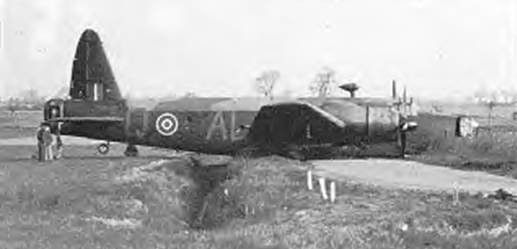
Wellington HE635 at East Moor airfield.
On 28th April 1943 429 Squadron Wellington HE635 took off from East Moor at 21.01hrs with two 1500lb mines on board. The crew were
tasked with a mine-laying operational flight but failed to find the Eglantine area to lay their mines so returned with
them on board. At 01.49hrs the aircraft overshot the landing at East Moor and ran onto a road on the edge of the airfield.
The mines were later removed and the aircraft repaired. The crew were uninjured.
Pilot - P/O John Albert Edwin Lancaster RAFVR (142541).
Navigator - P/O Ronald W Hale RCAF.
Bomb Aimer - Sgt Lyndsay J Boyes RCAF.
Wireless Operator / Air Gunner - F/Sgt Alexander L Thom RAF.
Air Gunner - P/O Manuel Rabinovitch (or Raber) RCAF, of Medicine Hat, Alberta, Canada.
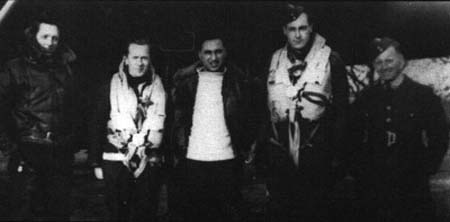
Sgt Lancaster and his crew; Boyes, Thom, Raber, Lancaster and a member of ground crew a F/Sgt Wood.
John Lancaster was born in Wandsworth, London in Decemeber 1943 and was living in Yorkshire when he enlisted into the RAF in 1941.
He and his crew were one of the first three 429 Squadron crews to arrive at East Moor when 429 Squadron were posted there
in November 1942 and his and the other two of these first three crews became known as "The Muskateers".
John Lancaster received a commission on 2nd March 1943 to the rank of P/O on probation (emergency)
Another website details the early 429 Squadron Wellington-days and states.. "Sgt Manuel Rabinovitch, part of
Sgt Lancaster's crew, said that the day after they arrived there were still no aircraft for the crews to fly in.
They kept busy getting flying gear issued, learning the lay of the land, participating in various sporting events
and doing what training they could without aircraft. According to Sgt Boyes logbook, Lancaster's Bomb Aimer, the
crew didn't make their first training flight until 31st December 1942." "76 and 78 Squadron, stationed at
Linton on Ouse, were responsible for taking the "Bison" pilots on their second Dickie trips. These trips took
place from 18th November 1942 to 9th December 1942." "Reporting to the squadron in the early days was not an event
that inspired confidence. When Sgt John Lancaster and his crew arrived at the small train station in the wilds of
North Yorkshire they called to the East Moor Station to have someone pick them up. The Orderly Officer at the
other end of the phone told them there was only one truck on strength and it had been dispatched
to the York train station to pick up other aircrews that had arrived. The Orderly Officer, who was
also the Medical Officer, sent the ambulance out to pick them up. The men had to leave their baggage
at the train station because there was no room in the ambulance for the men and their kit. They
were dropped off at the Sergeant's Mess. The Orderly Sergeant promptly appeared and informed the
gaggle that there was only one cook and two kitchen staff and they were located at the Airmen's
mess. They enjoyed a meal of tea and sandwiches at the Airmen's mess then bedded down for the night
at the Senior NCO's Barracks! At this point there were a total of two officers, the Medical Officer
and Adjudant, one WO1, one Quartermaster Sergeant with a staff of three airmen along with the newly
arriving aircrews." "A great deal of excitement occurred on 25th November 1942 when the roar of
Hercules engines of the Squadron's first four Wellington MkIII's flew over the airfield and landed
at 14.30hrs. S/Ldr Cairns, Sgt Lancaster and two other crews (probably DeBussac and Bruce) had picked
up the Wimpy's from Driffield, which was fifteen minutes airtime from East Moor. These four Wellington's
were handed over by 466 (Australian) Squadron." "The weather was very miserable and permanently foggy
allowing Lancaster and his crew to fly only twice in December." This account is included to give the
casual reader of this website an idea of the sparseness of East Moor at this stage in the War as it
prepared for operational readiness."
"P/O Lancaster had been doing most of the test flying, familiarization flying for the new pilots and acting as the Senior Pilot
in A-Flight ever since he arrived at the Squadron. At this point P/O John Lancaster and crew had
completed twelve operational flights. The following day Ron Hale, Lyn Boyes and Manny were called
into the Orderly Room and given applications for their officer commissions to fill out and return
to the Adjutant. They were told it was RCAF policy to commission all crews who had finished
twelve ops and had no derogatory items on their record. After this task was completed they helped P/O Lancaster move into his
new digs at the Officers Quarters at Sutton Hall."
Lancaster's last operational flight with 429 Squadron was on 3rd July 1943. He was promoted to F/O on probation (war subs)
on 2nd September 1943. John Lancaster was awarded the DFC for service with 429 Squadron, Gazetted on 7th December 1943, there
appears to have been no citation as such. He had completed his Tour and was posted to 1679 HCU on 27th October 1943. He was
later promoted to F/Lt on 2nd March 1945 and resigned his commission on 26th June 1947.
This photograph is often identified as being Wellington HE635 but this is almost certainly an error.
"Q-Queenie", as it was named, was damaged in landing away from East Moor on the Mannheim raid on 16th-17th
April 1943. I include the photograph here to attempt to clarify the identify of this aircraft. The aircraft
shown above shows the coding "AL-Q" but Wellington HE635 carried the code "AL-C".
Both Hale and Boyes were posted to 23 OTU on 4th November 1943,
Manuel Rabinovitch joined the RCAF in September 1941, he was later posted to 432 Squadron but became a PoW on Ops to Frankfurt
on 26th November 1943 flying in Halifax LK995. The autobiography "Manny goes to War" published in 1999 gives a full account
of his wartime experiences as a Jewish officer held in a German PoW camp.
Alexander Thom was almost certainly born in Birmingham in 1918. He was initially posted to 24 OTU on 3rd December 1943
and later served with 405 (Pathfinder) Squadron at Gransden Lodge in early 1945. He probably married in Smethwick, Worcestershire in 1942.
Wellington HE635 was built to contract B124362/40 by Vickers Armstrong at Chester and was delivered directly to 429 Squadron
at East Moor on 22nd February 1943. It's AM Form 78 states that it sustained minor Cat.Ac/FA damage on 2nd March 1943 but how this happened is not yet known. It was repaired on site and returned to 429 Squadron on 12th March 1943. As a result of the mishap at East Moor on 28th April 1943 Cat.Ac/FB damage was the damage assessment and it was repaired on site again at East Moor. It was returned to 429 Squadron on 19th June 1943 but was then transferred to 83 OTU on 29th July 1943 when the unit formed at Childs Ercall,
this airfield's name was changed to Peplow on 20th August 1943. This unit disbanded on 28th January 1944. What happened to it immediately isn't known though it may have been left at Peplow. On 11th March 1944 it received a Cat.B/FA damage assessment that saw it sent for repair in works somewhere. It resurfaced in November 1944 but went to store. It remained in storage until being struck off charge and sold for scrap on 30th December 1948.