Wellington HE350 damaged by flak, landed at East Moor airfield.
On the night of 3rd / 4th August 1943 the crew of this Wellington took off from East Moor at 21.21hrs for a mine laying operational flight to lay mines in the "Beeches" area. This aircraft was slightly damaged by fire from a flakship or flakships. They returned to East Moor and landed at 02.30hrs. This was the last operational flight carried out by 429 Squadron while based at East Moor, they moved to Leeming in the days that followed.
Pilot - Sgt David MacMaster Smith DFM RCAF (R/106305).
Navigator - Sgt William Pass RAF.
Bomb Aimer - F/Sgt Douglas Rae Nelson RCAF (R/114213).
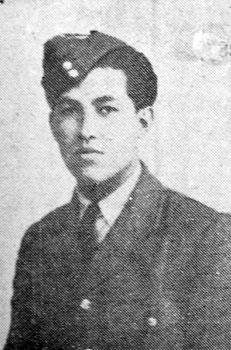
Wireless Operator / Air Gunner - Sgt Randolph Thadius Abbott RAFVR (1382581), of St.Vincent, West Indies.
Rear Gunner - Sgt Herbert Henry Rodgers RCAF.
F/Sgt Abbott and Sgt Nelson were both slightly injured in the attack by the Me110, the aircraft was crash-landed at Hardwick airfield at 04.50hrs on 26th June 1943.
On the night of 25th / 26th November 1943 Smith, Nelson and Abbott were in Halifax LK995 on Ops to Frankfurt. The aircraft was shot down by a night-fighter over Belgium and all
three became PoWs.
Randolph Abbott was one of a small band of West Indians who travelled to the UK to join the RAF in 1940. Born in June 1916 his parents are recorded as living in Barataria, Trinidad. He was employed in Aruba, Netherlands West Indies prior to travelling to England on his own accord to join the RAF. Having survived being a PoW he initially lived in Chorley but later moved to the USA and died in 1981.
David Smith was born in Winnipeg in 1922, his home in was St.James, Manitoba but he enlisted for RCAF service in Winnipeg on 27th May 1941. After completing his training he was posted to 429 Squadron in Spring 1943 and on 3rd April 1943 he was the pilot of Wellington Z1670 on an airtest when he was forced to land at South Kilvington near Thirsk. He and Doug Nelson and the others on the aircraft all survived. He appears to have flown his first operational flight with 429 Squadron on 11th June 1943. He awarded the DFM for his efforts on the night of 25th / 26th June 1943 in Wellington HF495, notification was printed in the London Gazette on 27th July 1943 although the award was not presented until 8th May 1948. The Citation reads.. "This airman was the pilot of an aircraft which attacked Gelsenkirchen one night in June 1943. On the return flight the bomber was attacked by an enemy fighter and sustained damage to the fuselage, the hydraulic system and the wireless equipment, while two of the crew were wounded. A fire broke out in the bomb bay but Sergeant Smith violently dived his aircraft and the flames were extinguished by the force of the wind. On reaching an airfield in this country he effected a successful crash landing. Sergeant Smith displayed great skill and resource in harassing circumstances."
F/Sgt Nelson was born in May 1920 in St.Catharines, Ontario. His family moved to North Tonawanda, New York State, USA when he was young but he returned to his native Canada to enlist into the RCAF in 1941. He was posted in to 429 Squadron from 22 OTU on 27th December 1942. While stationed at East Moor he would meet his future wife. He survived the crash-landing of Wellington Z1670 near South Kilvington on 3rd April 1943. After being liberated in 1945 he returned to England and married at Acomb, York before returning to Canada together. Also of interest is that in 1955 they and their two children returned to Yorkshire to live where he started a motor mechanic buisness and later ran a service station at Green Hammerton, between York and Harrogate. Douglas Nelson died in Yorkshire on 3rd May 1997.
Sgt Pass was posted into 429 Squadron from 427 Squadron on 6th May 1943, and posted out to 24 OTU on 29th November 1943 probably for instructing duties. Nothing more is known about him.
A commissioned Herbert Rodgers was later posted to 432 Squadron and on 28th May 1944 he was flying in Halifax LK811 on Ops to Bourg-Leopold when the aircraft crashed in Holland. He was one of four that died and his body was either never found or the burial location was unknown post-war, he is commemorated on the Runnymede Memorial. He was twenty three years old.
Wellington HE350 was built to contract B124362/40 by Vickers Armstrong's at Chester and was delivered to MU storage in December 1942, it was issued to 429 Squadron at East Moor on 11th June 1943. It suffered Cat.A/FB flak damage on 29th June 1943 and was repaired on site with the repairs being completed by 3rd July 1943. It then suffered damage due to the undercarriage collapsing on landing on 26th July 1943. Cat.Ac/FA damage must have been the damage assessment as it remained at 429 Squadron. On 4th August 1943 it was slightly damaged by flak and was again repaired on site at East Moor, Cat.A/FB damage probably being the damage assessment. None of the three damage incidents at East Moor are recorded on the aircraft's AM Form 78. The one on 26th July 1943 sounds on the face of it to be fairly serious damage. On completion of these final repairs in August it was issued to 1485 Target Towing Flight at Skellingthorpe on 13th August 1943. On 20th September 1943 both engines cut on take off and it crashed two miles north-east of Skellingthorpe, Lincolnshire. Cat.E2/FA damage was the damage assessment and it was struck off charge.