On the night of 21st / 22nd October 1943 the crew of this aircraft took off from Croft airfield to undertake a night cross-country training exercise with 1664 Heavy Conversion Unit, such exercises would see the crews navigate their way around the UK to various landmarks used as turning points before returning to their home airfield to land. At just after 01.30hrs the Halifax had completed the training route and had returned to the air over Croft, under normal circumstances the aircraft would have made a good landing their soon after. On arrival in the Croft area the aircraft made three passes over the airfield but did not make any attempt to land, it then flew off in a southerly direction and began a steep banked turn to the left to (it was thought) get the aircraft into position with airfield lighting used prior to making a landing. During the banked turn the port outer engine cut out, with the port wing then being in the lowest position in the steep banked turn and the starboard wing (pointing up) having more power than the port wing (with a dead engine causing drag and pointing down) the aircraft sank towards the ground. It was thought that the pilot had then momentarily lost control but was able to just about recover control and was nearly able to level out the aircraft but it ran out of available height. The port wing was still slightly low by the time it clipped the ground at Atley Hill and it ran down a field with the port wing touching the ground, it then hit a hedge and trees which broke the aircraft up across a field. Atley Hill, near Pepper Arden is part of the South Cowton parish and was the site of a deserted medieval village. Sadly five of the crew were killed in the crash. The sixth member of the crew was thrown out as the aircraft broke up and while he was taken to the Friarage Hospital in Northallerton and received treatment for his serious injuries but he died four days later. The crash investigation believed that the only way the port outer engine could fail when it did was down to lack of fuel and that the fuel tank settings were selected in a way that would cause a failure of this engine. A change to the fuel tank settings must only have been made during the banked turn and because this brief error unfortunately caused an engine on the lower wing to fail control was lost.
Pilot - F/Sgt Hugh Robertson Simmons RCAF (R/134345), aged 27, of Winnipeg, Manitoba, Canada. Buried Harrogate Stonefall Cemetery, Yorkshire (C/D/2).
Flight Engineer - Sgt Raymond Albert Harris RAFVR (2203780), aged 19, originally of Coventry, late of Barnoldswick, Lancashire. Buried London Road Cemetery, Coventry, Warwickshire.
Navigator - F/O Stephen Henry Martin RCAF (J/21567), aged 26, of Toronto, Ontario, Canada. Died of injuries on 26th October 1943. Buried Harrogate Stonefall Cemetery, Yorkshire (C/D/5).
Bomb Aimer - Sgt Ashley Bertram White RCAF (R/158113), aged 25, of North Battleford, Saskatchewan, Canada. Harrogate Stonefall Cemetery, Yorkshire (C/D/3).
Wireless Operator / Air Gunner - Sgt Kenneth Irvin RAFVR (1546937), aged 21? Of Shouth Shields. Buried Harton Cemetery, South Shields (O/11966).
Air Gunner - Sgt John Louis Campbell RCAF (R/162832), aged 28, of Vancouver, British Columbia, Canada. Harrogate Stonefall Cemetery, Yorkshire (C/D/1).
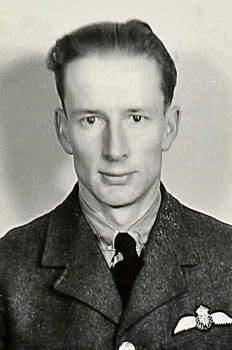
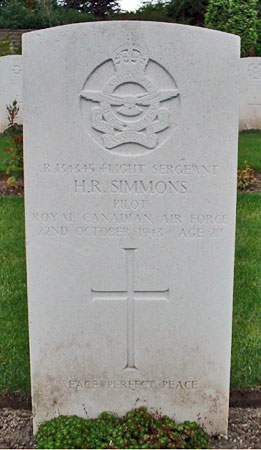
Hugh Simmons was born on 27th October 1915 in High Bluff, Manitoba, Canada and was the son of James Alfred and Lydia (nee Coxsmith) Simmons. He and his family later moved to Portage la Prairie. After leaving high school in Portage in 1936 he began working as a bridgeman for the Canadian National Railways and went to live in Winnipeg. He married Margaret Knight there on 5th July 1941 and was living there when he enlisted for RCAF service on 4th October 1941. having undertaken basic flying training in Canada he was awarded his Pilot's Wings on 30th December 1942. On arrival in the UK in early 1943 he trained 14 (P)AFU, 1518 BAT Flight and 22 OTU before posting to 1659 HCU at Topcliffe on 9th Sepetmber 1943. For some reason he (and probably the whole crew) was then posted out of 1659 HCU the following day and to 1664 HCU at Croft on 21st Septamber 1943. His wife later moved to Toronto.
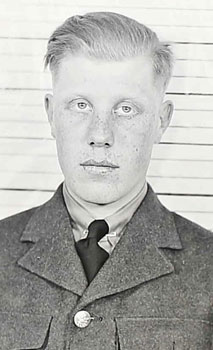
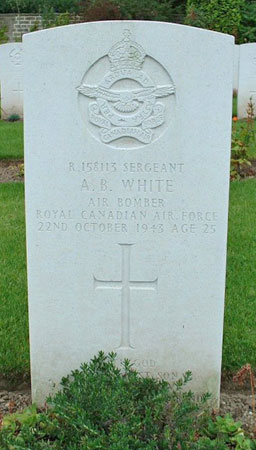
Ashley White was born on 5th December 1917 in North Battleford, Saskatachewan, Canada and was the son of Bertie James and Elizabeth Edna (nee Wade) White. After leaving school he had worked as a variety of jobs, latterly as a carpenter. He enlisted for RCAF service on 31st March 1942 in Saskatoon and after training he was awarded his air gunner's flying badge on 19th February 1943. On arrival in the UK he trained at 5 AOS and 22 OTU before the same brief posting to 1659 HCU. He was then posted to 1664 HCU on 21st September 1943.
Stephen Martin was born on 6th May 1917 in Toronto, Ontario, Canada and was the son of William Gill and Anne Louisa (nee Halls) Martin. As a young man he worked as a salesman, latterly for the British American Oil Co, in Canada. He enlisted for RCAF service on 8th October 1941 in Toronto for aircrew duties, after initially beginning pilot training he switched to navigator training and was then awarded his navigator's flying badge on 4th December 1942. While training in Canada he married Mary Barbara Hanley on 18th April 1942. On arrival in the UK he further trained at 3 (O)AFU, 22 OTU and was also posted to 1659 HCU on 9th September 1943. He too was then posted out of 1659 HCU the following day and then to 1664 HCU on 21st September 1943. As a result of the crash of Halifax EB199 he sustained serious injuries including a broken back and was taken to the Friarage Hospital but unfortunately succombed to his injuries there in the early hours of 26th October 1943.
John Campbell was born on 11th December 1914 in South Vancouver, British Columbia, Canada and was the son of John McPherson and Valerie Lillian Campbell. He left school in 1931 and had worked for a timber company before becoming a "streetcar operator" (tram driver?) for the BC Electric Street Railway from 1936 until enlisting for RCAF service. He married Louise May Russell in Sorrento, British Columbia on 14th October 1939 and they had a baby girl in 1940. He enlisted for RCAF service on 29th April 1942 for aircrew duties and having undertaken basic training in Canada he was awarded his air gunner's flying badge on 25th June 1943. On arrival in the UK in late-July 1943 he trained at 22 OTU before being posted to 1659 HCU with other members of this crew on 9th September 1943. His stay at 1659 HCU was also brief, he too was posted to 1664 HCU on 23rd September 1943.
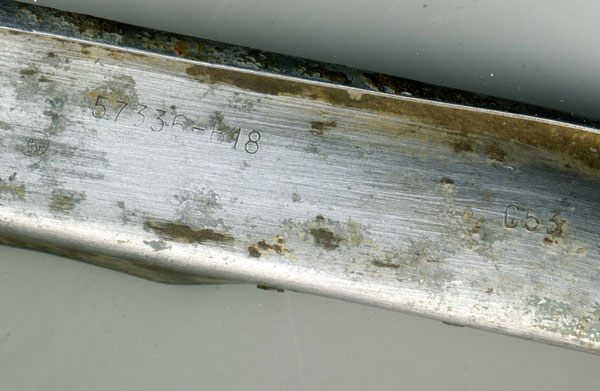
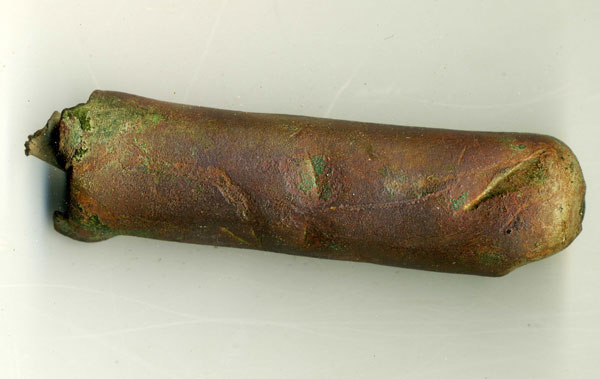
Air historians Albert Pritchard, Eric Barton and Ken Reast located small fragments on the surface at the crash site in May 1999 with permission from the landowner, confirming the crash location. The item above and below was retained by Eric Barton after the visit. The item above shows a typical Halifax part number while the item below is the outer portion of the aircraft's pitot tube. A memorial was placed on the site of the crash in August 2016 by the flight engineer's nephew Mr Ray Harris.