Halifax EB198 near Huby, Easingwold.
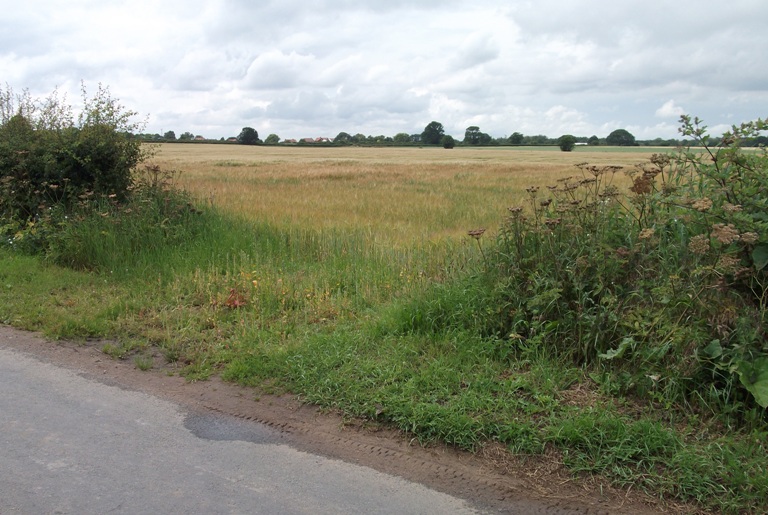
On 15th September 1943 the crew of this 1664 Heavy Conversion Unit aircraft were undertaking a practice bombing training exercise over the Strensall Ranges near York. As they were about to drop their third bomb on the range the pilot's escape hatch opened at the jettison pins. The crew attempted to close the hatch but it broke off and as it broke free it hit and damaged the starboard fin leading edge and starboard rudder. Control of the aircraft was lost as a result of this damage to the tail of the aircraft. The pilot instructed his crew to bale out but he stayed with aircraft possibly trying to force-land the aircraft. It would appear unlikely that he was trying to find the nearest airfield as he must have flown over East Moor airfield but was perhaps trying to fly the aircraft back to base of Croft (but speculation on this researchers part). Before a landing could be made the aircraft went into a dive from which the pilot recovered but it then made a slow roll and crashed at around 12.30hrs (this time varies between sources, ranging from 12.25hrs, 12.35hrs and 12.45hrs). The rest of crew survived but the pilot was killed when the aircraft crashed between Huby and Stillington on land belonging to, as the police report quotes, "Newtons Farm, Huby" though there is no farm with this name at Huby (it is actually Newton House Farm). A hole in the hedge made by the crashing aircraft is still to be seen today. Tholthorpe airfield's Flying Control log book mentions this incident, it was witnessed crashing by the crew of a 431 Squadron that was in the air at the time. It refers to EB198 as "AO385" and I do not know what this means.
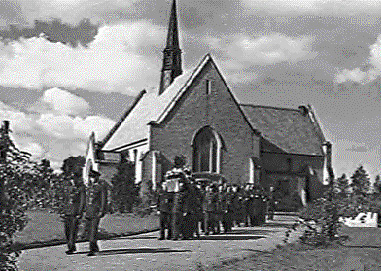
The pilot's funeral took place on 21st September 1943 at 11.30hrs, Linton on Ouse supplied the Guard of Honour and the firing party and was attended by surviving members of his crew. The Unit's chaplin, S/Ldr Earl Lautenslager officiated.
Halifax EB198 was built to contract ACFT/637/C4/C by Rootes Securities at Speke and was received by 12 MU on 2nd June 1943. The aircraft was taken on charge as new by 1664 Heavy Conversion Unit at Croft on 15th June 1943. As a result of the crash at Huby on 15th September 1943 Cat.E2/FA(Burnt) damage was the damage assessment and it was struck off charge on 23rd September 1943.
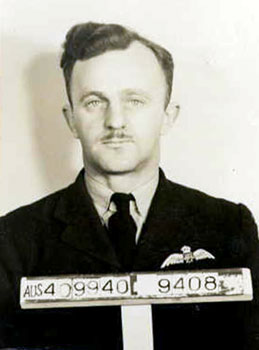
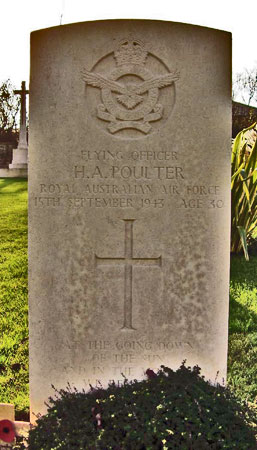
Pilot - F/O Henry Alfred Poulter RAAF (409940), aged 30, of St.Kilda, Victoria, Australia. Buried Harrogate Stonefall Cemetery, Yorkshire.
Flight Engineer - Sgt Harry Glass RCAF (R/156584), of Dufferin County, Ontario, Canada. Uninjured.
Navigator - Sgt Cyril William Way RAFVR (1314764), of Mudford, Somerset. Uninjured.
Bomb aimer - F/O Christopher Wellington Graham RAFVR (151241), of Trinidad, West Indies. Uninjured.
Wireless Operator / Air Gunner - Sgt Stanley Charles Sharp RAFVR (1317939). Slightly injured.
Mid Upper Gunner - Sgt H J Robinson RCAF (R/138018), of Montreal, Quebec, Canada. Uninjured.
Rear Gunner - P/O Douglas Findlay RAFVR (145465). Uninjured.
Henry Poulter and his gravestone in Harrogate Stonefall Cemetery. He was born on 24th September 1912 at Richmond, Victoria and enlisted into the RAAF on 7th November 1941 in Melbourne, Victoria, Australia. He was married and had a young daughter and was a school teacher in civilian life in Australia. While training at 24 OTU on 20th June 1943 the undercarriage of Whitley AD701 failed to lower on approach to land at Honeybourne and he was forced to make a wheels-up landing. The photograph below shows his funeral procession in the cemetery at Harrogate. I thank his great grand-daughter for contacting me in April 2012.
In July 2011 I met with Stillington resident Mr John Sparrow who remembered this incident occurring in 1943 and was himself at school in Stillington at the time. He kindly showed me where the aircraft crashed, it is the area shown in the photograph above with the hole in the hedge being created by the crashing aircraft.
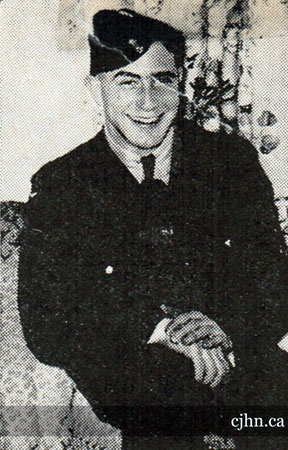
Harry Glass was born on 21st April 1921 in Dufferin County, Ontario and was the son of Joseph Benjamin and Esther (nee Rumunick) Glass. His parents were both born in Poland but had emigrated to Canada before they married in Toronto on 1917 and his father ran a ladies clothing buisness in Toronto. After leaving school Harry undertook a number of jobs including being a news agent for the Canadian Pacific Railroad and a car mechanic, he had entered the Galt Aircraft School in 1941 to train as an aero engine mechanic and was still there when he enlisted into the RCAF in Galt on 31st January 1942. He originally trained as a member of ground crew as an aero engine mechanic. On arrival in the UK in February 1943 he served at 1659 HCU and 1664 HCU as an aero engine mechanic but in the summer of 1943 he remustered as aircrew to be a flight engineer. He received training at No.4 School of Technical Training and was posted back to 1664 HCU on 21st August 1943 as aircrew to continue his training. After receiving a replacement pilot for Henry Poulter killed at Huby his crew were later posted to 429 Squadron on 6th January 1944. As stated above he was awarded an immediate DFM, Gazetted on 2nd May 1944, for his actions a few weeks previously. The citation for his award reads.."This airman was the flight engineer of an aircraft detailed to attack Nuremberg one night in March 1944. During the operation the aircraft was repeatedly attacked by fighters and sustained extensive damage. A fire commenced but Sergeant Glass, by his gallant and determined efforts, succeeded in extinguishing the flames. Later, whilst over the North Sea on the homeward flight, the pilot was forced to bring the aircraft down on to the water. Two wounded members of the crew were in danger of losing their lives but were saved by Sergeant Glass who also assisted other members of the crew into the dinghy. He proved a tower of strength in most distressing circumstances." He then received a commission on 15th June 1944 (C/87159). P/O Harry Glass was still serving with 429 Squadron on 8th August 1944 when he was flying in Halifax LW132 on Ops to Foret de Chantilly, the aircraft caught fire at 15,000ft outbound and broke up at 5,000ft. Only one of his then crew was able to bale out before the aircraft crashed into the sea. Harry Glass was sadly killed and his body was recovered and buried in Brookwood Cemetery, Surrey. He was twenty three years old. The photograph of his shown above was found on "www.cjhn.ca".
Stanley Sharp was also posted away from 429 Squadron on 5th August 1944 to 405 Squadron PFF. He died in 2003. I thank his son for contacting me in April 2020.
Those who baled out and survived the incident detailed at the top of this page later were allotted another pilot, almost certainly F/O James Henry Wilson RCAF (J/16948) and completed their training and were posted to 429 Squadron in January 1944. On 22nd March 1944 all of the above crew who survived the incident to Halifax EB198 were involved in a taxying accident in Halifax LW619 which collided with Halifax LK801 on the ground at Leeming. On 30th/31st March 1944 Glass, Way, Sharp, Robinson and Findlay of the Halifax EB198 crew were undertaking an operational flight to Nuremburg in Halifax LK804 when it was attacked by Junkers Ju88's and was badly damaged. A fire broke out in the aircraft but Sgt Glass was able to put this out, on their return they were forced to ditch the badly damaged aircraft in the English Channel when the fuel ran out. Unfortunately the nose section of the aircraft broke away on impact with the water and the pilot was unable to get clear of the aircraft before it sunk and he was sadly lost. The rest of the crew climbed into the dinghy and although injured they were later picked up off the Normanby coast by high speed launches. Their then pilot, F/O Wilson, was never found and is commemorated on the Runnymede Memorial. For his efforts in fighting the fire on board the aircraft and his efforts in rescuing his crew Harry Glass was awarded a DFM, Gazetted on 2nd May 1944.
Cyril Way was injured when Halifax LK804 ditched in the English Channel and may well have spent a period in hospital after being rescued. He was then posted to 420 Squadron in May 1944 and received a commission on 18th October 1944 to the rank of P/O on probation (emergency) (186920). He was sadly killed on 16th January 1945 when his aircraft, Halifax NA192, failed to return from Ops to bomb Magdeburg. He is now buried in Berlin War Cemetery and he was still just twenty one years old. Well after his death he was awarded the DFC for his service, with effect from 15th January 1945, but Gazetted on 11th December 1945.
Douglas Findlay received a commission to the rank of P/O on probation (emergency) on 5th June 1943, other accounts of the incident to Halifax ED198 list his rank as being Sergeant but this is an error. He was promoted to F/O on probation (war subs) on 5th December 1943. He too was posted to 420 Squadron in May 1944.
Christopher Wellington Graham was one of a small number of West Indian aircrew who served in Bomber Command. He received a commission on 19th February 1943 to P/O on probation (emergency). He was posted from 1664 HCU to 429 Squadron in January 1944 with the rest of the crew involved in the incident to Halifax EB198, he was then posted to 405 Squadron in April 1944 but returned to 429 Squadron in May 1944 and was then posted to 420 Squadron in July 1944. He was then promoted to F/O on probation (war subs) on 19th August 1943. He rose to F/Lt on 19th February 1945. He remained in the Reserve after the War and was granted a substantive rank of Flight Lieutenant on 1st November 1947 (with seniority back dated to 19th August 1946) but nothing more is known of him.
The only member of the crew of Halifax EB198 not fully identified is Sgt Robinson. H.J.Robinson had previously served in the Merchant Navy in 1940 but later transferred to the RCAF. After his time with 429 Squadron he was posted to 431 Squadron in April 1944. A F/Sgt H J Robinson was posted from 427 Squadron to 429 Squadron on 15th May 1944 and if he was the same person he must have been posted from 429, to 431, to 427 and back to 429 Squadron in less that a month. If so then this posting was only brief as he was posted to RCAF "R" Depot on 23rd May 1944. R-Depot was a centre aircrew went to just before they were repatriated to Canada.