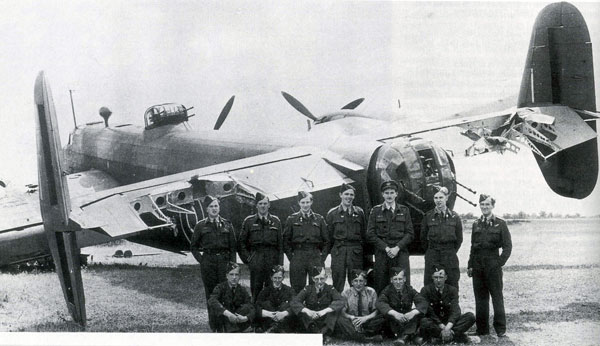
On the night of 2nd / 3rd August 1943 the crew of this 10 Squadron aircraft were undertaking an operational flight to bomb Hamburg and took off from Melbourne at 23.45hrs. The aircraft was attacked and damaged by a Junkers Ju88 during the flight, the Halifax's gunners returned fire and the rear gunner was later credited with damaging it. The pilot of the halifax was able to make a return to land at Melbourne at 04.15hrs but the undercarriage collapsed and it came to a halt with further damage. For their actions on this night the pilot was awarded the DFC and the rear gunner was awarded the DFM. Halifax DT792 carried the nose-art of "Farouk". The photograph shown above is believed to show the damaged Halifax DT792 after landing at Melbourne on 3rd August 1943 with the crew listed below along with ground crew.
Pilot - F/O John George Jenkins RAFVR (130667).
Flight Engineer - Sgt J Ollerton.
Navigator - Sgt John William Desmond Ryan RAFVR (1387936).
Bomb Aimer - Sgt Eric James Saddington RAFVR (1218578).
Wireless Operator - Sgt James Edward Whatley RAFVR (1330479).
Air Gunner - F/Sgt Arthur Leslie Fuller RAAF (420464).
Air Gunner - Sgt Richard Neil Hurst RCAF (R/151677).
The joint citation for the DFC/DFM was Gazetted on 24th August 1943 and adds further details, it reads.. "Flying Officer Jenkins and Sergeant Hurst were pilot and rear gunner respectively of an aircraft detailed to attack Hamburg one night in August 1943. During the operation the bomber was intercepted by a fighter which attacked from close range. Flying Officer Jenkins took the necessary evading action and when the enemy aircraft attacked the second time Sergeant Hurst delivered accurate bursts of fire causing the attacker to spiral slowly down in flames. The bomber sustained extensive damage, both elevators were shot away while the rudders were pierced in many places and much superficial damage sustained. In spite of this Flying Officer Jenkins, displaying superb airmanship, flew the damaged bomber to base. This officer and airman displayed great courage in harassing circumstances.
All of the above apart from Sgt Ollerton were forced to bale out of Halifax HR924 on 23rd September 1943 on return from Ops to Hannover after suffering damage by a night-fighter. The aircraft crashed near Patrington, East Yorkshire and all survived.
John Jenkins received a commission to the rank of P/O on probation on 25th September 1942 and rose to F/O on 25th April 1943. He was later promoted to F/Lt on 25th August 1944. After the War he remained in the RAF for many years retiring as S/Ldr on 17th May 1970.
Eric Saddington was also awarded the DFM for service with 10 Squadron but not for his actions in August 1943, notification of the award was printed in the London Gazette on 23rd May 1944.
James Whatley later received a commission to the rank of P/O on probation (169679) on 12th December 1943. He was awarded the DFC for service with 10 Squadron, Gazetted on 2nd June 1944. He later received promotion to F/O on 12th June 1944 and to F/Lt on 12th December 1945 and remained in the RAF until 1950 when he resigned his commission. He died in November 2018.
John Ryan later received a commission to the rank of P/O on probation (157327) on 26th August 1943. He too was awarded the DFC for service with 10 Squadron, Gazetted on 2nd June 1944. He was later promoted to F/O on 26th February 1944 and to F/Lt on 26th August 1945.
Les Fuller was born on 3rd September 1920 and was also awarded the DFC for service with 10 Squadron, Gazetted on 2nd June 1944.
Halifax DT792 was built to contract B.982938/39 by English Electric Co. Ltd. at Samlesbury and was taken on charge by 10 Squadron at Melbourne on 3rd February 1943. The aircraft received minor Cat.Ac/FB damage when it overshot on landing at Melbourne on 5th April 1943. The repair was begun two days later and it was returned to 10 Squadron on 7th May 1943. On the night of 24th / 25th June 1943 it was slightly damaged by flak that probably resulted in Cat.A/FB damage and a repair on site benig made. There is no reference to this on the aircraft's AM Form 78 suggesting it was very minor. On 3rd August 1943 it returned to Melbourne badly damaged on an operational flight on Hamburg. On landing the undercarriage collapsed and it was further damaged. Cat.B/FB damage was the initial damage assessment but on 14th August 1943 it was re-assessed as Re.Cat.E that saw it then struck off charge. It had flown a total of 196 flying hours.