Halifax DT703 damaged by flak, returned to Pocklington airfield.
In the early hours of the 26th / 27th April 1943 the crew of this 102 Squadron aircraft were to fly an operational flight to bomb Duisberg. They took off at 00.13hrs and bombed the target area from 19,000ft, while flying at 18,000ft and west of the target the aircraft was coned in searchlights and then hit by two flak bursts at 02.35hrs with the port outer engine being set on fire. The fire was put out and the crew made a return to base and landed at Pocklington at 05.35hrs having crossed the English coast in the Norfolk area.
Pilot - F/Sgt Terence McKinley RNZAF (NZ.402544).
Navigator - Sgt Frank Alexander Sutherland RCAF (R/85849).
Wireless Operator / Air Gunner - Sgt K Millar.
Air Gunner - Sgt M L O'Grady.
Air Gunner - Sgt K F Crosby.
Flight Engineer - Sgt N Shaw.
Bomb Aimer - Sgt F/P Allibone RAFVR (1058804?).
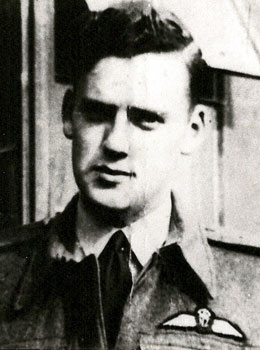
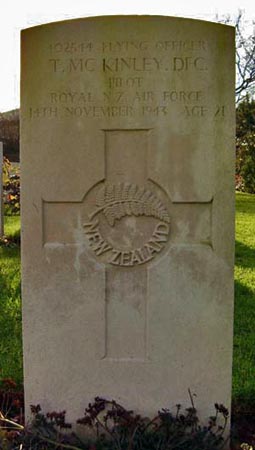
Terence McKinley completed a Tour with 102 Squadron and was awarded the DFC, Gazetted on 17th August 1943. The citation stated that "he is an outstanding captain" and "his fine fighting spirit, courage and leadership have gained him the entire confindence of his crew." He was born in Nelson, New Zealand in 1922 and was working as a clerical cadet in the Government Housing Construction Dept when he joined the RNZAF in July 1940. The photograph of him was kindly provided by air historian and author Mr Brian Lunn. After his time with 102 Squadron he was posted to 1652 Heavy Conversion Unit as an instructor. On 14th November 1943 he was the pilot of Halifax DG230 which was being air-tested, the aircraft suffered a double engine failure and crashed out of control at Kirk Hammerton, between York and Harrogate with the loss of four of the men on board. F/O McKinley was 21 years old and is buried in Harrogate Stonefall Cemetery. This incident is detailed on it's own webpage on this website.
Halifax DT703 was built to contract B.982938/39 by English Electric Co. Ltd. at Samlesbury and was taken on charge as new by 158 Squadron at Rufforth on 29th December 1942. On 28th February 1943 the aircraft landed tail first at Lissett on the squadron move there. The aircraft was repaired on site by a team from Handley Page and on 17th March 1943 it rejoined 158 Squadron. On 15th April 1943 this aircraft was transferred to 102 Squadron at Pocklington. As a result of flak damage sustained on 27th April 1943 Cat.A/FB damage was the damage assessment and it was repaired on site. On 5th May 1943 it sustained minor flak damage on Ops to Dortmund that saw Cat.A/FB again be the damage assessment. It was swiftly repaired on site. On 24th May 1943 it was attacked by an enemy aircraft on Ops to Dortmund that saw damage inflicted to the port wing. Cat.Ac/FB damage was the damage assessment. It was again repaired on site and was returned to 102 Squadron charge on 26th June 1943. On 9th September 1943 it was transferred to 1654 Heavy Conversion Unit at Wigsley but on 30th September 1943 it was transferred to 1661 Heavy Conversion Unit at Winthorpe. On 2nd December 1943 it was transferred to 1656 Heavy Conversion Unit at Lindholme. On 17th July 1944 the aircraft's AM Form 78 states that it was in need of a repair on site by 60 MU. This repair may well not have been completed as on 7th September 1944 the damage was listed as Re.Cat.E on the AM Form 78 and it was struck off charge on 11th September 1944. It had flown a total of 482 hours from new.
Frank Sutherland was awarded the DFM for service with 102 Squadron, Gazetted on 13th August 1943. Hugh Halliday has located the citation for his award which reads.."Flight Sergeant Sutherland, who has served with both Coastal and Bomber Command, has taken part in attacks against such heavily defended targets as Essen, Hamburg, and Berlin. On several occasions his aircraft has been damaged
by anti-aircraft fire and attacked by night fighters. An outstanding member of a gallant crew, Flight Sergeant Sutherland has consistently set a high standard of efficiency, confidence and devotion to duty."