Halifax DT666 near Drax.
On the night of 3rd / 4th April 1943 the crew of this 51 Squadron aircraft were undertaking an operational flight to bomb Essen and left Snaith at 19.53hrs. On their return and as they approached their base on but flew an overshoot of Snaith airfield instead of landing. The aircraft appears to have remained at a very low height and before a safe landing could be made the aircraft crashed near Drax at 00.25hrs. The location given was at Shortlands Farm. Sadly three of the crew were killed and four were injured. A letter from a rescuer of the crew to the rear gunner in 2005 and is almost certainly correct, this letter is published on "aucklandmuseum.com" adds a lot more information surrounding what happened after the crash. It states that the rear turret containing the gunner broke off in the crash and came to rest in a ditch, the rest of the aircraft broke up across a field and caught fire. The farmer at Shortlands Farm, Mr Alfred Lunn, located the released the rear gunner from his turret and took him into the farmhouse before returning to the wreckage. There were a number of Army buildings and personnel who were stationed on the farm at the time joined the farmer and set about locating and attempting to rescue other members of the crew from the aircraft. The bomb aimer broke his foot or leg and was found and assisted in trying to rescue the pilot from the wreckage but they were beaten back by an intense fire. The four injured members of the crew were later taken back to the farmhouse before the RAF collected them and took them for treatment at hospital.
Halifax DT666 was built to contract B.982938/39 by English Electric Co. Ltd. at Samlesbury and was delivered to 12 M.U. at Kirkbride on 28th November 1942. The aircraft was taken on charge by 77 Squadron at Elvington on 20th December 1942 and carried the squadron code "KN-F". On 14th January 1943 it collided with a vehicle parked on the side of the perimeter track and sustained minor Cat.A/FA damage. It was then transferred to 51 Squadron at Snaith on 4th March 1943 where it carried the squadron code "MH-T". As a result of battle damage sustained on the night of 12th / 13th March 1943 Cat.A/FB damage was the damage assessment and it was repaired on site at Snaith. The aircraft then crashed near Drax on 4th April 1943 on return from an operational flight to Essen. Three of the seven man crew were killed. Cat.E2/FB damage was the damage assessment and it was written off having clocked up 102 flying hours.
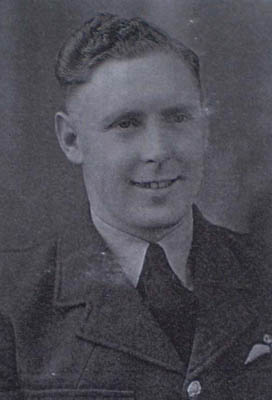
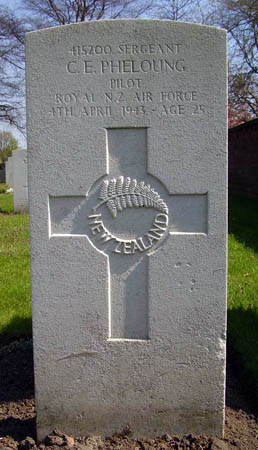
Pilot - Sgt Charles Edward Pheloung RNZAF (NZ.415200), aged 25, of Oamaru, Otago, New Zealand. Buried Selby Cemetery, Yorkshire.
Wireless Operator / Air Gunner - Sgt Frank Henry Knight RAFVR (1380457), aged 31, of Horsham. Buried Hills Cemetery, Horsham, Sussex.
Air Gunner - Sgt John James Merritt RAFVR (1252255), aged 21. Buried Beaufort Churchyard, Monmouthshire.
Flight Engineer - Sgt Donald William Kemp RAFVR (1162793). Head injuries.
Navigator - Sgt Vernon Buchanan McKenzie RNZAF (NZ.412794) Injured.
Bomb Aimer - Sgt Donald Geoffrey Fakley RAFVR (1390577). Leg injuries.
Rear Gunner - Sgt Basil Williams RNZAF (NZ.412776). Slightly injured.
Sgt Pheloung and his grave in Selby Cemetery. He was the son of Charles and Annie Pheloung, of Oamaru, Otago, New Zealand.
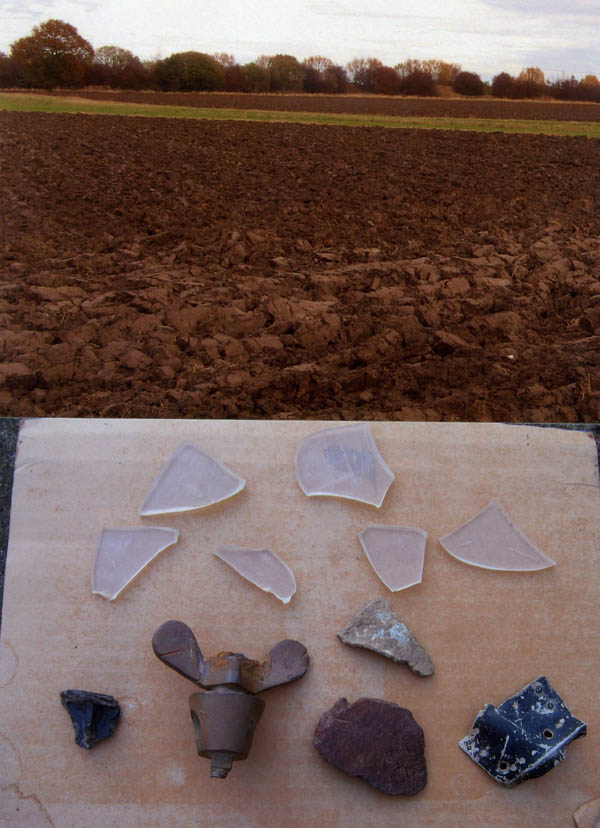
Air historians Albert Pritchard, Eric Barton and Ken Reast located small fragments on the surface at the crash site in August 1997 with permission from the landowner, confirming the crash location was in this area. Their finds were in a field just west of Newland, roughly mid-way between Drax and Rawcliffe. The two photographs shown here were taken by Eric Barton.
The flight engineer Donald Kemp returned to 51 Squadron when he recovered, on 28th August 1943 he was flying in Halifax HR869 on Ops to Nuremburg when the aircraft was shot down over Germany with the loss of the whole of his then crew, he was twenty one years old and is now buried in Durnbach War Cemetery.
Basil Williams was later posted to 431 Squadron on 19th May 1943 and was serving with 432 Squadron, when, on 22nd September 1943 he was flying in Wellington LN547 on Ops to Hannover when the aircraft failed to return to base. He and his then crew all became PoW's.
John Merritt had already survived the crash of Halifax DT581 on moorland above Hebden Bridge earlier in 1943.
Vernon McKenzie survived the war and returned home but sadly drowned in the Wanganui Rover in the late 1940s.