Lancaster DS648 at East Moor airfield.
During the morning of 21st September 1943 this 1679 Heavy Conversion Flight Lancaster was to be flown on a training flight with a trainee pilot and also a new instructor for a dual control training flight. At 09.50hrs during the take off from East Moor the aircraft entered a swing which the pilots did not correct. The swing resulted in the aircraft's undercarriage collapsing.
Pilot (Instructor) - P/O Eric Arthur Johnson DFC RAFVR (147215).
Pilot (Trainee) - Sgt Raymond Charles Burgess RCAF (R/133334).
Raymond Burgess was born on 28th January 1920 in Liverpool, England and was the son of John and Jessie Gillies (nee Davenport) Burgess. His family moved to Neslon, British Columbia, Canada when he was three years old. He had a brother who also would serve in the RCAF and a sister. He had been working for the Nelson Daily News newspaper as a proof-reader and printer for three years when he was drafted into the Canadian Army early in 1941. He then enlisted for RCAF service in Vancouver on 6th October 1941 and after training in Canada he was awarded his Pilot's Wings on 28th August 1942. He married Geraldine Grace Wallace on 28th April 1942 and she was pregnant with a baby boy when Ray left for service overseas in November 1942. On arrival in the UK he trained at 6 (P)AFU (posted there on 14th November 1942) and 24 OTU (posted there on 9th March 1943) before posting to 432 Squadron on 27th May 1943. On 3rd / 4th July 1943 Sgt Burgess was flying Wellington HF493 on an operational flight with 432 Squadron to bomb Cologne when the aircraft was hit by flak. Believing that the aircraft was severely damaged (and probably about time to bale out) the bomb aimer handed the navigator a parachute, he then made his way to the rear escape hatch and baled out. Sgt Burgess still had control of the aircraft and while the aircraft had indeed been damaged he did not give the order to abandon the aircraft. The crew jettisoned their bomb load and made for West Malling airfield to make a landing. Before they reached West Malling because of poor weather an instruction to divert to Hardwicke was sent to but not received by the aircraft because some of the radio equipment had been damaged by flak. Because of the poor weather they were unable to locate West Malling so the crew then baled out when the fuel began to run out. The Wellington crashed near "Codham golf couse, Kent" (Cobham, Surrey?) and the rest of the crew landed safely. The bomb aimer Sgt Albert Dabous RCAF (R/141458) survived and became a PoW.
Between 9th September 1943 and 7th October 1943 he was attached to 1679 Conversion Unit to convert to fly the four engined Lancasters. On 24th September 1943 he was at the controls of Lancaster DS626 when the tail rose off the ground on landing then dropped back down damaging it. With this training complete he returned to 432 Squadron. He received a commission on 26th October 1943. On 16th November 1943 he was flying Lancaster DS847 on a cross country training flight, from base of East Moor they were to fly to Donnington and then Ramsey. During the opening part of the flight he reported to the crew that the starboard wing was low and the aircraft was hard to hold on course. The reached Donnington safely and with the problem not righting itself he decided to abandon the training flight and return to base. While over Lincolnshire the starboard outer engine failed and then caught fire, followed soon after by the failure of the starboard inner engine. P/O Burgess gave the order to abandon the aircraft, he and was last seen at the controls holding the aircraft level while his crew baled out. His and two other members of his crew did not escape the aircraft before it crashed in the area around Fillingham / Ingham, Lincolnshire. He was buried in Cambridge City Cemetery, and not the usual Harrogate Stonefall Cemetery as was more common.
Lancaster DS648 was built by Armstrong Whitworth and, as a new aircraft, was one of the first four Lancasters the unit received on 22nd May 1943 on the day it formed. The date given on the aircraft's AM Form 78 for the transfer is given as 26th May 1943. As a result of the mishap at East Moor on 21st September 1943 Cat.B/FA damage was the damage assessment and it was taken for a repair at a works factory. Once servicable on 4th July 1944 it was flown to 46 MU and placed in store where it appears to have remained until 15th January 1947 when it was struck off charge and scrapped.
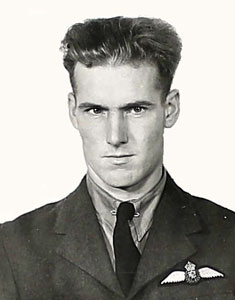
Eric Johnson was born in Enson, Staffordshire was one of 427 Squadron's first pilots joining the squadron in late 1942 flying his first operational flight to Turin as a second pilot in December 1942. He was initially recommended for the DFM on 30th June 1943 when he had flown twenty operational flights but this must have been well after he was recommended for a commission because the London Gazette states that he received his commission on 15th March 1943 to the rank of P/O on probation (147215) though 427 Squadron's ORB states that he only received notification of this in July 1943. He was recommended for the DFC on 20th July 1943 when he had flown twenty two flights, the DFC was granted and notification was printed in the London Gazette on 14th September 1943. He appears to have left 427 Squadron around September / October 1943 because he is not listed in their operational flying list after this. He was promoted to F/O on 15th September 1943 and F/Lt (war subs) on 15th March 1945. He remained in the RAF after the war and was also awarded the Air Force Cross, Gazetted on 1st January 1947 while in the rank of Acting S/Ldr. He left the RAF reliquishing his commission on 20th January 1950. He later received the British Empire Medal. He died in April 2008 in Stafford aged 85.