Lancaster DS635 at East Moor airfield.
On 2nd September 1943 this Lancaster of 1679 Heavy Conversion Flight was landing at East Moor following a twenty five minute training flight but on the approach to land it lost power in the port outer engine. On touching down at East Moor at 21.25hrs this caused an uncontrolled swing which eventually led to the undercarriage collapsing. The aircraft caught fire as it came to halt but the crew were reported to have escaped without injury. Only three of their names are currently known. Both trainees were 408 Squadron aircrew undergoing conversion training to fly the Lancaster type at the time and both were at 1679 H.C.Flt with their respective crews. Exactly whom from each of their crews on board DS635 is not yet known.
Lancaster DS635 was built to contract ACFT/239 by Armstrong Whitworth at Baginton and was delivered as new to 115 Squadron at East Wretham on 30th April 1943. This aircraft had been one of the first four Lancasters 1679 Heavy Conversion Flight received on 22nd May 1943 on the day it formed although the date of transfer given on the AM Form 1180 is 12th June 1943. Following the accident at East Moor on 2nd September 1943 the damage was assessed as being Cat.E2/FA Burnt. It was struck off charge on 11th September 1943.
(Instructor) Pilot - F/Lt John Gordon McNeill DFC RCAF (J/9201).
(Trainee) Pilot - F/O William Benjamin Stewart RCAF (J/15486).
(Trainee) Pilot - F/O Douglas MacKenzie Bell RAFVR (122394).
John McNeill was born in Calgary on 15th April 1919 in Calgary, Alberta, Canada and was the son of John Abraham and Ethel May (nee Parslow) McNeill. As a young man he worked on his father's farm before joining the Canadian army in 1935, serving in the Royal Canadian Corps of Signals. He was granted a discharge from his army unit in 1940 and enlisted for RCAF service in Kingston, Ontario on 10th June 1940, having then undertaken pilot training in Canada he was awarded his Pilot's Flying Badge on 5th December 1941. He was also awarded a commission on the same date as his Wings. On arrival in the UK in early 1942 he was firstly posted to No.1 Flying Instructor School, he then trained at 14 AFU and 22 OTU before posting to 426 Squadron on 4th November 1942. In June 1943 he was posted to 1679 Conversion Unit to convert to fly the Lancaster and in July 1943 he returned to 426 Squadron, he was awarded the DFC for service with 426 Squadron, Gazetted 13th August 1943 (presented at Buckingham Palace on 11th August 1944). The citation for his DFC reads.."The fine fighting spirit displayed by this officer has been an inspiration to the rest of the squadron. He has taken part in may recent heavy raids on the Ruhr and on one occasion in April 1943 completed his mission successfully although one engine failed while his aircraft was hotly engaged by the defences. As deputy flight commander he has rendered valuable assistance in the operational training of new crews and has contributed much to the high morale maintained in the squadron." He was soon taken off front line operational flying for a period, being posted back to 1679 C.U. (becoming their chief flying instructor) and then to Boscombe Down. He returned to 6 Group with a posting to 433 Squadron in January 1944 for a month but then served at Bomber Command H.Q. He was later posted to 415 Squadron on 15th July 1944 but was killed in a flying accident on 21st August 1944 whilst serving with 415 Squadron when Halifax NA609 collided with Halifax MZ633 and both aircraft crashed near West Haddlesey, Selby, Yorkshire. W/Co John McNeill DFC is buried at Harrogate Stonefall Cemetery and was twenty five years old.
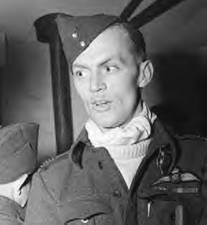
William Stewart was later promoted to S/Ldr and was sadly killed on 13th June 1944 in 408 Squadron Lancaster DS726 that was shot down on Ops to Cambrai, the aircraft crashed near Seranvillers-Forenville. He is buried Seranvillers-Forenville Military Cemetery.
Douglas Bell had received a commission in Spring 1942. Posted back to 408 Squadron once his conversion training was complete he was then killed on 24th November 1943 flying Lancaster LL623 on Ops to Leipzig. He has no known grave and is commemorated on the Runnymede Memorial.