Lancaster DS624 at Wombleton airfield.
On Christmas Eve 1943 the crew of this 1679 Heavy Conversion Flight Lancaster were awaiting take off from Wombleton airfield for a basic circuits and landings exercise and were parked with the engines idling. Fuel was found to have been dripping onto the starboard inner engine which then caught fire and the extingushers did not put out the flames. The crew escaped the aircraft and ran clear but the bomber ran off the runway and onto the grass. The fire spread to the cockpit but the airfield's fire teams managed to put out the fire before it spread any further. Two members of the fire-fighting team; F/Sgt Whitehead and F/O Walker, were later given credit for their work in organising the fire-fighting and assisting in putting out the fire at great personal risk when the flames closed in on the partly full fuel tanks. The aircraft had earlier been flown on a flying exercise that involved the crew shutting down two of the engines (probably including the starboard inner engine). The cause of the fire was investigated by the AIB, while the pilot was partly blamed for not spotting the dripping fuel he later became an outstanding bomber pilot and was awarded the DFC for his service.
Lancaster DS624 was built to contract AC 239 by Armstrong Whitworth Ltd at Baginton and was taken on charge as new by 115 Squadron at East Wretham on 27th February 1943 when the unit converted from Wellington B.III's to Lancaster B.II's. It was transferred to 426 Squadron at Linton on Ouse on 7th June 1943 and then onto 1679 Conversion Flight at East Moor on 8th August 1943. The aircraft moved with the unit to Wombleton on 13th December 1943. Following the crash on 24th December 1943 the damage assessment was initially Cat.B but it was re-assessed as Re.Cat.E and struck off charge on 12th January 1944.
Pilot - F/Sgt Joseph Edouard Flavien Jean RCAF (R/96956).
Flight Engineer - Sgt Edgar Dacre RAFVR (575724 / 56574).
Navigator - F/O C Gray RCAF (J/14671).
Bomb Aimer - F/Sgt Hugh John Porter Lockett RCAF (R/94472).
Wireless Operator / Air Gunner - F/Sgt C Elsey RCAF (R/129030).
Air Gunner - Sgt G Desjardins RCAF (R/207492).
Air Gunner - Sgt J Favreau RCAF (R/194221).
Joseph Jean was born in Phomphile, Quebec and prior to enlisting his home was in L'Islet, Quebec when he enlisted into the RCAF in Quebec on 17th October 1941. He later received his commission in 1944 and awarded the DFC for his service with 425 Squadron and 426 Squadron. The award being effective from the 1st December 1944, and was Gazetted on 12th December 1944. The citation reads... "This officer is a pilot of exceptional skill who has completed a very successful tour of operations over enemy territory. In March 1944 he and his crew were detailed to bomb Berlin. While over the target anti-aircraft fire became very heavy, visibility was poor and the weather stormy. Despite severe damage from the
anti-aircraft fire, Pilot Officer Jean pressed home a very successful attack. On the return flight severe ground fire was once again encountered over Brussels. The rear gunner was wounded and further damage done to the aircraft. With great determination and courage, however, Pilot Officer Jean flew it safely back to base. This officer has displayed exceptional gallantry, ability and resolution throughout his whole operational tour". They landed at Coltishall on return from this one incident, which occurred on 24th/25th March 1944. My thanks to Pierre Lagace, 425 Squadron blogger, for the photograph of him shown above.
The recommendation refers to the incident on 24th March 1944 on Ops to Berlin and reads.. "Shortly after take-off the oxygen supply began to fail and after an hour’s flying time, the Navigator was unconscious. WO1 Lockett, together with the pilot, pin-pointed into the target from Kiel Canal. Path Finder Force’s target indicators dropped late and it was necessary to do an orbit over the target. Berlin, being carpeted with flak, rendered this task very precarious. Displaying great courage and unshakeable determination, the crew drove home a successful attack. On the trip back to base, navigation was once again carried on by pin-pointing, the Bomb Aimer doing the majority of the navigation. It became increasingly difficult to keep the aircraft on track. The Rhur Valley had to be circled and in doing so the aircraft met strong enemy ground opposition over Brussels and was riddled by flak. On this occasion as well as on the many other sorties throughout his tour, WO1 Lockett has exhibited a presence of mind, quick thinking and splendid initiative beyond the ordinary call of duty. His activity in the air has marked him as an exceptional Bomb Aimer. It is for this reason that I recommend WO1 Lockett for the non-immediate award of the Distinguished Flying Cross."
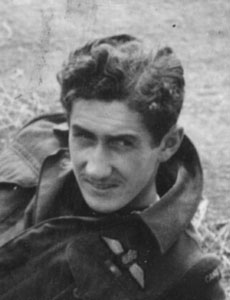
Hugh Lockett was born in May 1920 in Musselborough, Scotland but was living in Westmount, Quebec when he enlisted in Montreal in May 1941 as a radio mechanic. He later re-mustered as aircrew in 1942 and was posted overseas to the UK in March 1943. He received his commission to the rank of P/O on 15th December 1944 and was posted to 425 Squadron probably with his pilot and crew listed above. For service with 425 Squadron he was awarded the DFC, Gazetted on 10th May 1945. Hugh Halliday's RCAF awards research has located the recommendation for this DFC which gives alot of information on one specific incident, it reads.. "Pilot Officer Lockett has completed a successful tour of operations, throughout which he has shown himself to be a skilful and resourceful air bomber. On one occasion in March 1944 his aircraft was detailed to attack Berlin. On the outward flight the oxygen supply began to fail and the navigator became unconscious. This Pilot Officer gave his pilot most valuable assistance in navigating the aircraft. In spite of intense anti-aircraft fire and the necessity of flying over the target prior to bombing, a successful attack was pressed home with the utmost determination. On the homeward flight strong enemy opposition was encountered from the ground and damage was sustained. Again Pilot Officer Lockett played a very large part in navigating the aircraft back to base. His courage and devotion to duty at all times have always merited high commendation."