On 21st December 1943 the crew of this 1679 Heavy Conversion Flight aircraft took off from Wombleton airfield to undertake a night-time dual control circuits and landings training flight, the exercise would consist of the trainee crew making a series of landings and take offs to get to grips with the basics of night-flying a four engined bomber. After taking off and the exercise was begun it appears that visibility reduced over the general area of the airfield so the crew were diverted to land at Topcliffe where visibility was better. On board was an instructor in one of the pilots' seats and a trainee in the other pilot seat with part of his crew flying with them, the trainee crew was at 1679 H.C.Flt. to convert to fly the Lancaster type as they had just arrived in to 408 Squadron from a Halifax Heavy Conversion Unit and were not passed out on the Lancaster type. During one of the approachs to land at Topcliffe at 21.10hrs the aircraft was not flying high enough to make the end of the runway, realising the aircraft was going to undershoot, one of the pilot applied more power to maintain height until over the runway but it was thought that both port engines momentarily "chocked" and lost power, with more power applied on the starboard side the aircraft then swung to port, lost height and touched down some 200 yards to the left of the runway in use (21/04). The Lancaster's port wing then struck parked Halifax DT548 causing the Lancaster to overturn and catch fire. Sadly four members of the crew died as a result of the accident while two escaped serious injury. Visibility on the approach to land at Topcliffe may have been a factor into this accident. Dishforth airfield has stopped their circuits and landings exercises because of visibility issues around the same time as this crash.
Pilot (Instructor) - F/O John Joseph McGavock DFC RCAF (J/17116), aged 24, of Winnipeg, Manitoba, Canada. Buried Harrogate Stonefall Cemetery, Yorkshire (C/G/19).
Pilot (Pupil) - F/O Thomas Ernest Major RCAF (J/21628), aged 24, of Toronto, Ontario, Canada. Buried Harrogate Stonefall Cemetery, Yorkshire (C/G/20).
Flight Engineer - Sgt Kenneth Forster RAFVR (1581900), aged 20. Buried Hartshill Cemetery, Stoke on Trent, Staffordshire.
Bomb Aimer - F/Sgt Robert Thomas James Welch RCAF (R/101969), aged 24, of Boissevain, Manitoba, Canada. Died of injuries on 23/12/1943. Buried Harrogate Stonefall Cemetery, Yorkshire (C/H/7).
Wireless Operator / Air Gunner - Sgt James Arthur Lawrenson RAFVR (1454834). Slightly injured.
Air Gunner - Sgt William Ronald Clapham RAFVR (1425802 or 1425082). Slightly injured.
Lancaster DS615 was built by Armstrong Whitworth and was initially taken on charge by 115 Squadron on 27th February 1943. It sustained minor Cat.Ac/FB damage on 27th March 1943 and following a repair on site was returned to 115 Squadron on 5th June 1943. The aircraft was transferred to East Moor airfield on 2nd July 1943 and joined 1679 Conversion Unit on 19th August 1943 (though the AM Form 78 has the taken on charge date as being 20th August 1943). On 29th November 1943 it sustained minor damage at East Moor with Cat.A/FA damage being the damage assessment. A repair on site was made and it was returned to 1679 Heavy Conversion Flight. On 21st December 1943 the aircraft crashed at Topcliffe, it was badly damaged and a Cat.E/FA (Burnt) damage assessment was made. The aircraft was struck off charge on 6th January 1944.

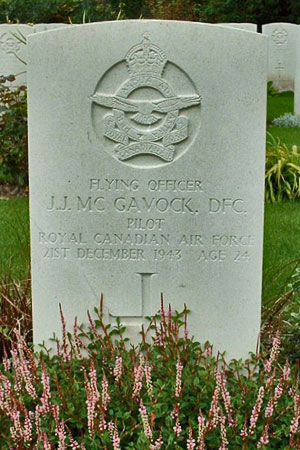
John McGavock was born on 14th March 1919 at Winnipeg, Manitoba, Canada and was the son of Frank and Theresa (nee Forsythe) McGavock. After leaving high school John attended business college before starting work as an office clerk for a company in Winnipeg. He enlisted for RCAF service 4th June 1941 in Winnipeg for aircrew duties and trained as a pilot, receiving his pilot's flying badge on 13th March 1942. On arrival in the UK he trained at 12 (P)AFU and 22 OTU before posting to 426 squadron on 28th October 1942 who were flying Wellingtons at the time. He received a commission on 6th March 1943. 426 Squadron converted to Wellingtons and his service file state he converted at 1678 Conversion Flight (though 1679) was more common for No.6 Group airmen). For service with 426 Squadron he was awarded the DFC, Gazetted on 15th June 1943. The citation for his award reads.. "This officer has taken part in numerous attacks against all types of enemy targets including such heavily defended areas as Hamburg, Mannheim, Essen and Cologne. He has also participated in several mine-laying operations. Pilot Officer McGavock's quiet determination to complete his allotted tasks, regardless of adverse weather or enemy opposition, has proved him to be an outstanding captain of aircraft who inspires the utmost confidence in his crew."
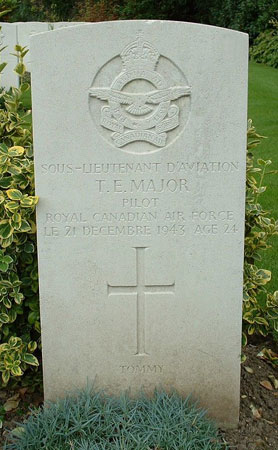
Thomas Major was born on 30th July 1919 at Toronto, Ontario, Canada and was the son of William John and Rose (nee Bertrand) Major. After leaving high school he worked as stenographer. He enlisted for RCAF service way back on 10th November 1939 in Kingston, Ontario but for ground duties and he served as an office clerk, his war up until that date would have been reasonable safe. Probably wanting to do more he remustered as aircrew and then begun training as a pilot in January 1942, being awarded his Pilot's Wings on 25th September 1942 and also a commission on the same date. He was posted to the UK soon after and over the coming months would train at 15 (P)AFU, 19 OTU and 1664 HCU. He was briefly posted to 408 Squadron on 16th November 1943 but twelve days later was posted to 1679 H.C.Flt to convert to fly the Lancaster type.
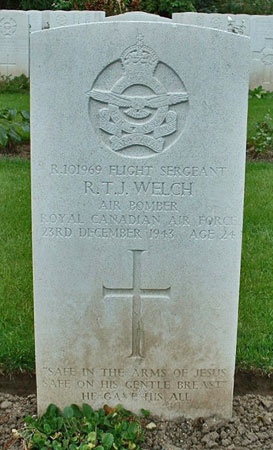
Robert Welch was born on 18th July 1919 at Boissevain, Manitoba, Canada and was the son of James Alexander and Clara (nee McKenzie) Welch. After leaving high school 1940 he worked for his father as a clerk in his shop until enlisting for RCAF service on 9th May 1941 in Winnipeg for ground duties and was selected to train as a radio mechanic. He re-mustered as aircrew in May 1942 and initially undertook pilot training but then switched to bomb aimer training. He was awarded his air bombers' flying badge on 19th March 1943. On arrival in the UK he trained at 2 (O)AFU, 19 OTU and 1664 HCU before posting to 408 Squadron on 16th November 1943. He was later posted to 1679 H.C.Flt. to convert to fly the Lancaster type. Following the crash at Topcliffe on 21st December 1943 he sustained serious burns and was admitted to the RAF hospital at Northallerton but died two days later.