During the evening of 2nd December 1943 the crew of this 1664 Heavy Conversion Unit aircraft were one of a number that took off from Croft airfield to undertake a basic circuits and landings exercise. The exercise began at 17.40hrs and at first was carried out with an instructor flying with the trainee crew. The instructor was present in the aircraft for a number of the laps of the airfield and deemed the pilot and crew capable of flying them without on-board instruction so departed the aircraft after one of the landings instructing them to continue the exercise. The pilot had not flown a Halifax solo at night up until this point, they then took off and after flying a circuit one good landing was made followed by a take-off to continue the sequence flying another circuit and making another landing. As they set out for the second circuit visibility was deteriorating, patches of low ground "fog" had begun to envelop the Croft area (believed to have been mainly caused by steam from passing trains on the nearby railway line), flying control were to suspend the flying exercises as soon as all their aircraft landed. This aircraft then flew two overshoots of the runway (probably because visibility had then effected making a safe landing) and was making a third approach when a train passed alongside the airfield and the smoke from the train then hung over the area of the railway track and further effected visibility. It appeared that the pilot had completely lost sight of the runway, all the airfield lighting and also forgot to check his instruments as the aircraft was flying very low but not directly over the airfield. At 21.30hrs the Halifax struck a hay stack and then an ash tree which stood around a hundred yards from the officers mess building, this severely impeeded the aircraft's flying speed. It then struck the ground and skidded to a halt between the Admin Site and No.4 Technical Site and caught fire. Sadly five of the crew died as a result of this accident while two survived. The mid upper turret was occupied by the second flight engineer (Sgt Fletcher) at the time of the crash and he would therefore be doubly lucky to survive as everyone else at the front of the aircraft where he would normally have been positioned were killed. The position of the mid upper gunner (who was therefore not in his turret) is not known but he was killed. With the crash site being so close to a larger number of service personnel a rescue attempt was made. S/Ldr Robert Clare Scott RCAF (C/646) was subsequently awarded the OBE for his effects in rescuing the badly injured rear gunner. Notication of the award of the OBE was printed in the London Gazette on 28th April 1944 and the citation reads.. "One night in December 1943, a Halifax aircraft crashed in the vicinity of an airfield and burst into flames. Squadron Leader Scott, the station engineer officer, was one of the first to arrive at the scene of the accident and immediately took charge of the rescue party in a cool and efficient manner. Seeing one member of the crew trapped inside the rear turret, he entered the blazing fuselage from the front and walked towards the rear in an endeavour to rescue the airman. Squadron Leader Scott was at first driven back by the heat and smoke but, displaying great determination, he repeated his effort and succeeded in reaching the turret and in passing the injured airman to safety through a hole in the rear. He then ensured that there were no further members of the crew left before he made his way out. Squadron Leader Scott displayed courage and devotion to duty in the face of fire and of the further danger that the petrol tanks might have exploded whilst he was engaged in the rescue. He was undoubtedly responsible for saving the airman's life". This was the second fatal accident to befall 1664 Heavy Conversion Unit on this day, earlier Halifax DJ982 had crashed in Northallerton killing all seven crew. Air historians Albert Pritchard, Eric Barton and Ken Reast located small fragments on the surface at the crash site in October 1999 with permission from the landowner, confirming the crash location.
Pilot - F/Sgt Peter Ritchie Gray RCAF (R/140935), aged 25, of Brandon, Manitoba, Canada. Buried Harrogate Stonefall Cemetery, Yorkshire (C/F/8).
Flight Engineer - Sgt John Harrison Catto RCAF (R/97729), aged 20, of New Westminster, British Columbia, Canada. Buried Harrogate Stonefall Cemetery, Yorkshire (C/F/7).
Wireless Operator / Air Gunner - Sgt George Alfred Chilvers RAFVR (1235580), aged 21. Buried Great Yarmouth RC Cemetery, Norfolk.
Bomb Aimer - F/O James Arthur Foulston RCAF (J/25075), aged 23, of Medicine Hat, Alberta, Canada. Buried Harrogate Stonefall Cemetery, Yorkshire (C/F/10).
Mid Upper Gunner - Sgt Henry Benedict Bellew RCAF (R/202312), aged 18, of Montreal, Quebec, Canada. Died of injuries. Buried Harrogate Stonefall Cemetery, Yorkshire (C/F/13).
Rear Gunner - Sgt C H Hills RCAF (R/170146). Injured.
Flight Engineer (in mid upper turret) - Sgt Stanley Fletcher RAFVR (1821944). Uninjured.
Sgt Fletcher would complete his Heavy Conversion Unit training and was posted to 420 Squadron. On 16th February 1944 he was flying an operational flight in Halifax LW396 when the aircraft crashed near Raskelf on the return to land at Tholthorpe. Sadly two members of his then crew were also killed.
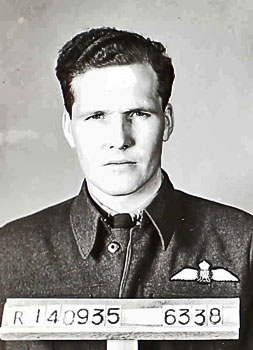
Peter Gray was born on 15th October 1918 in Brandon, Manitoba, Canada and was the son of Charles Crombie and Anna Bell (nee Milne) Gray. Both his parents were born in the Aberdeen area of Scotland but had emigrated not long after their marriage. After leaving school in 1935 he worked as a farm labourer and had worked gained an understanding of engines. He enlisted for RCAF service on 26th November 1941 in Winnipeg initially for ground service as an aero engine mechanic, he later re-mustered as aircrew and after basic training in Canada he was awarded his Pilot's Wings on 19th February 1943. On arrival in the UK he would train at 15 (P)AFU and 24 OTU before posting to 1664 HCU on 4th November 1943.
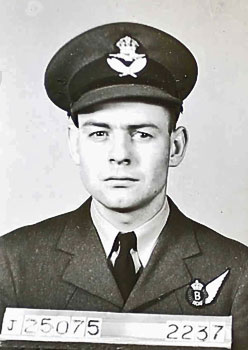
James Fouston was born on 9th June 1920 at Medicine Hat and was the son of Arthur Boyd and Annie (nee Gray) Foulston. After leaving school he worked as an car mechanic. He would marry Esther Deering in February 1942 in Medicine Hat. He enlisted for RCAF service on 24th July 1941 in Calgary for ground duties but later re-mustered as aircrew and trained as an air bomber, receiving his flying wings and also a commission on 2nd April 1943.
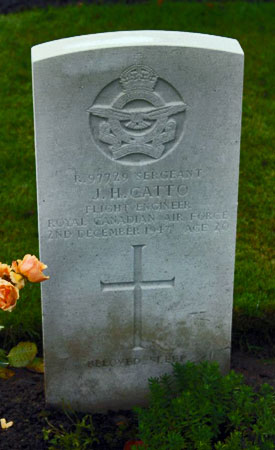
John Catto was born on 15th January 1923 in Burnaby, British Columbia, Canada and was the son of John William and Harriett (nee Ware) Catto. Both his parents were born in the UK but had emigrated to Canada. John was still at college, studying wood work and shet metal work when he had originally enlisted for RCAF ground duties on 25th March 1941 in Vancouver. Following basic training in Canada he left for service overseas as an air frame mechanic. On arrival in the UK in late 1941 he then served at 415 Squadron until June 1943 when he re-mustered for aircrew duties to train as a flight engineer. With training at No.4 School of Technical Training complete he was posted to 1664 HCU on 23rd October 1943.
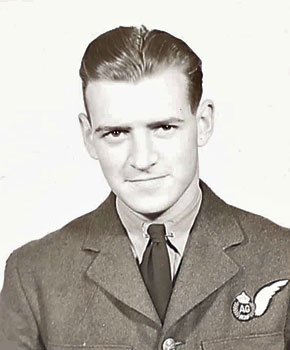
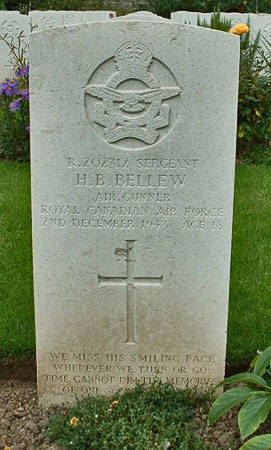
Henry Bellew was born on 9th December 1924 at Loverna, Saskatchewan, Canada and was the son of Benedict Cosgrove and Rachel (nee Allan) Bellew. After leaving school he started work as a precision instrument assembler for the Domestic Electric Protection Company in Montreal, Quebec. He was living in Montreal when he enlisted for RCAF aircrew service on 12th November 1942 and trained as an air gunner, receiving his air gunner's flying badge on 6th August 1943. He left for the UK soon after and would train at 24 OTU before posting to 1664 HCU on 4th November 1943. Although on paper he was the mid upper gunner in this crew he was not in the mid upper turret at the time of the crash. Following the crash he was immediately taken to the Friarage Hospital in Northallerton but sadly died an hour after admission. He was still just eighteen years old. RCAF service files tend to contain details of any "bad conduct", in his service file there is a slightly amusing entry stating that he was reprimanded after being caught by the Wing Co trying to sneak an "unauthorised female" back into a hotel (possibly) in Bournemouth which the RAF had requisitioned. Oh well, worth a try :)
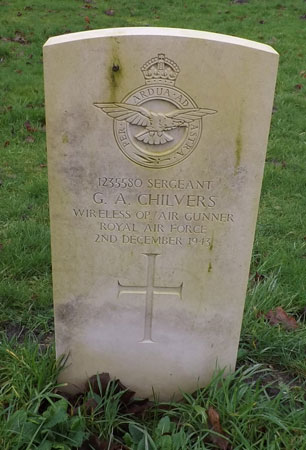
George Chilvers' grave. Photo from "Find a grave" by "Darealjolo".