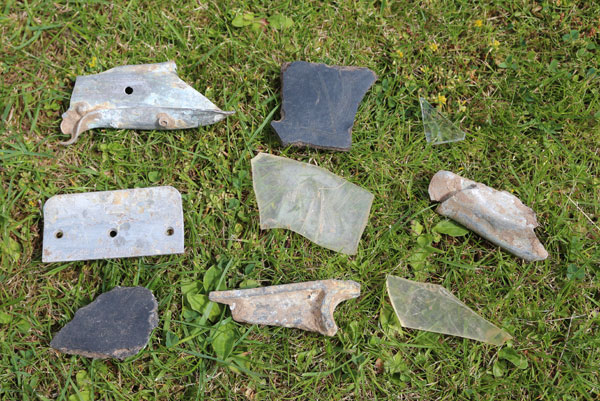
Spitfire BM346 near Thornton le Beans.
During the afternoon of 17th February 1943 three pilots of 401 Squadron were instructed to undertake a formation flying exercise. At 13.55hrs all three Spitfires took off from Catterick. Two of the pilots were Canadians while the third was a Polish pilot; W3839 was flown by F/Sgt Leonard Gilis PAF, BM346 was flown by WO1 Harvey Muirhead RCAF and the third W3941 P/O Arthur Christian Bishop RCAF. The pilots must have then immediately climbed away and begun their training exercise once above a layer of cloud at around 2-3,000 feet. A short time later they had reached around 6,000 feet and at 14.01hrs they were flying in formation in the general area around Northallerton. Gilis appears to have been leading the formation with Muirhead and Bishop flying in formation behind, Muirhead was not flying straight and level but was seen by P/O Bishop to be weaving when Gilis made a tight turn, this turn would have taken Gilis across the path of Muirhead and with Muirhead weaving he did not have time to avoid a collision. P/O Bishop saw both Spitfires go into spins but lost sight of them when they disappeared into the cloud base at 2-3,000 feet. Both aircraft dived into fields south of Northallerton. W3839 crashed near Stubb House, North Otterington while Spitfire BM346 crashed at the other side of the main York-Edinburgh railway line near Thornton House, Thornton le Beans. The third pilot undertaking the exercise made a radio transmission immediately after the collision and immediately returned to land at Catterick.
A crash party was despatched to locate the remains of both aeroplanes, this was done but the bodies of either pilot could not be found in the parts of the aeroplanes that were found above ground. The following day RAF Regiment parties began digging operations at both crash sites to attempt to recover the bodies of the pilots, owing to the soft nature of the ground and the depths both went to this was very difficult. The 401 Squadron records state that the body of WO1 Muirhead was recovered on 19th February 1943 but I have my doubts as to how much of his body was recovered. Work carried on until 21st February 1943 to attempt to recover Leonard Gilis' body but this was eventually abandoned owing to the soft ground making it an impossible task with the tools available to them at that date in time. The squadron records suggest depths of between fifteen and eighteen feet had to be reached and this was not possible. The body of F/Sgt Leonard Gilis was unable to be recovered so was recorded as "missing".
Jumping forward in time some thirty-plus years, the site where Spitfire BM346 crashed was dug with a mechanical digger though I have am not permitted to name who was responsible. The
engine from this aircraft was recovered and was eventually placed on display at an antique centre in Lancashire until around 2020.
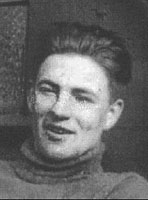
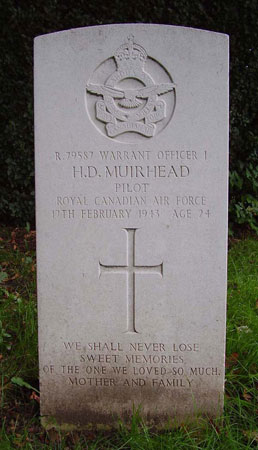
Pilot - WO1 Harvey Donald Muirhead RCAF (R/79587), aged 24, of Estevan, Saskatchewan, Canada. Buried Catterick Cemetery, Yorkshire.
Harvey Muirhead was born on 13th December 1919 in Estevan, Saskatchewan to William and Nancy Isabel Muirhead. He was known to his family as "Mickey". He was working in farming when enlisted into the RCAF on 30th October 1940 in Regina, Saskatchewan. After basic training in Canada he arrived in the UK and was posted to 55 O.T.U. in August 1941, upon completion of his training he was posted to 263 Squadron in on 30th September 1941. He undertook operational flying with 263 Squadron for some months flying his first sortie on 26th December 1941 in Whirlwind P6990 on a patrol but with no enemy sighted. On 3rd July 1942 he was taxying a Whirlwind at Portreath airfield in a strong wind when the aircraft was caught in a gust and collided with another Whirlwind damaging both aircraft slightly. Confusion exists after this incident, 263 Squadron ORB states that on 28th September 1942 he was posted to 286 Squadron at Colerne but his service record does not mention this. His service record states he was injured on 18th November 1942 and transferred to Colerne as Non-Effective (ie. sick / injured). His service record states that he was posted to 286 Squadron on 6th December 1942. Perhaps this was when he was declared fit to return to duty. On 5th January 1943 he was posted to 57 O.T.U. and then to 401 Squadron on 11th February 1943. The 401 Squadron records state that he arrived at Catterick on 16th February 1943, just one day before his death. The Muirhead Lake in Saskatchewan is named in his honour.
Knowing the history of this incident, in September 1999 air historians Albert Pritchard, Eric Barton and Ken Reast obtained permission from the landowner to field walk the area
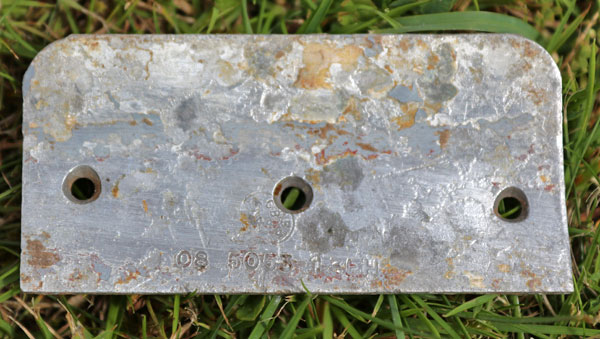
to locate the crash site. Small fragments were found on the surface and there-by pinpointing where the aircraft crashed. Eric retained some of the fragments. The photograph shown
below gives a good example of a Spitfire part number with a "C.B." Castle Bromwich inspection stamp visible near the rivet home in the centre.
Spitfire BM346 was built to contract B.981687/39 by Vickers Armstrong Ltd. at Castle Bromwich and was delivered to 5 M.U. at Kemble on 28th March 1942. On 26th April 1942 it was taken on charge by 403 Squadron at North Weald who then moved to Southend on 2nd May 1942. On 1st June 1942 it sustained minor damage on return from Ops, Cat.A(c)/FB damage was the assessment and it was repaired on site. On 3rd June 1942 it moved with the unit to Martlesham Heath, it then moved with them to Manston on 1st July 1942, Catterick on 8th July 1942, Manston on 16th August 1942, Catterick on 20th August 1942, Kenley on 1st October 1942 and back to Catterick on 10th October 1942. On 22nd January 1943 403 Squadron left Catterick for Kenley but the aircraft was clearly not serviceable so was transferred to 401 Squadron who moved in to Catterick on that day from Kenley. As a result of the crash on 17th February 1943 Cat.E2/FA damage was recorded and the aircraft was struck off charge. It had flown just short of 260 flying hours from new.