Wellington BK155 damaged by flak, returned to Topcliffe airfield.
On the night of 24th / 25th February 1943 the crew of this 428 Squadron aircraft were undertaking an operational flight to bomb Wilhelmshaven. The crew released their bomb load at 20.44hrs but the aircraft was hit by flak in the port wing and slightly damaged and the pilot temporarily lost control. He regained control and was able to bring the aircraft back to the UK and landed safely at Topcliffe at 00.42hrs.
Pilot - Sgt Kingdon Roger Knapp RCAF.
Navigator - Sgt Norman Lawrence Magnusson RCAF (R/110974).
Bomb Aimer - Sgt Gordon Barnholden RCAF (R/102462).
Wireless Operator / Air Gunner - F/Sgt Bertram Arthur Nicholls RAFVR (942990).
Air Gunner - Sgt J C W Pilfold RCAF (R/103676).
? - Sgt James B Agate. (Possibly Sgt James Victor Agate RCAF (R/121039)).
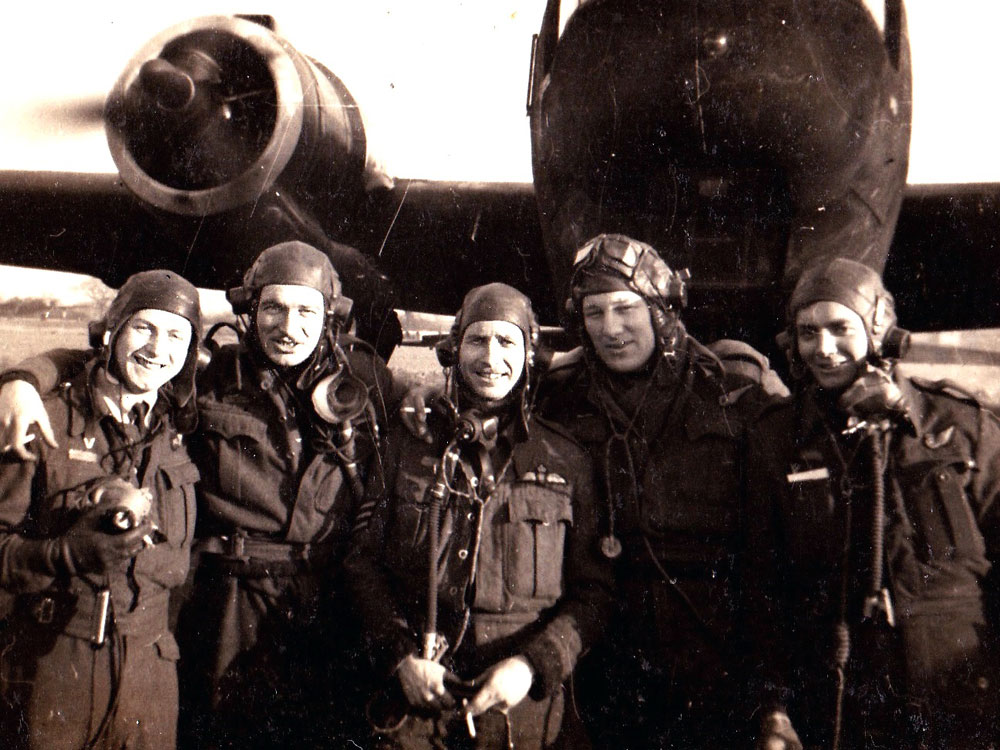
Bertram Nicholls is far left. No other names are known. I thank Bertam Nicholls' daughter for kindly supplying this photograph.
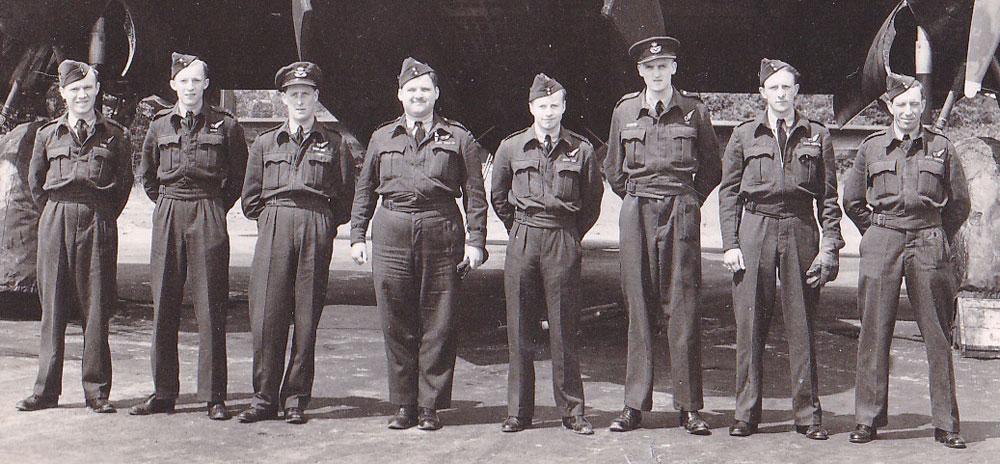
Bertram Nicholls is 5th from left on this photograph, no other names are known. It is probably taken at Wombleton where he served as a staff instructor in 1945.
Bertram Nicholls was awarded the DFM for service with 428 Squadron, Gazetted on 9th July 1943 for flying two operational tours. The first was in Hampdens with 83 Squadron while the second was with 428 Squadron. He flew a total of fifty operational sorties; 30 with 83 Squadron and a further 20 with 428 Squadron. By the time the notification of his DFM came through he had received a commission in March 1943. He last flew with 428 Squadron on 30th May 1943 just before 428 Squadron begun conversion to the Halifax. Following his operational flying he served at 1659 H.C.U., RCAF Battle School, 1666 H.C.U. and 1668 H.C.U.. He died on 30th November 2020 at the age of 101 years. I thank his daughter for kindly contacting me in March 2021 and for supplying both crew photographs shown above. Should anyone be able to add further names we would both very much like to hear from you.
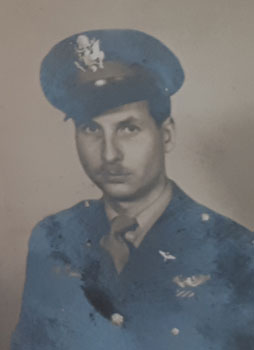
Kingdon Knapp was born in Chicago, USA in May 1916. He enlisted into the RCAF in June 1941 in Hamilton, Ontario, Canada and after training was posted to 428 Squadron. He and his crew were in the first intake of crews ever to be trained at 1664 HCU, being posted there on 1st June 1943 just days after it had formed. On 8th June 1943 Knapp's transfer to the USAAF came through but he completed course and was posted back to 428 Squadron on 24th June 1943 to continue to fly the Halifax there. By 30th May 1943 Nicholls had completed fifty operational flights so was screened and did not undertake the conversion training. For service with them Knapp was awarded the DFC, Gazetted on 13th July 1943, the citation for the award reads.. "On one occasion while engaged in mine-laying the aircraft in which Pilot Officer Knapp was flying was engaged by anti-aircraft fire and searchlights. The pilot was temporarily blinded and the aircraft struck the water, damaging the port propeller and engine. Displaying great skill and fine airmanship, Pilot Officer Knapp regained control and flew the aircraft back to this country where a successful landing was made. Throughout his operational tour this officer has displayed courage and coolness of a very high order, always pressing home his attacks with the greatest determination in the face of intense opposition. He possesses great ability and presence of mind." While based at Middleton St. George he married Catherine Pybus. He later transferred to the USAAF (service no:0885977) and flew USAAF crewed Mosquitos and also with the 856th Bomber Squadron flying Liberators. He was serving in the USAF as a pilot when he died on 31st January 1954 in Korea. He was the pilot of B26 44-35277 on an operational flight when the aircraft failed to return and he is listed as missing in action.
Norman Magnusson was awarded the DFC, Gazetted on 23rd March 1945.
Gordon Barnholden was involved in a serious flying accident while training with No.2 Bombing and Gunnery School in March / April 1942, for his actions he was Commended for Valuable Serice (as per Canadian Gazette of 2nd March 1943). Hugh Halliday's superb research has located the following.. "While on a gunnery exercise a Fairey Battle aircraft caught fire and force landed. The pilot and one of the gunners were rendered unconscious. The other gunner, Sergeant Barnholden, regardless of any danger to himself, with the assistance of an ambulance driver, pulled the pilot clear and both Sergeant Barnholden and the ambulance driver then went back into the burning aircraft and rescued the other gunner."
Wellington BK155 was built to contract B.124362/40 by Vickers Armstrong's Ltd. at Chester. It was taken on charge by 428 Squadron at Dalton on 2nd December 1942 soon after they had formed on 7th November 1942. As a result of this incident on 3rd January 1943 minor Cat.A/FA was the assessment and it was repaired on site at Dalton by a team from Vickers at Weybridge. On 25th February 1943 it sustained flak damage on Ops to Wilhelmshaven and Cat.A/FB damage was the assessment, resulting in a repair on site again at Dalton. On 21st March 1943 the aircraft was transferred to 1485 (Bomber) Gunnery Flight at Fulbeck before later moving on to 82 O.T.U. at Ossington on 7th August 1943 before finally serving with 83 O.T.U. at Peplow from 2nd October 1943. On 28th October 1944 83 OTU disbanded so it was placed in MU storage pending disposal. It was eventually struck off charge on 12th May 1947.