On 15th September 1943 this 1659 Heavy Conversion Unit aircraft was being flown on a fighter affiliation exercise when the port outer engine broke loose of its mountings but remained as part of the aircraft. It was not possible to feather the propeller on this engine and because of the effects of drag caused by the odd position of the engine flying normally was not possible. The instructor found that by reducing power on starboard side help in keeping control of the aircraft but height was gradually lost so it was force landed in a field near Askham Richard at 12.15hrs. One member of the crew baled out at too low a height and was killed on striking the ground. On touching down it broke up.
Pilot (Trainee) - F/Sgt Walter Francis Burge RAAF (413820).
Pilot (Instructor) - F/O Thomas Chisholm Kaye DFC RAF (50584).
Pilot (Trainee) - F/Sgt Roy Richard Clegg RAAF (420337), aged 27, of Penrith, New South Wales, Australia. Buried Harrogate Stonefall Cemetery, Yorkshire.
Wireless Operator / Air Gunner - Sgt J F Pratt RAFVR (1526484).
Flight Engineer - Sgt W H Blake RAFVR (978336).
Air Gunner - Sgt R C Bechtold RAFVR (1318261).
Air Gunner - Sgt N Martin RCAF (R/188035).
Bomb Aimer - P/O Charles Sidney Lambert RAFVR (151374).
Navigator - Sgt A A Deane RAFVR (1515512).
Air Gunner - Sgt William Carter Gilchrist RCAF (R/139912)
Air Gunner - Sgt Douglas Gordon Addison RCAF (R/225303)
Air Gunner (Instructor) - Sgt Reginald McNamara RCAF (R/101601).
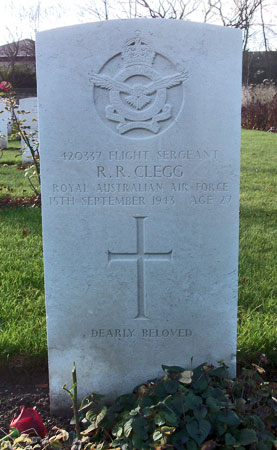
Roy Clegg was the son of Edward and Sarah Clegg and was born on 6th November 1915 in Dalby, Queensland, Australia. He enlisted for RAAF service in Sydney. The bulk of those on board Halifax BB210 were part of the same crew undertaking Halifax four-engine conversion training; with F/Sgt Clegg being killed at 1659 HCU Pratt, Blake, Bechtold, Martin, Lambert and Deane received a new pilot (F/O Jack Edwin Dickenson RCAF) and were posted to 427 Squadron. On the night of 21st / 22nd January 1944 they were flying Halifax LL169 on Ops to Magdeburg when the aircraft was attacked and badly damaged by a night-fighter, they all abandoned the aircraft safely over Germany but survived only to all be taken PoW.
Burge, Addision and Gilchrist were part of the same crew, they were killed on 18th November 1943 while flying with 431 Squadron in Halifax LK632 on Ops to Mannheim, they are buried in Rheinberg war Cemetery.
Douglas Addison was born on 24th July 1923 in Otterville, Ontario, Canada and was the son of Wilfrid Lawrence and Myrtle Rosabelle (nee Fisher) Addison. He was working in a bakery when he enlisted for military service and had initially served in the Canadian Army from September 1941 until November 1942. By 13th November 1942 he was serving in the UK and on this date he transferred to the RCAF in London, England. Unlike most RCAF recruits he did not undertake his basic RCAF training in Canada but did this in the UK, eventually training at 2 AGS and 24 OTU before posting to 1659 HCU and then on to 431 Squadron.
Walter Burge was born on 31st January 1921 in Burwood, New South Wales, Australia and was the son of Herbert Laurence and Frances Blanche Burge. He was working as a commercial artist when he enlisted on 13th September 1941 in Sydney and after basic training in Australia he was awarded his pilot's Wings on 27th May 1942. He married Gwennyth Aisla Leslie Friend on 24th July 1942 in Sydney and remained in Australia until 1943. On arrival in the UK he trained at 3 (P)AFU (beginning 30th March 1943) and 24 OTU (beginning 1st June 1943) and while training at 24 OTU he was involved in a minor flying accident involving Whitley Z9309 at Long Newton. He was then posted to 1659 HCU on 27th August 1943 and to 431 Squadron on 24th September 1943.
William Gilchrist was born on 3rd April 1915 in Saskatcehwan, Canada and was the son of George and Margaret Elizabeth (nee Cormack) Gilchrist. Both his parents were born in Scotland but had immegrated to Canada. William was working in farming when he enlisted for RCAF service on 2nd December 1941 in Saskatoon and undertook initial air gunnery training in Canada. On arrival in the UK he trained a 8 AGS and 1659 HCU before posting to 431 Squadron with the rest of his crew including Addison and Burge.
Reginald McNamara was born in Blackburn, Lancashire, England in October 1922 but had moved to Carmen, Manitoba, Canada at a young age. When he enlisted into the RCAF in April 1941 he was already serving in the Canadian Army. He was awarded the DFM for service with 427 Squadron, Gazetted on 19th October 1943, the citation for his DFM reads.. "Sergeant McNamara has successfully completed a number of sorties during which he has displayed a very high degree of skill and initiative during a flight to Peenemunde. Before reaching the target his aircraft was attacked by a Focke Wulf 190 but, handling his guns with cool determination, Sergeant McNamara returned the fire and was successful in shooting down the enemy aircraft. He has at all times displayed calm and quiet efficiency in the execution of his duty." He was almost certainly acting as an instructor at 1659 HCU in September 1943. He received a commission and was later posted to 415 Squadron, for service with them he was awarded the DFC, Gazetted on 17th July 1945 the citation reads.. "This officer has a splendid record of operational flying. He has completed many sorties against important targets in enemy territory since the award of the Distinguished Flying Medal. As gunnery leader in his squadron he has trained its gunners to a high standard of skill and efficiency and by his own courage and vigilance on operations has set a fine example to all."
Thomas Kaye was born in Winnipeg, Manitoba, Canada in 1916. In the 1930s he had served in the Canadian Army before enlisting for RAF service in early 1939 as ground crew. He re-mustered as aircraft in 1940 and trained as a pilot serving with 408 Squadron who were flying Hampdens at the time. He was awarded the DFC for service with 408 Squadron, Gazetted on 14th May 1943. After completing this Tour he was posted to instruct at 1659 HCU at Topcliffe. He was Mentioned in Despatches for his work instructing with 1659 and 1666 HCUs and in the recommendation his actions in force-landing Halifax BB210 in the incident recorded at the top of this page were cited (Gazetted on 1st January 1945). The reccomendation reads..
"Flight Lieutenant Kaye is an outstanding Pilot Instructor of four-engines aircraft. He was especially picked from 1659 Conversion Unit as their best instructor to be posted to 1666 Heavy Conversion Unit Instructor School. Since his arrival he has proved himself to be an exceptional pilot whose experience and outstanding ability has been an inspiration to the instructors being trained at the school. On September 15th (1943) he had a port outer engine cease in the air. The two top bearers broke and the engine slipped forward on its mountings, causing so much drag that Flight Lieutenant Kaye was unable to hold the aircraft straight. In spite of this Flight Lieutenant Kaye showed exceptional skill and executed a perfect "Wheels Up" landing. It is strongly recommended that this officer's devotion to duty may be mention in despatches."
He transferred to the RCAF in January 1945, he was then awarded the Air Force Cross for his work instructing, Gazetted on 7th September 1945. The citation for his AFC also mentioned the forced landing to Halifax BB310 and stated that there were no injuries to the crew, I would beg to differ with that opinion. The citation reads.."Since completing a tour of operational duty, Squadron Leader Kaye has flown more than 500 hours as an instructor on Halifax and Lancaster aircraft. He has displayed fine leadership as a flight commander and has contributed in a large measure to the success of the unit. One afternoon in September 1943, whilst engaged on an instrument flight, the port outer engine of his aircraft failed and half fell out of the wing. Due to the position of the engine, it could not be feathered. Squadron Leader Kaye was therefore compelled to reduce power on the starboard engines to prevent the aircraft from diving to the ground. Much height was lost and, realizing that he could not reach an airfield, this officer ordered his crew to crash positions. He effected a skilful landing in a field without any of the crew members sustaining serious injury. On another occasion, when instructing on a Halifax II, two engines of the aircraft failed. Though the aircraft was losing height rapidly, this officer succeeded in returning to base and executed a masterly landing without further damage. His example and fine record have been an inspiration to all." Post-ww2 he remained in the RCAF and would re-join 408 Squadron. He died in 1992.
I credit Hugh Halliday with awards research shown on this page.