Halifax JB914 (?) damaged by flak, returned to Leeming airfield.
On the night of 10th / 11th April 1943 this aircraft was one belonging to 405 Squadron that had carried out an operational flight to bomb Frankfurt, this crew set out from Leeming airfield at 23.30hrs and bombed the target area. On their return near the coastline the aircraft sustained flak damage to the bomb doors. The crew made a safe return to base landing at Leeming at 06.57hrs. The aircraft carried the 405 Squadron code "LQ-L" which was Halifax JB914 at that time, it must have been repaired quickly as it was further damaged in a flying accident just two days later.
Pilot - Sgt John Alwyn Phillips RAFVR (1339011), of Swansea, Wales.
Flight Engineer - Sgt Herbert C McLean RCAF (R/68504 ?).
Navigator - F/O Hugh Thompson Huston RCAF (J/13071), of Vancouver, British Columbia, Canada.
Bomb Aimer - Sgt Vernon Alfred Knight RAFVR (1416022).
Wireless Operator / Air Gunner - Sgt Ronald A Andrews RAFVR (1294715).
Air Gunner - Sgt Wilfred Herbert King RCAF (R/146659), of Gravenhurst, Ontario, Canada.
Air Gunner - Sgt Lloyd D Kohnke RCAF (R/107109), of Dunblade, Saskatchewan, Canada.
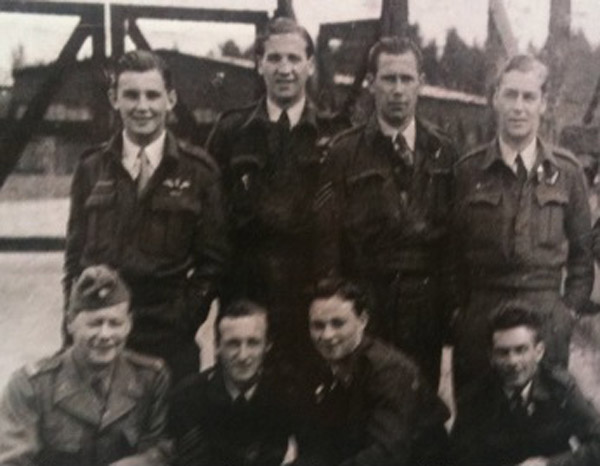
Many of this crew would be interned in Sweden in 1943. Alwyn Phillips (shown far left back row) would write the book "Valley of the Shadow of Death" about the 1943 bombing operations of Spring and Summer 1943. John Phillips was known by his middle name of Alwyn, he was born in Swansea in 1922 and enlisted into the RAF in 1941. He was flying with 405 Squadron on the night of 3rd / 4th July 1943 when his aircraft was badly damaged on Ops to Cologne, he managed to bring the aircraft and his crew back to England safely and for his actions he was awarded the DFM. Notification of his DFM was printed in the London Gazette on 17th August 1943. Hugh Halliday's Canadian awards research has located the recommendation for his DFM of 9th July 1943 when he had flown eighteen operational flights, it reads.. "Sergeant Phillips has completed 18 operational sorties against many heavily defended targets and has displayed considerable skill and courage. On the night of 3rd July 1943, on an attack on Cologne, his aircraft was attacked by a night fighter and sustained damage making the handling of the aircraft and evasive action most difficult. After having driven off the fighter by fire from the rear turret, in spite of the fact that the bomb doors had been shot off, Sergeant Phillips proceeded towards the target and released the explosive bombs manually, showing exceptional presence of mind in not releasing his marker Target Indicators."
On the night of 2nd / 3rd August 1943 all of the above crew apart from F/O Huston were flying Halifax HR871 tasked with an operational flight to Hamburg, outbound the aircraft flew into a thunderstorm, before they reached the target the aircraft control surfaces became effected by icing on them. Controlling the aircraft became difficult, fearing that if they should be attacked by a night-fighter or flak the pilot would not be able to take evasive action the crew opted to abandon the task of dropping the target markers. The aircraft was also struck by lightning in the forward section of the fuselage which blinded the crew. The aircraft went out of control and although the pilot recovered his sight and some control, the engines and radio had been damaged. Flying back across the North Sea was deemed impossible given the damage so the crew opted to try to head north to Sweden, on reaching the Swedish Coast the crew baled out. Phillips landed on a cow in a field! All were then interned until being repatriated in January 1944. The aircraft was discovered by chance by a team scanning the sea bed off Sweden in 2011 and funds are being sought to raise the wreckage. The notification of Phillips' DFM being granted was not printed in the London Gazette until 17th August 1943 after he was interned in Sweden. The photograph shown above was found on "www.thelocal.se".
Vernon Knight was later appointed to a commission on 26th April 1945 in the Meteorological Branch of the RAF to the rank of Flying Officer. He remained in the RAF until May 1971.
Wilfred King later received a commission and flew a second tour with 405 Squadron, beginning on 27th April 1944. He was awarded the DFC for service with them, Gazetted on 17th November 1944 but this was only presented to him in 1956.
Hugh Huston also had his own interesting story of escape and evasion. On 15th / 16th July 1943 he was flying in 405 Squadron Halifax HR854 which was shot down by a night-fighter over France. He evaded captured after landing in France and he escaped over the Pyrenees to safety. He probably died in Maple Ridge in May 2005.