Wellington Z8645 near Walshford.
On 2nd May 1942 the pilot of this 305 Squadron aircraft elected to force land close to the A1 road at Forest Farm near to the village of Walshford at 14.30hrs after the port engine developed a severe vibration and the starboard engine caught fire while those on board were giving it an airtest. The aircraft was badly damaged following the fire and was forced-landed. Some of the Polish air and ground crew on board are believed to have been injured. The four named below are believed to have been four of the nine on the aircraft, the names of the other five remain unknown.
Wellington Z8645 was built to B71441/40 by Vickers Armstrong's Ltd. at the Weybridge factory and was awaiting collection in March 1942. It was received by 9 MU on 9th March 1942 and was taken on charge by 305 Squadron at Lindholme on 26th April 1942. As a result of the damage sustained on 2nd May 1942 Cat.E/FA damage was the assessment which saw it written off. The aircraft was struck off charge on 11th May 1942.
Pilot - F/Sgt Wicherek PAF (P/782276). Admitted to York Military Hospital with injuries.
Pilot - F/O Kazimierz Konopasek PAF (P/1208), admitted to York Military Hospital with injuries.
Pilot (Observer?) - Acting S/Ldr Karol Zaucha PAF (P/0051).
Air Gunner - "Sgt Beeger". Admitted to York Military Hospital with injuries. Probably Sgt Pawel Beeger PAF (P/793097).
Five others(?) - Names unknown.
Kazimierz Konopasek was born in July 1924 Lviv, Poland and was flying in Poland as far back as 1928. On arrival
in the UK he trained at 18 OTU and then flew with 305 Sqnadron. He survived the crash landing of Wellington Z8586
on the night of 14/15th April 1942 at Wroot on the Lincolnshire/Yorkshire boarder. He was later awarded the DFC and
served with 300 Squadron but returned to become Commanding Officer of 305 Squadron on 28th July 1943 until
31st July 1944 when he was rested. He later transferred to Transport Command and survived the War.
After the war he returned to Poland in 1947 and became a civilian pilot. He died in 1974 and is buried in Warsaw.
The place of his birth, Lviv, is better known as Lwow (in Polish) and is now in the Ukraine.
Karol Zaucha was flying in Poland in the 1930s but further details of this are not yet known. For his service with 305 Squadron he was awarded the DFC
which was approved on 5th September 1942. The recommendation was drafted when he had flown twenty three operational flights (118 flying hours); it reads.. "This officer has been engaged on operational flying since April 1942. As captain of aircraft he has exhibited skilful airmanship, combined with the greatest determination to complete his allotted
task. On one occasion, shortly after leaving base for a raid on Mannheim, his aircraft became iced-up making it difficult
to control and causing it to lose height rapidly. Skilfully overcoming a difficult situation, Squadron Leader Zaucha persisted in his task and finally bombed the target. The
flight occupied a flying time of seven hours in severe weather. This officer has participated in attacks on a wide variety
of important enemy targets." He was also awarded the Polish Virtuti Militari medal.
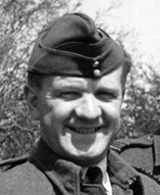
Sgt Beeger recovered from his injuries and continued his service with 305 Squadron. On 3rd August 1943 he was flying Wellington HZ467 on Ops to Hamburg when the aircraft was shot down by a night-fighter. He is buried at Kiel War Cemetery. He was born in November 1911.