On the night of 21st May 1942 the crew of this 460 Squadron aircraft were undertaking a night flying test but as the aircraft gathered speed down the runway the pilot's escape hatch flew off. The pilot continued in taking off but did a circuit and immediately came in to land. The aircraft's brake pressure was limited and the aircraft was unable to be stopped before the end of the runway, fearing a collision with workmen the pilot swung it away from them and while the crew escaped injury the aircraft sustained damage.
Pilot - Sgt Solomon Levitus RAAF (402910), of Rose Bay, New South Wales, Australia.
Second Pilot - Sgt Allan Francis McKinnon RAAF (407531), of Myrtle Bank, South Australia.
Navigator - Sgt Hugh Rowell Brodie RAAF (400524), of East Melbourne, Victoria, Australia. B.A.(Hon).
Wireless Operator / Air Gunner - Sgt Robert George Dunlop Read RCAF (R/69516), of Birch Cliff, Ontario, Canada.
Air Gunner - Sgt Tom Gordon Prentis Townsend RAFVR (1051659).
Wellington Z1334 was built to contract B.97887/40 by Vickers Armstrong's Ltd. at Hawarden, Chester, was awaiting collection in October 1941. It was received by 44 MU on 26th October 1941 and was taken on charge by 460 Squadron on 1st December 1941 just after they formed at Molesworth. It then moved with the squadron to Breighton on 4th January 1942. As a result of the battle damage sustained on 26th March 1942 minor Cat.A/FB damage was the damage assessment and it was repaired on site. The incident does not feature on the aircraft's AM Form 78. On 21st May 1942 it sustained Cat.B/FA damage when it overshot on landing at Breighton. The damage was then re-assessed soon after and it was Re-Cat.E which saw the aircraft be about to be struck off charge on 30th May 1942 but this Re-Cat.E assessment was then cancelled and it was repaired in a works factory. On 9th December 1942 it was flown to 8 MU and it was then taken on charge by 18 O.T.U. at Bramcote on 15th January 1943. On 18th April 1943 it was being flown on a training flight when, on attempting to drop a photo-flash on a practice bombing run on the Grandborough bombing range and immediately after releasing the photo-flash, it exploded. This explosion removed the fabric skin between the wings and the tailplane. The flying control of the aircraft was not effected but the crew made a safe landing at Church Lawford and Cat.Ac/FA damage was the damage assessment. Repairs were carried out on site by a team from Vickers at Weybridge and it was returned to 18 O.T.U. on 5th June 1943. The aircraft was later transferred to 104 (Transport) O.T.U. at Nutts Corner on 1st July 1943 and flew with them until an routine assessment discovered a problem with the aircraft so a team from Vickers at Weybridge started work to repair it on site on 2nd December 1943, During the repair it was then struck off charge on 1st February 1944. A more serious problem must have been discovered.
On the night of 25th / 26th April 1942 many of this crew had been involved in combat with an enemy aircraft and had shot it down but sustained damage to their aircraft at the time. On the night of 2nd / 3rd June 1942 Sgt Levitus, F/Sgt Hugh Brodie, Sgt Townsend and Sgt Read were flying in Wellington Z1249 on Ops to Essen. The aircraft was found to have been shot down and crashed near Deulken, twenty miles from Dusseldorf with the loss of the whole crew. The crew were removed from the wreckage and buried but the Post-War wargrave investigations failed to reveal their buried location and as such they are still commemorated on the Runnymede Memorial. Solomon Levitus and Robert Read were twenty years old, Hugh Brodie was thirty years old.
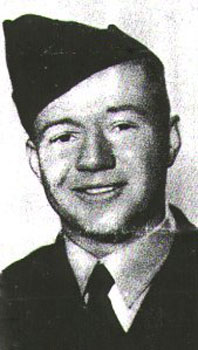
Hugh Brodie (pictured above) was born on 19th February 1942 in Melbourne and enlisted in Melbourne on 15th September 1940. At the time he was working as a school teacher in Hawthorn, Victoria. On arrival in the UK he trained with 27 OTU and was posted to 460 Squadron on 23rd February 1942. It would be worth noting here that he had attended Melbourne University and gained a Bachelor of Arts (Honours in History) and a Bachelor of Education before becoming a teacher. He was clearly a very bright young man. During his War Service he penned a poem which has since been reproduced across the world, the most well known publication being in Time Magazine in 1943. His poem I show here...
All Almighty and All Present Power,
Short is the prayer I make to Thee.
I do not ask in battle hour
For any shield to cover me.
The vase unalterable way
From which the stars do not depart,
May not be turned aside, to stay,
The bullet flying to my heart.
I ask no help to strike my foe
I seek no pretty victory here.
The enemy I hate, I know
To Thee is also dear.
But this, I pray, be at my side
When death is droning through the sky
Almighty God, who also died,
Teach me the way that I should die.
Sgt's Townsend's personal details are not listed on the CWGC online database and prior to October 2012 nothing else was known about his life. In October 2012 I was kindly contacted by Mr Frank Turner; a relation of his wife. Tom Townsend was born on 27th February 1920 at Cockersdale Farm, Cockersdale, Drighlington, North Bierley, Yorkshire at the home of his mother's parents. His parents were not married and he was brought up by these grandparents but they sold the farm when he was young and moved to Scarborough, Yorkshire. Upon leaving school he trained as an optician but enlisted into the RAF around the start of the War. He married Jean Gill in Scarborough in June 1941 and his wife followed him around during his RAF postings. After he was posted missing she returned home to Scarborough to live with her parents, she re-married in 1948 and died in 2011.
Solomon Levitus was born on 17th April 1920 in Sydney, New South Wales and enlisted there. Nothing more is known of him.
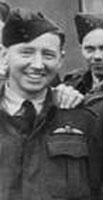
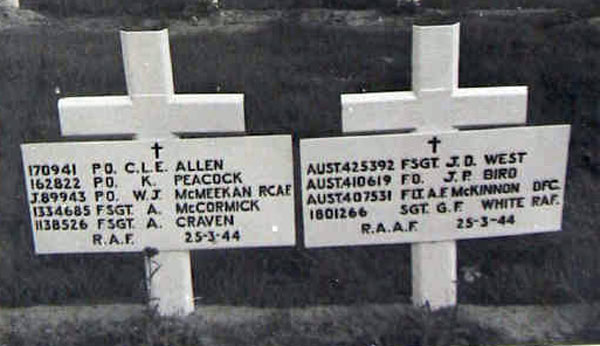
Allan McKinnon was born on 6th December 1918 in Hyde Park, South Australia. He enlisted in Adelaide. For services with 460 Squadron he was awarded the DFC, Gazetted on 14th May 1943, the citation reads..
".. has completed numerous successful sorties over Germany, Italy, and Occupied France, always pressing home his attacks regardless of enemy opposition. His sorties have included two raids on Cologne and two on Essen. He also took part in a raid on Berlin in March 1943, when great damage was inflicted. From this mission, P/O McKinnon secured a most valuable photograph of the target area." He later converted to flying Lancasters and was flying on his second Tour with the same 460 Squadron when, on the night of 24th / 25th March 1944 he was the pilot of Lancaster ME640 on Ops to Berlin. The aircraft was hit by flak and crashed near the Dortmund-Ems canal with the loss of all but one of the crew. He was initially buried at Lingen-on-Ems in Germany but was re-interred in Reichswald War Cemetery after the War. He was twenty five years old.