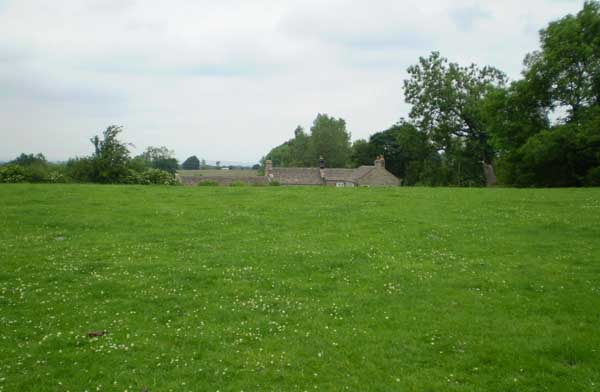
Halifax W7761 at Beckwith, Harrogate.
On the night of the 13th / 14th July 1942 the crew of this 35 Squadron aircraft were tasked with bombing Duisburg, the aircraft took off from Linton on Ouse at 00.12hrs. Whilst over the target the bomb release mechanism failed and the crew were unable to release their bombload including a huge 4000lb "Cookie" bomb. They attempted to jettison their load over the North Sea on their return but this also failed. The forward release mechanism had failed and at that time there was no manual release system for it. At 05.00hrs they abandoned the aircraft but I have been unable to trace where the crew landed. With no-one at the controls the aircraft eventually rolled onto its back, this dislodged the massive bomb which then fell out just prior to the aircraft crashing at Beckwith, a few miles from Harrogate, at 05.20hrs. The bomb landed about a mile away near Brackenthwaite creating a massive crater. The crew all escaped though two sustained minor injuries. This was the pilot's second mishap in a month, on 22nd June 1942 he was the pilot of Halifax W1159 that crashed on landing at Linton on Ouse airfield.
Pilot - Sgt Harry Burns MacDonald RCAF (R/76079). Injured ankles on landing.
Navigator - P/O John Baker RAFVR (120393).
Wireless Operator / Air Gunner - Sgt Edward Whitter RAFVR (1059518).
Wireless Operator / Air Gunner - Sgt Jack Reginald Ely RAFVR (1335515).
Air Gunner - P/O Gerald Frederick Freedman RAFVR (105173). Injured.
Flight Engineer - Sgt James Ellis Jones RAFVR (610981).
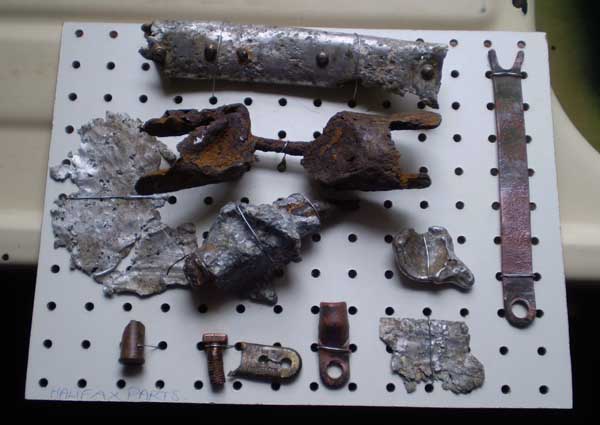
I was shown the location of the crash site by air historians Ken Reast, Albert Pritchard and Eric Barton in June 2007. They had located the site some weeks previously and had cleared the return visit to allow me to visit the site. I would like to thank Mrs Sally Haithwaite for allowing the visit. A little of the aircraft was located when the site was first located, these pieces were cleaned and mounted on a board and given back to the landowner.
James Ellis Jones was later made a PoW when 35 Squadron Halifax HR903 was shot down on 9th August 1943 on Ops to Mannheim. Sadly he was shot whilst a PoW and died of his injuries on 2nd April 1944. He was awarded the DFM for service with 35 Squadron but this was Gazetted on 13th August 1943, after he had been lost on Ops.
John Baker was awarded the DFC for service with 35 Squadron, Gazetted on 11th June 1943. He later served with 405 Squadron and then with 7 Squadron. He was awarded the DSO, Gazetted on 9th June 1944. Unfortunately by that date he had already died. On 20th May 1944 he was flying in Lancaster ND845, he was serving as Master Bomber on this flight
and was killed when their aircraft collided with another over the target area.
Halifax W7761 was built to contract B.73328/40 by Handley Page Ltd. at Radlett and was delivered to 35 Squadron at Linton on Ouse on 26th June 1942. As a result of the crash on 14th July 1942 Cat.E2/FB Burnt damage was the assessment of the damage and it was struck off charge on 23rd July 1942 with a low 33.30 hours total flying time.
The pilot Harry MacDonald was born in 1915 in Canada. He enlisted into the RCAF in Halifax on 18th October 1940 and trained at 1 ITS (graduated 26th February 1941), 11 EFTS (graduated 22nd April 1941) and 8 SFTS (graduated 27th July 1941). He flew at least two Tours. He received a commission in 1942 (J/15644) and was awarded the DFC for service with 35 Squadron, Gazetted on 13th May 1943 for completing "a large number of operational sorties against the enemy's most heavily defended targets. On all occasions he has displayed skill and determination of the highest order." When his recommendation for the DFC was submitted he had completed thirty operational flights (158 operational hours flying time). The recommendation for the DFC, found by Hugh Halliday in his RCAF awards research, states that "Flight Lieutenant MacDonald has completed a large number of successful attacks against the heaviest and most hotly defended targets. He has invariably returned with clockwork regularity having successfully bombed his target. On several occasions recently he has operated in a most important role showing the same skill and success. In recognition, Flight Lieutenant MacDonald is recommended for the non-immediate award of the Distinguished Flying Cross". He survived the War but sadly died in 1956 at the rank of Squadron Leader and is buried in Lakeside Cemetery, North Sydney, Cape Breton County.
Jack Ely was awarded the DFM for service with 35 Squadron, Gazetted on 13th August 1943. His birth was registered in Medway, Kent in 1921, he married in Chatham, Kent in 1945 where he died in 1986.